Cold air bites the back of your throat the moment the arena doors swing shut, carrying the sharp, metallic tang of shaved ice and heated boards. Inside an NHL rink, temperature is not just a number on a thermostat. It is an emotional gauge. When a crowd turns hostile and a game spirals into chaos, the room feels heavier, louder, and dangerously close to boiling over.
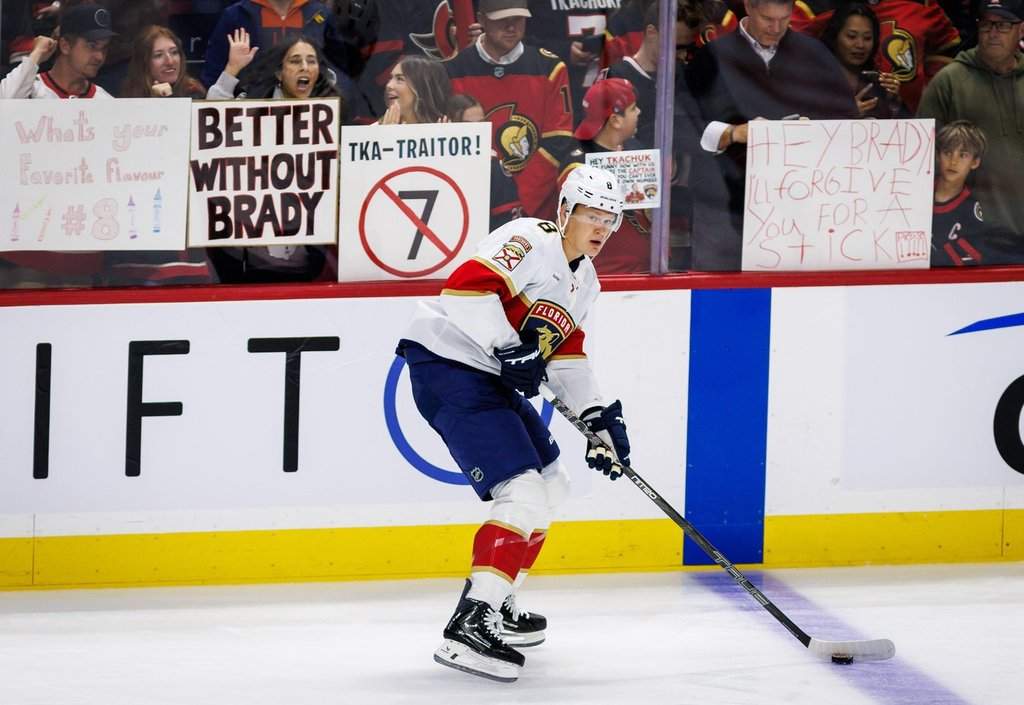
On Wednesday, October 21, 2026, in Ottawa, that pressure cooker blew its lid. The Ottawa Senators defeated the Florida Panthers 5–1 in a game that piled up 84 penalty minutes. At 3:35 of the third period, tempers snapped in front of Ottawa's bench. Florida's Matthew Tkachuk exchanged gloved jabs with Ottawa's Dylan Cozens, sparking a melee as Tkachuk's brother Brady—now suiting up for Florida after his return to Ottawa—jumped into the fray. Nearby, Senators forward Nick Cousins drew a roughing penalty and a 10-minute misconduct for unsportsmanlike conduct aimed at an opponent from the bench.
The next day, the NHL's Department of Player Safety handed down its verdict. Tkachuk was fined $5,000 for roughing. Cousins was fined $4,091.49 for unsportsmanlike conduct. Both were the maximum allowable under the league's Collective Bargaining Agreement, with the combined $9,091.49 routed to the Players' Emergency Assistance Fund.
Numbers.
A standard box score treats those figures like closed books. Five thousand dollars here, four thousand and ninety-one dollars and forty-nine cents there, case closed until the next whistle. Yet anyone who has ever stood near the glass during a rivalry game knows that the real cost of a fine is rarely measured in dollars. It lives in the split-second calculus of an athlete whose job requires him to skate right up to the line between fierce competitiveness and reckless antagonism—and sometimes step across it.
When a Five-Thousand-Dollar Bill Feels Like Pocket Change
To understand why those fines spark debate every time they appear on the league wire, step out of the arena for a moment and picture a hypothetical everyday worker named Sam.
(Note: Sam and his household budget are a hypothetical illustration created to show how fixed-cap penalties scale against real income.)
Sam makes $95,000 a year managing logistics for a regional distributor. One afternoon, after a tense argument in the loading bay, Sam shoves a coworker and is hit with a disciplinary fine equal to roughly half a day's pay—around $180. That hurts. It trims the grocery budget or delays a car repair. Now imagine Sam is a multimillion-dollar athlete and the fine is capped at $5,000. For a player earning several million dollars a season, five grand is barely a rounding error on a monthly statement.
That gap sits at the heart of the league's discipline dilemma. Under the Collective Bargaining Agreement, fines are tied to salary formulas up to strict ceilings rather than functioning as crushing financial blowback. When a player like Tkachuk—who has faced supplemental discipline multiple times across his career—gets tapped for $5,000, critics immediately ask whether the penalty deters anything at all. Even Cousins, penalized for crossing the line from the bench during a heated stretch, faces a fine that looks modest next to the adrenaline of a rivalry night.
Why keep the cap so low, then? Because hockey players are unionized workers who negotiated rules to protect themselves from arbitrary, runaway financial punishment by management. When the stakes are high and emotions run hot, the union wants clear boundaries so discipline does not turn into an open checkbook against player paychecks.
Still, watching a chippy game unfold makes the tension unmistakable. You hear the muffled thud of shoulder pads hitting boards, the shrill rasp of the referee's whistle trying to restore order, and the roar of thousands of fans feeding off every shove. In that environment, a fine assessed twenty-four hours later feels almost theoretical.
The Invisible Line Between Pest and Liability
Anyone who has watched enough hockey knows the paradox of the agitator. The same edge that makes a player maddening to opponents can also tilt a game away from his own team.
Think of hockey discipline like a high-wire act without a net—except the performer is sprinting on blades while someone shakes the cable.
(Note: The high-wire act is a metaphor for balancing aggressive play against penalty risk.)
Push too gently, and you get pushed around in the corners and lose battles in front of the net. Push too hard after the whistle, and suddenly your team is shorthanded, burning energy killing off a penalty while the scoreboard tilts. In Ottawa on October 21, the Senators already held control on their way to a 5–1 win when the third-period scuffle erupted. When emotions surge that late in a lopsided or physical game, pride often overrides math.
Consider what happens next: a player who makes his living getting under skin—whether through relentless forechecking, chirping, or physicality—has to walk that razor's edge every single shift. Cousins's unsportsmanlike conduct from the bench and Tkachuk's roughing minor in the scrum show how quickly a stopped play turns into a powder keg. Even the family dynamic in that game added fuel. Brady Tkachuk's return to Ottawa carried heavy emotion, with a cold reception from the home crowd and constant tension on the ice. When history, homecoming noise, and bitter rivals collide, nobody plays like a robot.
I have stood at cold rinks long enough to recognize that look in a player's eyes right before a scrum breaks out. Your jaw tightens. Your breathing speeds up. Every slight feels personal, even if ten minutes later you would call it foolish. It is easy from a couch or a press box to say, Just skate away. It is much harder when twenty thousand people are screaming and another jersey is right in your face.
Let's be honest: even seasoned fans and analysts argue over where the Department of Player Safety gets it right and where it falls short. Sometimes a play looks borderline to one set of eyes and glaringly cheap to another. The league tries to weigh intent, injury risk, game context, and prior history in a matter of hours. It is messy work, and there is rarely universal agreement when the ruling drops.
Where the Money Actually Goes
When people hear about an NHL fine, they often assume the league pockets the cash or puts it toward operating costs. In reality, fine money goes to the Players' Emergency Assistance Fund.
That detail changes the texture of the story. Behind the bright lights, endorsement deals, and roaring arenas, pro hockey carries real off-ice vulnerabilities—medical emergencies, family crises, and hardships that can hit even inside a tough sport. Knowing that a $5,000 roughing fine or a $4,091.49 unsportsmanlike conduct fine helps support players in need gives a mundane administrative notice a human counterweight.
Yet a fund does not automatically fix on-ice restraint. A penalty minute in the third period still affects the night's outcome, and a fine still leaves fans debating whether accountability has real teeth. With the Senators and Panthers scheduled to cross paths again in Florida later in November, nobody expects memories of an 84-minute penalty fest to evaporate overnight.
Why Rivalry Nights Never Truly End at the Final Horn
Sports headlines move fast. One day a league announcement pops up with exact dollar amounts and rule citations; the next day another game takes over the scroll.
Still.
The lingering echo of a game like that isn't really about $9,091.49. It is about what happens when human pride meets high-speed collision, when old loyalties collide with new allegiances, and when a game built on controlled violence tests the thin veneer of order.
Long after the ice resurfacers smooth out the gouges and the arena lights dim, the real story remains etched into the boards: two teams, a roaring crowd, and the quiet, unspoken wager every competitor makes every time they step over the dasher—knowing full well that passion pays its own price.



