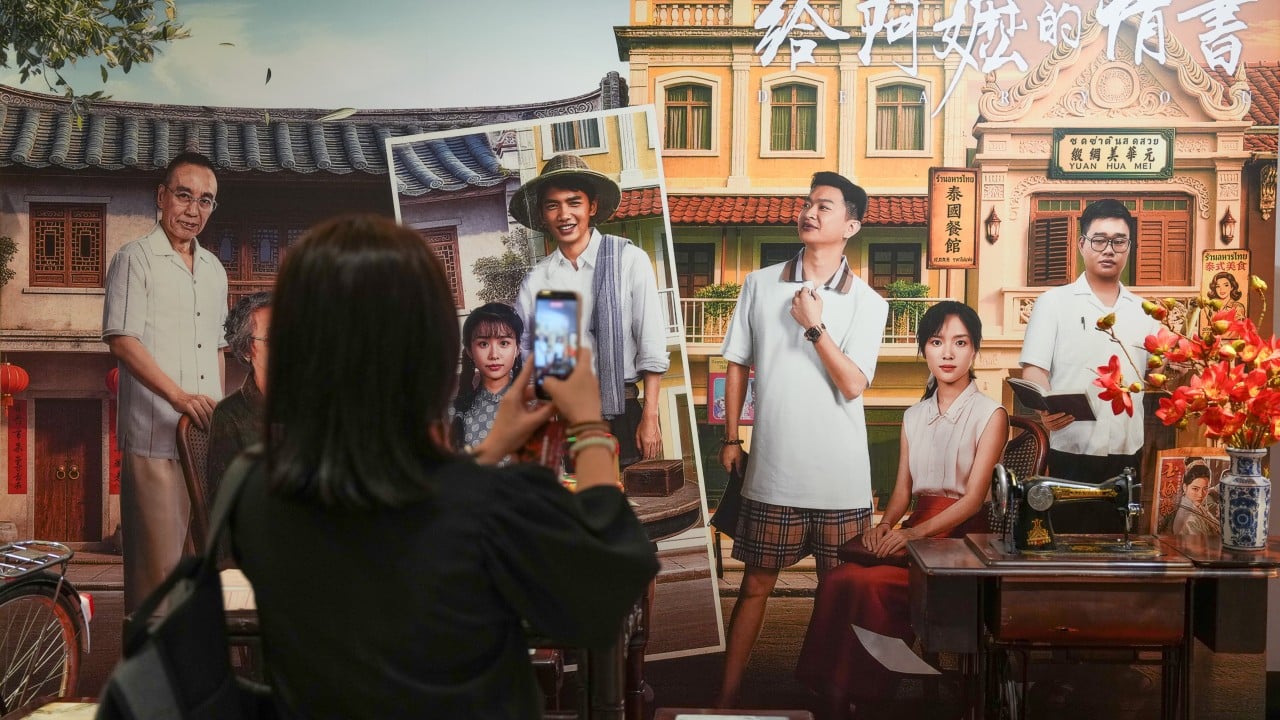
The lobby of the Golden Village cinema at VivoCity smelled of buttery popcorn and damp umbrellas, but the tension in the air belonged to a courtroom, not a multiplex.
An elderly woman in a floral blouse stood frozen before the ticket counter. Behind her, a line of twenty-somethings shifted their weight impatiently, checking their smartwatches. The woman, whom we will call Madam Teo—a grandmother who has spent all seventy-two years of her life navigating the humid backstreets of Toa Payoh—was trying to buy a ticket for Dear You.
The youth behind the glass, wearing a crisp uniform and a polite, practiced smile, delivered the bad news.
"The original version is sold out, Auntie. We only have the Mandarin-dubbed one left."
Madam Teo blinked, her fingers tightening around her coin purse. To her, this wasn't a matter of cinematic preference. It was a matter of translation. It was the realization that the characters on the screen would speak a language that felt like a starched school uniform, rather than the loose, comfortable housecoat of her native Teochew. She shook her head softly, stepped out of line, and walked toward the exit.
For forty-seven years, Singapore has conducted one of the most successful sociolinguistic experiments in human history. In 1979, the state launched the Speak Mandarin Campaign. The goal was logical, pragmatic, and fiercely forward-looking: unite a fractured Chinese diaspora that spoke a chaotic symphony of Hokkien, Teochew, Cantonese, and Hainanese, and bind them together under a single, modern tongue. It worked. Today, the street-corner arguments in roaring dialects have largely faded, replaced by the clean, uniform cadence of standard Mandarin and the economic dominance of English.
But logic has a habit of leaving bruises on the human heart.
The frantic, almost desperate scramble for tickets to Dear You—a modest, low-budget film imported from China—has cracked open a reservoir of quiet grief that many Singaporeans didn't even know they were carrying. When the Infocomm Media Development Authority (IMDA) initially decreed that the film's general release would be restricted to a Mandarin-dubbed version, keeping the original Teochew audio locked away for niche festivals, they underestimated something vital.
They underestimated the power of an un-dubbed ghost.
Consider how a language dies. It does not vanish in a dramatic explosion; it evaporates in the quiet spaces between generations. It dies when a grandson can no longer understand the punchline of his grandfather’s joke. It dies when the lullabies sung by a dying matriarch sound to her descendants like a foreign radio station playing through a wall of static.
The statistics tell the clinical story of this evaporation. According to the 2020 census, a mere 1.4 percent of Singaporean Chinese between the ages of 5 and 34 use a Chinese dialect as their primary language at home. For those aged 60 and above, that number sits at 31.6 percent. We are living in the exact moment where the bridge is collapsing. The generation that holds the memory of these languages is growing frail, and when they go, the vocabulary of their youth goes into the earth with them.
That is why the initial sixteen public screenings of Dear You in its native Teochew sold out in less than two hours. It is why local filmmaking icons like Eric Khoo and Jack Neo openly challenged the policy, labeling the restrictions outdated. The demand was so overwhelming that some Singaporeans openly discussed taking a bus across the causeway to Malaysia just to watch the film in its raw, unaltered state.
Think about the absurdity of that image: citizens migrating across an international border just to hear the language of their own ancestors without a government permit.
The bureaucratic machinery, to its credit, noticed the smoke. In a swift pivot, the Ministry of Digital Development and Information announced that the IMDA would adopt a "more flexible approach" toward dialect films, quickly approving fifty additional Teochew screenings across the island. The state reiterated its long-standing position: Mandarin remains the crucial, unifying thread for Chinese Singaporeans. Dialects are historical heritage, to be appreciated, but not institutionalized.
But the real problem lies elsewhere. The frantic hunger for Dear You isn't a political rebellion against Mandarin. It is a mass funeral disguised as a trip to the box office.
The irony is thick enough to choke on. If you tune your car radio to a local Chinese station in Singapore, you are highly likely to hear a glossy K-pop track sung in fluent Korean. You might hear a Japanese ballad. These foreign sounds are broadcast freely into the tropical air, treated as harmless, modern entertainment. Yet, the rich, historic traditions of Cantonese or Hokkien broadcasting remain heavily restricted, guarded by an anxious policy designed for a bygone era.
To the ears of a twenty-year-old university student in Singapore today, Teochew has already become as foreign as Korean. The original policy achieved its mission so thoroughly that the "threat" of dialects fracturing national unity is entirely dead. You cannot subvert a national language policy with a language that the youth can barely use to order a bowl of fishball noodles.
Instead, the strict policing of these media formats has accomplished the exact opposite of its intent. By restricting dialects, the state didn't erase them from the emotional landscape; it turned them into forbidden artifacts. It gave them a mystique. It engineered the very obsession it sought to prevent.
When a young Singaporean buys a ticket to a Teochew film, they aren't looking to master the syntax. They are searching for a phantom limb. They want to sit in a dark room and listen to the cadences that used to echo through their childhood homes, back when the family flat felt smaller, louder, and somehow more complete.
We often talk about national identity as if it is a monument built from concrete and policy papers. We measure it in gross domestic product, bilingual literacy rates, and regional influence. But identity is also built from the fragile, unquantifiable things—the specific texture of a sigh, the rhythm of an argument, the unique way a grandmother expresses affection without ever saying the words I love you.
The sudden flexibility shown by the authorities over Dear You suggests that the policy walls are beginning to soften, acknowledging that a nation can be unified without being entirely uniform. It is a welcome step, but the clock is ticking loudly.
As the extra screenings play out in crowded theaters across the city, the audiences sitting in the dark are a mix of white-haired seniors leaning forward to catch every familiar syllable, and young adults reading the English subtitles, trying to catch a glimpse of a world they were born too late to fully inherit.
When the lights come up and the credits roll, the silence that follows is the sound of a city remembering what it cost to become who we are.