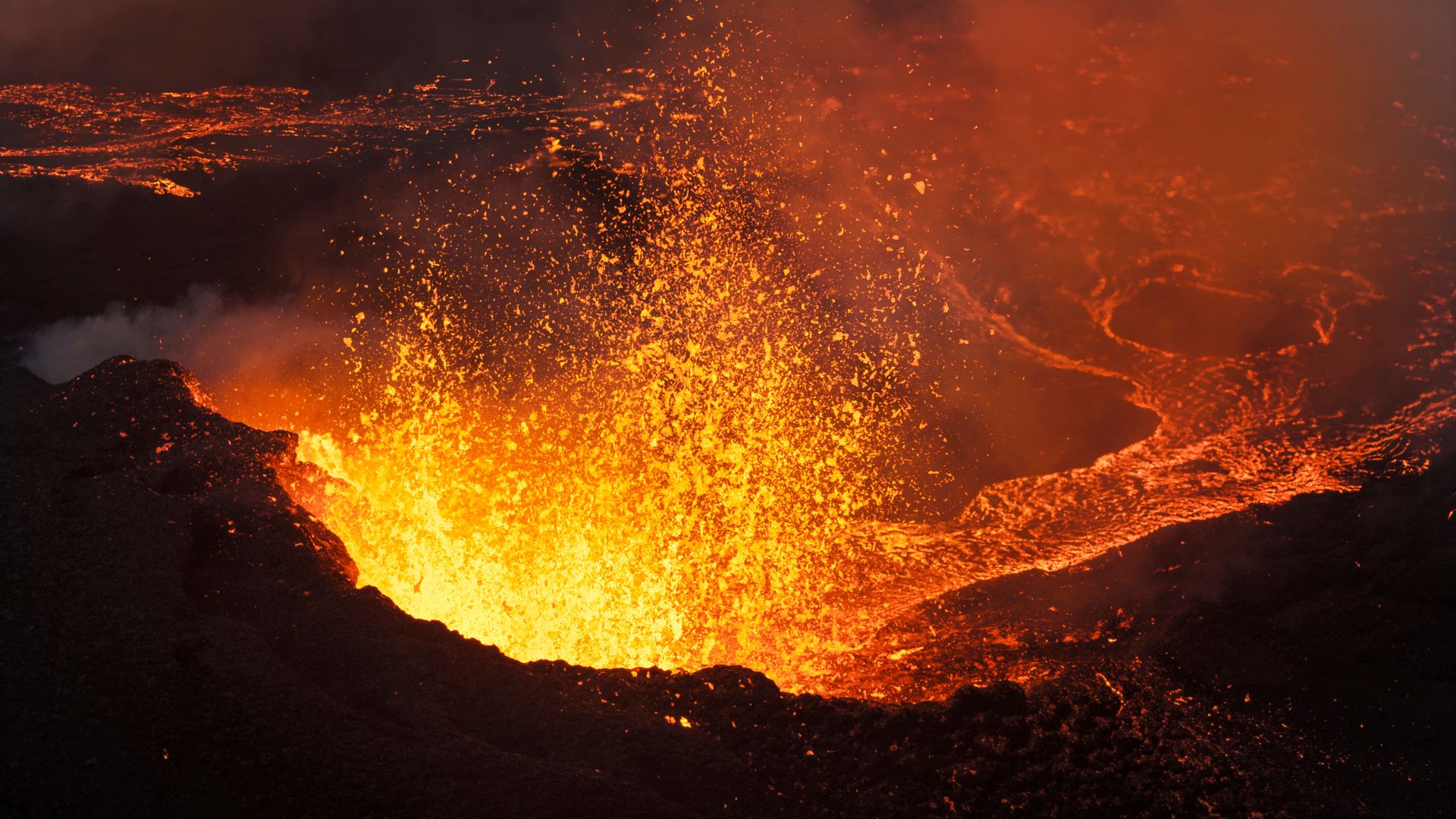
Volcanic eruptions present an extreme energy release event that instantly converts solid lithospheric material into mobile molten silicate streams. Extracting structural construction inputs directly from active lava flows requires solving a complex thermodynamic and kinetic problem. The premise of utilizing robotic systems to harvest, temper, and cast basaltic melt into functional construction material bridges planetary geology, high-temperature materials science, and extreme-environment automation.
Standard construction aggregate production relies on quarrying, mechanical crushing, and energy-intensive kiln firing for cement clinker production. This industrial pipeline consumes substantial fossil fuels and generates high greenhouse gas emissions. Basaltic lava, conversely, is a naturally calcined, high-temperature silicate fluid. It possesses an inherent chemical composition rich in silica, alumina, iron oxides, and calcium oxide that closely mirrors the raw mix required for durable structural masonry. Intercepting this fluid state bypasses the endothermic phases of traditional mineral processing. The primary challenge shifts from material synthesis to material capture, thermal management, and robotic handling under severe radiative and convective heat fluxes.
The Thermodynamic Cost Function of Molten Extraction
Operating mechanical systems in proximity to liquid rock operating between 1000 and 1200 degrees Celsius introduces severe material constraints. Conventional structural metals lose yield strength rapidly at these elevated thresholds. Titanium alloys, nickel-based superalloys, and advanced ceramic composites form the foundational hardware tier required for survival in this operational envelope.
The energy balance of direct lava harvesting depends on controlling cooling rates to dictate mineral phase formation. Molten basalt quenched rapidly yields an amorphous glass structure with high compressive strength but brittle fracture toughness. Controlled, slow cooling induces crystallization, forming micro-gabbros or diabase-like matrices that exhibit superior tensile performance and thermal shock resistance.
[Active Vent] ---> [High-Temperature Robotic Grapple] ---> [Active Annealing Chamber] ---> [Structural Mold Casting]
This sequence represents the core operational pipeline. The first variable is extraction efficiency, measured by the mass of usable silicate captured per unit of fuel expended by the robotic platform. The second variable is viscosity management. Basaltic lava exhibits non-Newtonian flow properties highly dependent on temperature and crystal fraction. If the extraction tool contacts material where crystallization has advanced beyond forty percent, the yield stress spikes exponentially, causing mechanical seizure of the manipulator joints.
Autonomous Hardware Architecture for Extreme Thermal Environments
Robotic deployment on active volcanic slopes requires moving away from traditional wheeled or tracked mobility models. Uneven terrain covered in loose scoria, combined with active fissures and unpredictable gas venting, favors legged locomotion systems. Quadrupedal or hexapod designs provide distributed ground contact points and dynamic balance capabilities, minimizing ground disturbance and maintaining stability on steep inclines.
Actuation mechanisms cannot rely on standard hydraulic fluids or uninsulated electric motors. Hydraulic systems require synthetic fire-resistant fluids with narrow operating windows, while copper windings in electric motors degrade swiftly above standard Curie points. Successful high-temperature automation utilizes high-pressure pneumatic systems driven by inert gases, coupled with magnetic gearless drives shielded by active liquid-nitrogen cooling loops or multilayer aerogel thermal blankets.
Sensor suites face degradation from sulfur dioxide outgassing, hydrofluoric acid plumes, and extreme infrared radiation. Optical cameras fail immediately without narrowband filtering and sapphire viewports. Radar, LiDAR, and long-wave infrared thermography provide the primary spatial mapping modalities. These sensors penetrate particulate-dense atmospheric plumes and map surface topology variations in real-time, allowing the autonomous system to predict flow fronts and identify optimal collection pools where the melt is quiescent and homogeneous.
Material Transformation Mechanics
Raw lava cannot be poured directly into standard formwork without catastrophic thermal shock failures. When a 1150-degree fluid contacts ambient steel or wooden molds, the massive thermal gradient causes immediate gas evolution, violent steam flashing if any residual moisture is present, and micro-cracking within the solidifying matrix.
Mitigating this requires intermediate processing stages analogous to traditional annealing arches used in glass manufacturing. The robotic harvester deposits the molten stream into a mobile, refractory-lined intermediate vessel. Within this crucible, chemical modifiers or fiber reinforcement matrices can be introduced via automated injection ports. Introducing metallic or carbon-based micro-fibers alters the fracture mechanics of the cooled basalt, suppressing crack propagation and transforming a brittle ceramic into a pseudoductile structural element.
The solidification kinetics follow classical nucleation and growth models. By regulating the thermal extraction rate through active cooling jackets or ceramic insulation blankets, engineers control crystal grain size. Fine-grained basalt structures yield higher hardness and abrasion resistance, making them ideal for wear plates, road surfacing tiles, and erosion barriers. Coarse-grained structures provide higher structural ductility, suited for load-bearing foundation blocks and retaining walls.
Scalability Bottlenecks and Failure Modes
Evaluating the economic viability of volcanic material extraction requires analyzing three distinct failure vectors that limit operational uptime.
The first limitation is temporal unpredictability. Volcanic eruptions are stochastic events. Designing high-capital-expenditure robotic machinery tailored to a specific eruption site creates extreme asset utilization risk. If an eruption subsides unexpectedly, the capital equipment sits idle or requires costly transport to active seismic zones globally. Mobile deployment platforms mounted on heavy transport vehicles mitigate this risk by enabling rapid redeployment across active tectonic arcs, such as the Ring of Fire or the East African Rift system.
The second limitation is chemical heterogeneity. Unlike manufactured industrial cement, which undergoes rigorous batch-testing to maintain strict stoichiometric ratios, natural lava compositions fluctuate even within a single eruptive phase. Variations in silica saturation, volatile content, and alkali metal concentrations alter the melting point, viscosity, and final tensile strength of the cast product. Automated inline spectroscopic analysis using laser-induced breakdown spectroscopy integrated into the robotic arm provides immediate compositional feedback, allowing real-time adjustment of cooling parameters and additive dosing.
The third limitation is infrastructural integration. Producing basalt structural elements on-site solves the mass transport problem of moving heavy aggregate materials to remote or disaster-stricken areas. However, these elements must meet standardized building codes for load-bearing capacity, seismic resilience, and shear strength. Without standardized certification pathways for naturally derived geopolymer and cast silicate masonry, regulatory acceptance remains a barrier to commercialization.
Deploy capital toward the development of closed-loop, magnetically shielded mobile robotic testbeds capable of processing industrial slag simulants under simulated volcanic thermal profiles before undertaking live-site field trials on active shield volcanoes.