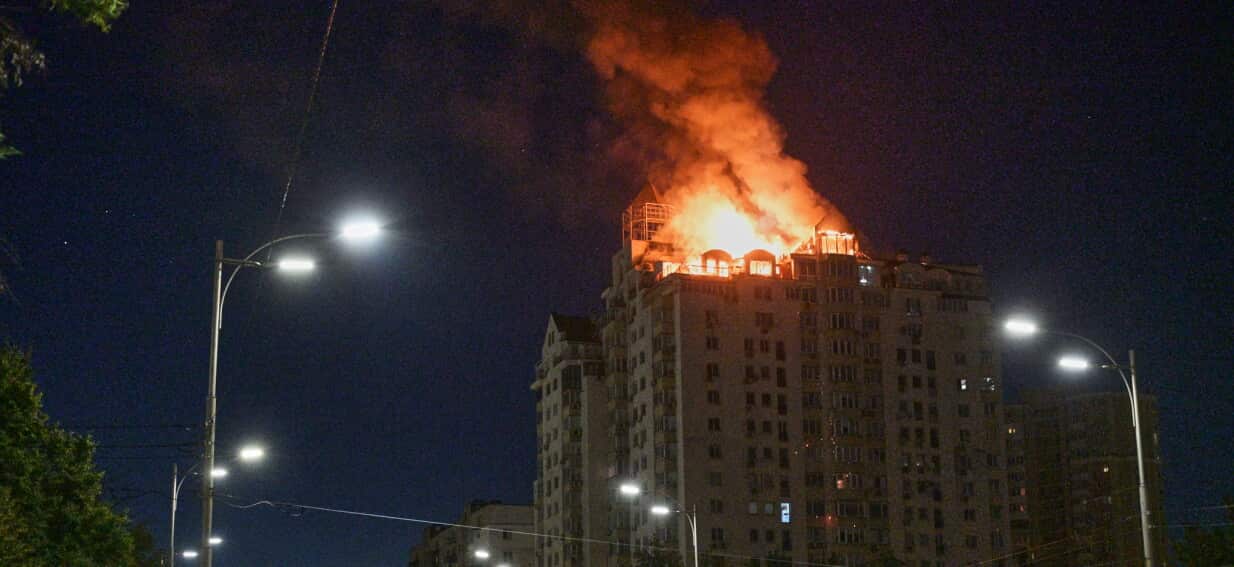
The metric of 13 fatalities and over 85 injuries resulting from a coordinated overnight strike series highlights a specific operational calculus in kinetic attrition. In modern asymmetric conflicts, urban strikes targeting civilian and dual-use infrastructure function less as immediate territorial acquisition tools and more as mechanisms of systemic degradation. To evaluate the strategic impact of these operations, analysts must look past the immediate headlines and map the underlying variables: air defense saturation thresholds, structural vulnerability coefficients, and the socio-economic friction generated by rapid mass-casualty events.
The Mechanics of Air Defense Saturation
The primary determinant of strike efficacy is the interception-to-penetration ratio of the defending state's anti-air network. Modern air defense systems operate under strict resource constraints, defined by radar tracking capacities, missile inventory limits, and reload cycle times.
Salvo modeling dictates that an attacker can bypass sophisticated defense systems by deploying a mixed-payload assault. By interchanging low-cost loitering munitions with high-velocity ballistic or cruise missiles, the striking force forces the defender into an economic and operational dilemma.
- Target Prioritization Delays: Radar systems must classify incoming signatures within seconds. Low-cost drones simulate high-value threats, consuming expensive interceptor missiles and exhausting localized fire units.
- Thermal and Mechanical Fatigue: Continuous operation over an extended overnight window degrades system readiness, increasing the statistical probability of a penetration event during late-stage waves.
- Geographic Dispersion: Distributing strikes across multiple nodes prevents the concentration of defensive assets, forcing the defender to accept higher risk profiles in secondary urban centers to protect high-priority infrastructure.
When penetration occurs, the resulting damage is a function of payload kinetic energy, explosive mass, and the structural resilience of the target site. The reported ratio of roughly 6.5 injuries for every one fatality indicates that the strikes primarily affected high-density residential or administrative zones, where secondary fragmentation—shattered glass, collapsing masonry, and pressurized blast waves—inflicts widespread non-lethal trauma.
The Kinetic Casualty Function
Civilian casualty figures in urban bombardment are not random; they follow predictable structural and temporal variables. The casualty function can be modeled through three distinct phases of exposure.
Primary Blast Effects
The immediate detonation creates a localized overpressure wave capable of collapsing reinforced concrete and shattering internal supports. Fatalities occurring in this zone are typically instantaneous and represent the core death toll. The size of this zone depends heavily on whether the munition utilizes thermobaric, fragmentation, or high-explosive warheads.
Secondary Structural Failure
The transformation of building materials into high-velocity shrapnel accounts for the high injury-to-fatality ratio. In older urban developments, non-reinforced masonry fails catastrophically under blast pressure, trapping occupants and complicating search-and-rescue timelines.
Tertiary Logistical Strain
A sudden influx of over 85 trauma patients within a single overnight window shifts local healthcare systems into triage mode. The operational capacity of emergency services is pushed to its functional limit, creating a secondary risk vector where survivable injuries can deteriorate due to delayed medical intervention.
Infrastructure Degradation as a Force Multiplier
Beyond the immediate human toll, overnight strikes impose long-term systemic costs on the defending nation's economy. When kinetic operations strike dual-use infrastructure—such as energy generation facilities, transport hubs, or communication nodes—the immediate tactical success scales into macroscopic economic friction.
The economic cost of structural remediation routinely outpaces the manufacturing cost of the offensive munitions. A cruise missile costing several hundred thousand dollars can inflict tens of millions of dollars in long-term structural and operational damage to a power grid or industrial facility. This asymmetric cost structure forces the defending state to divert capital from frontline military procurement toward civil stabilization and emergency reconstruction.
The displacement of civilian populations away from targeted urban centers disrupts localized supply chains and reduces the tax base necessary to sustain protracted defensive operations. The resulting migration waves place administrative and financial burdens on neighboring regions or international allies, effectively internationalizing the economic friction of the strike.
The Strategic Limits of Kinetic Terror
While the tactical execution of overnight strikes achieves localized destruction, historical data suggests that using kinetic attrition against civilian populations yields diminishing strategic returns. Rather than forcing a political capitulation, systemic bombardment frequently hardens domestic political resolve and accelerates international security assistance.
The long-term utility of these strikes depends on the attacker's industrial replenishment rate. If the rate of munition consumption during large-scale salvo operations exceeds domestic production capacity and import channels, the offensive force risks depleting its precision-guided inventory. This depletion compromises its ability to counter direct military maneuvers on the front lines, creating a strategic bottleneck where short-term political messaging undermines long-term operational sustainability.
Defending forces mitigate these strikes by decentralizing critical supply nodes, improving early-warning civilian broadcast networks, and integrating layered, mobile air defense assets capable of neutralizing low-cost threats without depleting high-tier interceptor stockpiles. The equilibrium of the conflict shifts based on which side can optimize its industrial throughput: the attacker's ability to manufacture precision payloads versus the defender's capacity to absorb, adapt, and reconstruct vital infrastructure.