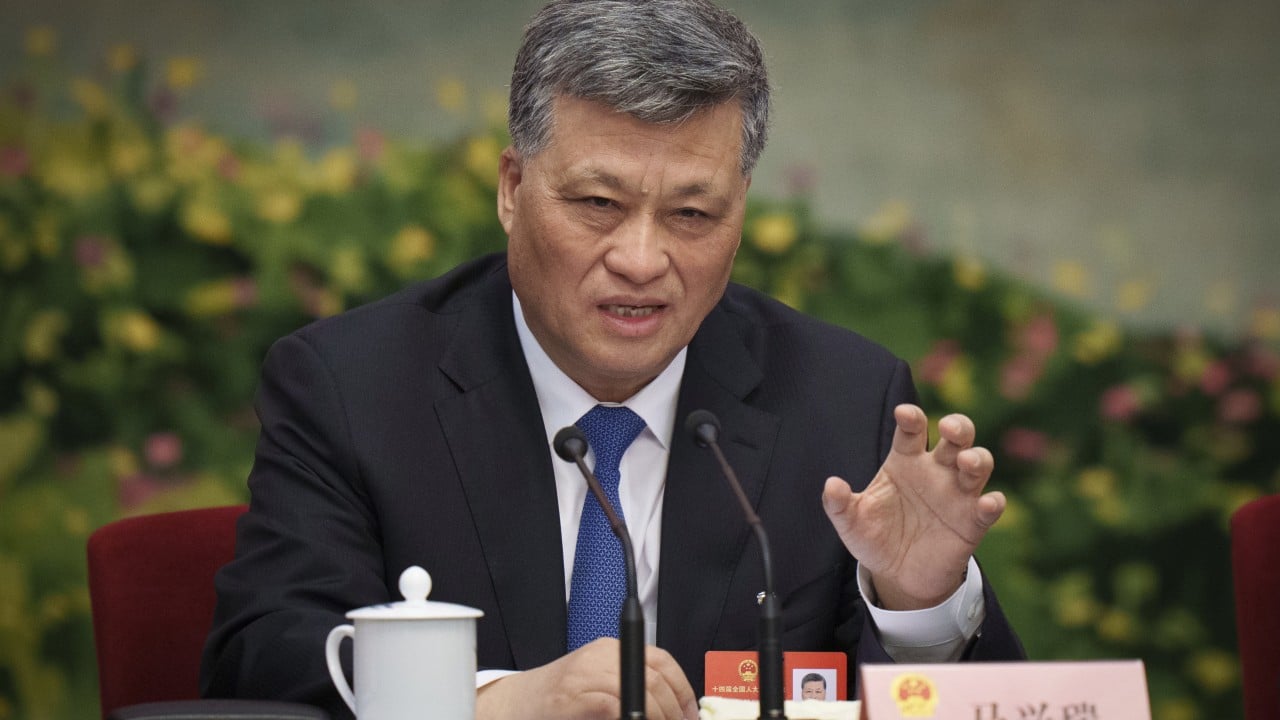
Corruption charges stretching back to the late 1990s against former Politburo member Ma Xingrui expose how Beijing’s anti-graft apparatus now reaches deep into the formative decades of China’s modern aerospace and industrial complex. Rather than targeting isolated bribes collected at the pinnacle of provincial power, investigators are tracing financial networks built during the rapid commercialization of state-owned defense conglomerates in the late twentieth century. By reaching back across twenty-five years, the Central Commission for Discipline Inspection (CCDI) is signaling that early-career patronage and procurement kickbacks no longer carry an informal statute of limitations.
In Chinese elite politics, this phrase—extending back to the end of the last century—is rarely accidental. It is a deliberate formula used by state prosecutors and disciplinary watchdogs to establish a pattern of lifelong systemic corruption rather than a momentary lapse in judgment. When an official’s transgressions are mapped across multiple decades, the state effectively argues that every subsequent promotion was tainted from the start.
The Aerospace Technocrat Pipeline
To understand why an investigation into Ma Xingrui reaches back to the late 1990s, you have to look at the institutional ecosystem where he built his reputation. Before entering provincial politics as governor of Guangdong and later party secretary of Xinjiang, Ma was one of the brightest stars in China’s aerospace technocracy. During the 1990s, he moved from academia at the Harbin Institute of Technology into senior leadership roles within the China Aerospace Science and Technology Corporation (CASC) and its predecessor bodies.
That era was a structural turning point for China’s defense and space industries. In the late 1990s, Beijing broke up massive state ministries into corporatized conglomerates to spur efficiency, commercialize satellite launches, and modernize missile and space programs. Money flooded into these newly formed entities. Yet oversight mechanisms lagged far behind capital allocation.
Procurement contracts for specialized components, joint ventures with private shell companies, and sub-contracting arrangements created vast gray zones. For ambitious engineers turned executives, control over vendor selection and research grants translated directly into political and financial capital. When investigators examine offenses from 1998 or 1999, they are rarely looking at suitcases of cash handed over in hotel rooms. They are looking at equity stakes parked in relatives' names, inflated subcontracting fees, and long-term profit-sharing agreements established when state assets were first restructured.
Why Old Files Surface Decades Later
A common misconception among outside observers is that Beijing uncovers twenty-five-year-old crimes through sudden forensic breakthroughs. In reality, much of this information sits dormant in disciplinary archives for years. In a system where patronage networks bind subordinates to superiors, low-level procurement officers and private contractors keep quiet as long as their patron rises.
The dynamic flips the moment an adjacent sector comes under scrutiny. Over the past several years, China’s military-industrial complex—specifically the Rocket Force and aerospace procurement networks—has undergone sweeping purges. Once investigators detain mid-level executives or equipment suppliers from CASC or sister conglomerates, those detainees trade historical testimony for leniency. A supplier questioned about a 2021 satellite component contract will readily confess to the sweetheart deal he struck with a rising deputy general manager back in 1999.
- The Chain of Custody in Graft: Early favors create permanent leverage. A contractor who secures a lucrative state subcontract in 1999 remains indebted to the approving official for decades, often funneling dividends to the official’s family long after the official leaves the industry.
- The Technocrat Shield: For years, engineers and scientists in strategic sectors enjoyed implicit protection because their technical expertise was deemed vital to national security. That shield has vanished.
- Retroactive Accountability: Under current party discipline rules, there is no expiration date on "continuing offenses," allowing prosecutors to bundle a 1999 kickback with a 2020 land deal into a single, insurmountable indictment.
From Technocratic Star to Provincial Heavyweight
Ma Xingrui’s career trajectory made him the archetype of the red technocrat—an elite class of engineers elevated to top political posts to inject managerial rigor into regional governance. After leading major space missions, including lunar exploration and manned spaceflight projects, he transitioned into full-time politics in 2013. He served as party chief of Shenzhen, governor of Guangdong—China’s economic powerhouse—and eventually took the helm in Xinjiang in late 2021, securing a seat on the 20-member Politburo in 2022.
Moving a career aerospace executive into Xinjiang was widely interpreted at the time as an effort to pivot the region from pure security crackdowns toward economic integration, trade, and industrial development. Yet transferring an official across multiple high-stakes jurisdictions also multiplies their exposure to scrutiny. Every move leaves a fresh trail of approvals, infrastructure budgets, and personnel appointments.
When an official reaches the Politburo, the political calculus changes entirely. At that altitude, corruption charges are never purely legal events; they are surgical political interventions. However, grounding the indictment in offenses dating back to the late 1990s serves a crucial institutional purpose. It allows the leadership to frame the downfall not as a failure of recent vetting during the 20th Party Congress, nor as an indictment of policies in Guangdong or Xinjiang, but as the inevitable unmasking of a deeply hidden flaw that predated his political ascent.
The Mechanics of "Lifelong" Indictments
In Chinese judicial practice, indictments that span twenty-five to thirty years rely on a specific legal architecture. Prosecutors do not need to prove continuous annual bribes to establish a multi-decade timeline. Instead, they establish an initial corrupt nexus—such as helping a business associate secure a state contract in 1998—and trace subsequent benefits received years or decades later as the delayed payout of that original transaction.
| Era of Career | Institutional Role | Typical Investigative Focus |
|---|---|---|
| Late 1990s – 2000s | Aerospace Leadership (CASC) | Equipment procurement, R&D grant diversion, equity transfers during state enterprise corporatization |
| 2013 – 2021 | Guangdong & Shenzhen Governance | Urban redevelopment approvals, tech subsidies, provincial infrastructure contracting |
| 2021 – 2025 | Xinjiang & Politburo | State-backed energy projects, cross-border logistics, personnel promotions |
This approach accomplishes two goals simultaneously. First, it inflates the total financial sum attributed to the accused, ensuring the case meets the threshold for the severest statutory penalties—typically life imprisonment or a suspended death sentence. Second, it signals to every sitting official that surviving a promotion vetting process does not clear the ledger.
The Myth of the Clean Technocrat
For decades, a prevailing theory among Western analysts and Beijing insiders alike held that technocrats from the aerospace, aviation, and nuclear sectors were inherently cleaner than career provincial bureaucrats. The logic seemed sound. Provincial party secretaries spent their lives managing land sales, real estate developers, and local mining bosses—sectors notorious for naked bribery. Aerospace engineers, by contrast, worked in high-security compounds, focused on launch windows and payload calculations, and answered to strict military-industrial standards.
That assumption has collapsed under the weight of recent investigations. The defense and aerospace sectors proved just as vulnerable to rent-seeking, only the mechanisms were harder to audit. Unlike a real estate deal, where land prices can be compared against market rates, cutting-edge aerospace technology involves bespoke components and classified budgets. Who outside a handful of senior engineers can verify whether a specialized alloy or guidance subsystem actually cost ten million yuan or fifty million yuan to develop?
Opaque pricing, combined with national security secrecy, created an ideal environment for long-term graft. Auditors lacked the technical literacy to challenge procurement costs, and external watchdogs were barred from inspecting classified facilities. By the time Ma Xingrui and his contemporaries moved into civilian governance, the financial networks established inside those classified compounds had already matured into self-sustaining investment vehicles managed by proxies.
What This Means for Beijing’s Governance Model
The decision to pursue charges reaching back to the end of the last century exposes a fundamental tension at the heart of China’s governance model. Beijing relies heavily on technical experts to drive its push for technological self-reliance—from semiconductors and artificial intelligence to deep-space exploration. Yet the very autonomy required to innovate rapidly in strategic industries also creates opportunities for unchecked patronage.
Tightening retroactive oversight sends an unmistakable chill through state-owned enterprises and research institutes. When senior executives see that decisions made during the chaotic, fast-moving reforms of the late 1990s can destroy a Politburo career nearly thirty years later, risk aversion becomes the rational survival strategy. Mid-level managers hesitate to sign off on unconventional suppliers. Procurement committees demand endless layers of compliance paperwork before approving emergency R&D funds.
At the same time, critics and seasoned observers of Chinese politics note a persistent gray area in how these timelines are constructed. Because disciplinary investigations happen entirely behind closed doors before a case ever reaches a courtroom, outside analysts cannot independently verify where genuine financial crimes end and political score-settling begins. In a system where every senior official operates within networks of mutual obligation, virtually anyone who rose through the ranks during the under-regulated 1990s can be found to have violated strict modern compliance standards.
The real lesson of Ma Xingrui’s downfall is not merely that an elite official accumulated illicit wealth over a quarter-century. It is that within the modern Chinese state, political survival depends on absolute alignment in the present, because the past is never truly closed. Every signature on a procurement form in 1999 remains an open file, waiting in the vault until the political winds shift.


