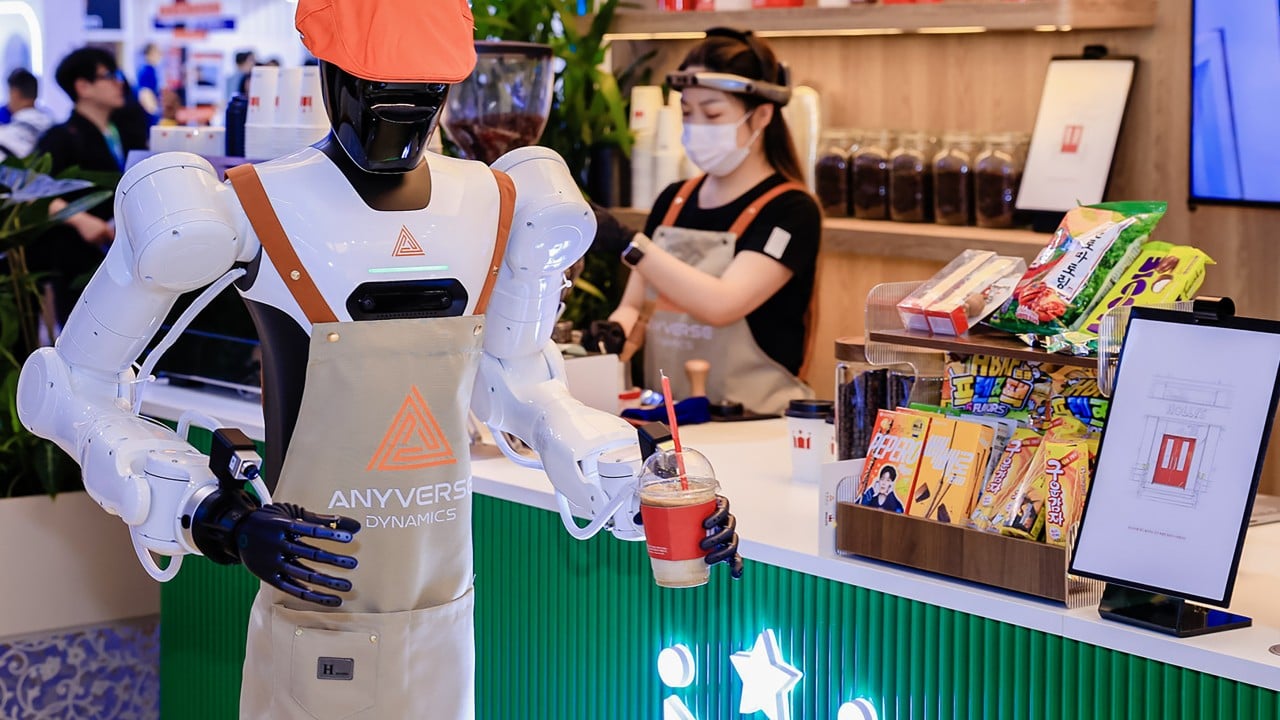
Fluorescent light hums above a concrete floor in Gyeonggi Province. Oil smells sharp in the cool air. Somewhere outside, traffic moves along a crowded highway, yet inside the bay everything feels strangely deliberate, almost suspended in time.
A metal hand reaches for a bracket. It pauses for a fraction of a second, recalibrates its grip, and sets the piece down without a scrape. No coffee break. No sigh at the end of a long shift. No aching wrist after eight hours of repetitive motion. Meanwhile, you can find similar developments here: AI Cyber Simulation and PHP Flaws: Why Patch Speed Decides Survival.
Watching a bipedal machine move through a factory aisle does something unsettling to the chest. You expect science fiction when you hear about humanoid robots, something loud and theatrical with glowing eyes and dramatic speeches. Instead, what arrives in real industrial spaces is quieter. Slower at first. Slightly awkward on a turn. Then, suddenly, eerily competent.
For years, factory automation looked like a cage of bolted arms welded to one spot. Those machines were brilliant at one task and helpless at anything slightly off-script. Drop a part two millimeters to the left, and the line stopped. Now, machines built on human proportions are stepping into spaces designed for human bodies, guided by software trained to read physical space rather than just follow rigid coordinates. To understand the bigger picture, we recommend the detailed analysis by CNET.
That shift—often called physical AI—is no longer a laboratory parlor trick. It is walking across borders, testing commercial pilots, and forcing policymakers and plant managers alike to ask an uncomfortable question: when a machine shaped like us shows up looking for work, who gets to decide what that work is worth?
A Factory Floor Where Margins Leave No Room for Hesitation
To understand why South Korea matters so deeply in this story, you have to feel the pressure inside its industrial economy. South Korea has spent decades building a reputation for precision manufacturing, electronics, shipbuilding, and automotive engineering. It is a country where supply chains run tight, quality standards are unforgiving, and demographics are shifting fast.
Fewer young people are entering heavy or repetitive factory work. At the same time, global competition keeps squeezing unit costs and delivery timelines. A plant manager looking at a shift schedule does not see an abstract geopolitical chart. They see open slots, overtime bills, ergonomics complaints, and bottlenecks that ripple all the way to a shipping port.
Now imagine a hypothetical plant supervisor in Ulsan or Ansan—let’s call him Min-jun—walking the line at six in the morning. This scenario is hypothetical, built to trace real pressures rather than report a specific person’s day. Min-jun knows every sound his floor makes. He can tell by pitch alone whether a feeder is starving or a conveyor belt is slipping. When he looks at a new bipedal unit running a trial cycle in the corner, his instinct isn't romance. It is triage. Can this thing lift a tote reliably without damaging the casing? Can it walk between two stations without bumping a cart? How many hours of supervision does it take before it actually saves labor instead of creating another job?
Those are grounded, practical questions. They are also the exact questions drawing Chinese humanoid robotics makers outward.
China has built an enormous, fast-moving supply chain for actuators, sensors, reducers, batteries, and general robotics hardware. Fierce domestic competition pushes manufacturers to iterate quickly, cut bill-of-materials costs, and prove commercial viability beyond trade-show demos. A lab prototype is easy to applaud on video. A machine surviving dust, heat, shift changes, and uneven floors in a paying customer’s facility is a completely different test.
South Korea offers an attractive proving ground for that test. Seoul has leaned heavily into backing physical AI and smart manufacturing upgrades as part of its broader industrial strategy, recognizing that software intelligence alone cannot move steel or assemble hardware. Where policy ambition meets manufacturing scale, hardware makers show up.
Still, bringing Chinese humanoid machines into South Korean industrial settings is not as simple as rolling them off a cargo ship and pressing start. Trust is earned slowly in manufacturing. Security scrutiny, data-handling rules, intellectual property concerns, and local integration standards all sit right beside the technical specs. A company can promise general-purpose adaptability on a slide deck, yet a buyer still wants to know who fixes a blown joint at midnight and whether telemetry leaves the building.
Why Walking Like Us Changes the Stakes
We tend to underestimate how much human bodies shape the built environment. Stairs, narrow aisles, workbenches at waist height, doors with handles, bins stacked on pallets—the modern workplace is an architectural mirror of human anatomy.
Wheeled robots do great on smooth floors. Fixed robotic arms excel at high-speed, unchanging cycles. Humanoid designs aim at a messier middle ground: brownfield facilities built for people rather than stripped down and rebuilt from scratch for specialized automation. If a machine can step over a threshold, reach into a rack, and shift between tasks, it promises automation without tearing up the entire floor plan.
Yet that resemblance carries emotional weight that a conveyor belt never had.
A stamping press looks like a machine. Nobody projects personality onto a hydraulic cylinder. A bipedal frame with a torso, articulated arms, and a head-mounted camera array triggers human social wiring whether we want it to or not. People watch how it balances. They notice when it hesitates. They measure it against themselves, even subconsciously.
I remember standing beside an automated warehouse aisle years ago, watching a mobile unit glide past stacked pallets with a soft chime. It wasn't humanoid, just a low rolling platform, yet workers nearby spoke to it like a coworker—telling it to wait, apologizing when a pallet sat crooked. Human beings are wired to read intent in motion. When motion looks vaguely human, the boundary between "tool" and "colleague" blurs faster than engineers expect.
And let’s be honest: the hype around humanoid robots can be exhausting. Every week brings another slick clip of a machine folding laundry, sorting parcels, or jogging across a studio floor. Real life on an industrial line is messier. Batteries run down. Wi-Fi drops in dead zones. A shiny surface gets scuffed on day two. A single unscripted obstacle can turn a viral demo into a frozen statue.
Admitting that gap is essential if we want to take this moment seriously. Physical AI is real, and momentum is building, but maturity in heavy industry takes years of grinding iteration, not one dramatic breakthrough.
Bet On Physical AI, Or Bet On The Whole System?
When governments and enterprises talk about betting on physical AI, it sounds like a single wager on clever algorithms inside tough metal shells. In practice, physical AI is a team sport of unglamorous parts.
Think of it like teaching someone to play tennis in a dark room with a slightly warped floor. Eyes, nerves, balance, muscle memory, and split-second judgment all have to work together. For a robot, "eyes" means cameras, depth sensors, and tactile feedback. "Nerves" means low-latency control loops. "Muscle memory" means policies trained in simulation and refined on real hardware so a slight slip doesn't become a fall.
Even then, hardware alone is only half the equation.
- Integration: A robot has to talk to existing warehouse management systems, safety sensors, and line schedules without slowing everything down.
- Maintenance: Parts wear out under continuous load, so local service, spare components, and clear diagnostics decide whether uptime stays high.
- Economics: A unit only makes sense when total cost per completed task beats alternatives over its real working lifespan.
South Korea has clear strengths in precision components, electronics, and industrial discipline, while China brings scale, speed, and aggressive hardware iteration. Watching Chinese humanoid entrants pursue work in South Korea reveals a tension that defines modern tech: rivalry and commercial pragmatism living side by side. Competitors can still be customers, partners, or test beds when incentives align—up to the exact line where national interest, supply-chain resilience, or proprietary know-how feels threatened.
There is also a human question that rarely fits neatly into an industrial roadmap. What happens to entry-level physical roles if machines become good enough at lifting, sorting, and moving goods?
History offers a mixed comfort here. Automation has repeatedly eliminated specific tasks while expanding total output and creating new roles in maintenance, supervision, and engineering. Yet transition rarely feels smooth to the person whose routine changes first. Retraining takes time. New jobs aren't always in the same town or at the same pay grade. Pretending automation has zero friction is just as dishonest as predicting mass idleness overnight.
What Actually Decides Who Wins
If you strip away the noise, the contest around humanoid robots hunting for industrial work comes down to three stubborn realities.
First, reliability beats novelty every single time. A machine that works 99.4 percent of the time at a steady pace beats a flashier machine that needs a rescue every hour. Industrial buyers buy predictability.
Second, trust is an engineering feature. Security architecture, transparent behavior, predictable stopping rules, and accountable support turn a clever prototype into something a plant manager can sign off on without losing sleep.
Third, adaptation happens through ordinary people. Engineers write the code and tune the joints, yes, but floor technicians, safety officers, and operators discover the edge cases that never show up in a clean test lab. Their feedback shapes whether these machines become useful helpers or expensive paperweights.
Steel cools. Shifts end. Outside the factory gates, evening rain darkens the asphalt and taillights stretch down the road in long red ribbons. Inside, one quiet machine finishes a cycle, holds steady in the low hum of the bay, and waits for the next signal to move.