One hundred and twenty-seven yards.
If you have never stood on a tee box staring down a par three, that distance might sound like a casual stroll down a suburban block. It is barely longer than a football field. Yet, when you are holding a piece of metal at the end of a slender graphite shaft, trying to launch a dimpled sphere smaller than an egg onto a patch of closely cropped grass no wider than a living room, one hundred and twenty-seven yards stretches out like a canyon. The wind whispers lies in your ear. Your wrists tighten. Gravity waits eagerly to pull your ambition into a sand trap.
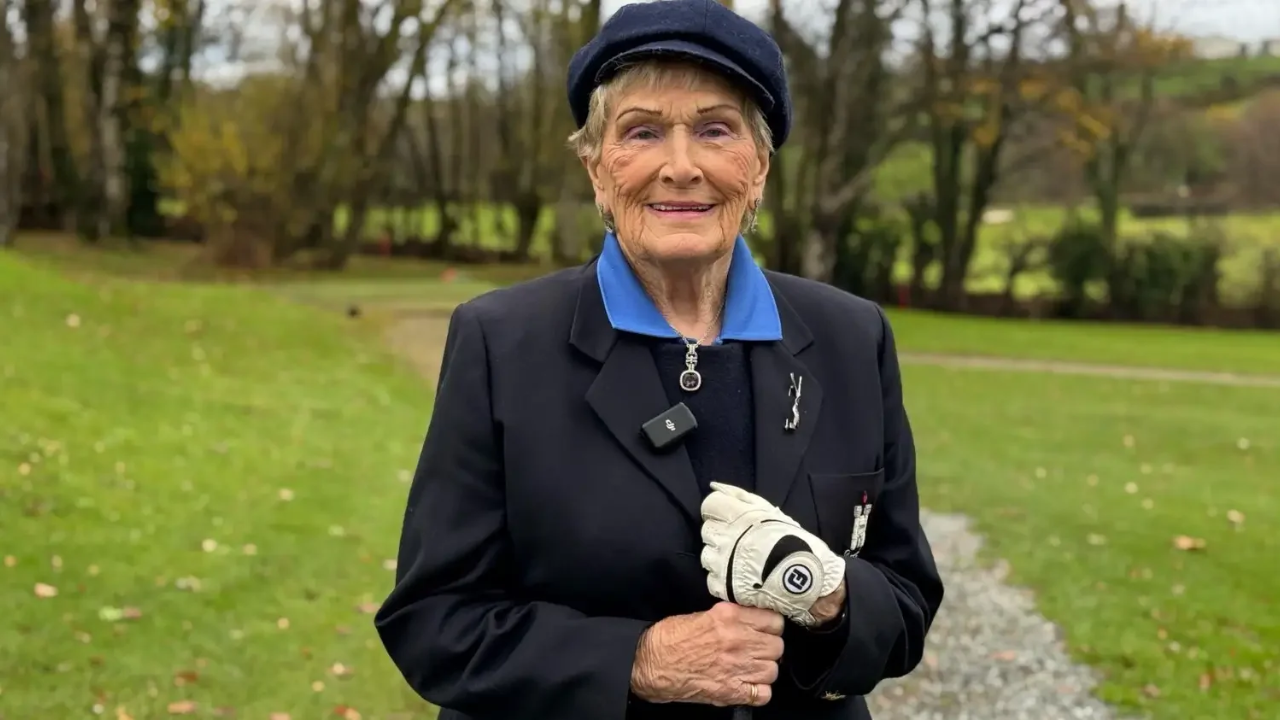
Now, subtract the supple tendons of a twenty-year-old. Subtract the explosive torque of a touring professional. Imagine instead the hands of a woman who has lived through nine decades of history, who remembers a world before commercial jetliners and smartphones, standing over a golf ball at ninety-one years old.
Her name is Maeve McVeigh. And when she swung her club, the ball did not merely find the green. It tracked the flagstick like a compass needle finding true north, bounced, rolled, and vanished into the bottom of the cup.
A hole-in-one. Her second.
Most news outlets treated this as a charming human-interest footnote—a feel-good palate cleanser tucked between political scandals and market crashes. They noted the novelty, smiled at the numbers, and moved on. They missed the point entirely. Maeve’s shot is not a cute anomaly; it is a quiet, devastating indictment of how we treat the second half of human life.
The Architecture of Surrender
We have built an entire culture around the slow retreat.
Think about the invisible script handed to us the moment we cross into middle age. By forty, we joke about our knees predicting the rain. By fifty, we stop trying new sports because we dread the humiliation of being a beginner again. By sixty-eight—the exact age Maeve McVeigh was when she picked up a golf club for the very first time—most of us have already begun curating our memories rather than creating new ones. We trade curiosity for comfort. We mistake caution for wisdom.
Consider a hypothetical man—let us call him Arthur—sitting in a recliner on his sixty-eighth birthday. Arthur has spent forty years in middle management. His muscles have adapted to the exact contours of an ergonomic desk chair. When his nephew suggests joining a weekend tennis clinic, Arthur laughs it off with a practiced line about his lower back and his "old dog, new tricks" philosophy. That single, seemingly harmless refusal sets off a quiet biological cascade. Without novel physical challenges, Arthur’s proprioception—the brain’s ability to sense where the body is in space—begins to dull. His balance erodes. His world shrinks, room by room, until the armchair becomes the center of his universe.
I know the seductive pull of that armchair. A few years ago, after a stubborn injury sidelined me from running, I convinced myself that my days of physical progression were over. I walked past a local driving range every evening, watching people swing at buckets of balls, and felt a sharp, bitter resistance. Why start something you will never master? I told myself. Why endure the frustration of whiffing at air when you can stay home and read? It took months of creeping stiffness and a pervasive, low-grade fog to realize that my body wasn't failing because I was getting older; it was failing because I had stopped asking it to learn.
When Maeve McVeigh stepped onto a golf course at sixty-eight, she rejected the architecture of surrender. She did not have a lifetime of muscle memory to fall back on. She had no teenage swing mechanics ingrained in her nervous system. She had to build a complex, full-body athletic movement from scratch at an age when society expects you to be sorting through photo albums and shopping for orthopedic shoes.
Why Golf Refuses to Be Conquered by Youth
To appreciate what Maeve accomplished, you have to understand the cruel physics of the sport she chose.
Golf is an exercise in delayed gratification and microscopic tolerances. Unlike running or cycling, where sheer cardiovascular grit can carry you through a bad day, golf punishes brute force. If the face of your club is open by just two degrees at the moment of impact—a margin thinner than a stack of three credit cards—your ball will slice fifty yards into the woods. To hit a target from 127 yards away requires a synchronized kinetic chain: the hips must initiate the downswing, the torso must rotate, the wrists must unhinge at the exact millisecond of truth, and the eyes must remain anchored while the rest of the body whips violently around its axis.
How does a ninety-one-year-old generate enough clubhead speed to cover 127 yards?
The secret lies in efficiency, a concept young athletes rarely understand because they can afford to waste energy. A twenty-five-year-old golfer swings with muscles; a ninety-one-year-old golfer swings with leverage and rhythm. Think of a grandfather clock. The pendulum does not strain or thrash to keep time; it relies on pure, unhurried geometry. Maeve’s twenty-three years of practice—spanning from age sixty-eight to ninety-one—stripped away every unnecessary twitch, every anxious lunge at the ball.
The statistics make the feat even more staggering. For an average amateur golfer, the odds of making a hole-in-one on a par three sit at roughly 12,500 to 1. Making two in a lifetime pushes those odds into the tens of millions. Doing it past the age of ninety places Maeve in a microscopic fraternity of athletes who have defied every actuarial table on earth. According to the National Hole-in-One Registry, while teenagers and octogenarians alike have recorded aces, sustaining the physical coordination, eyesight, and rotational mobility required to strike a golf ball cleanly into your tenth decade is a masterclass in applied longevity.
The Myth of the Fixed Brain
For decades, neurologists believed the adult brain was largely fixed—a biological concrete that hardened after adolescence, capable only of slow decay. We now know that picture is completely backward.
Neuroplasticity, the brain's ability to rewire itself by forming new neural connections, does not have an expiration date. It simply requires a catalyst. When you repeat routines you have known for forty years—driving the same route to the grocery store, cooking the same five meals, having the same conversations—your brain operates on autopilot, burning minimal energy and building zero new pathways.
Learning a new motor skill late in life acts like a lightning strike in a dark forest.
When Maeve began taking lessons at sixty-eight, her brain was forced to map entirely new territory. Every awkward swing, every topped ball that dribbled ten feet off the tee, sent urgent feedback loops racing from her hands to her cerebellum. Her nervous system had to recalibrate her balance, sharpen her depth perception, and coordinate left-and-right hemisphere communication in ways she had never demanded of it before.
In a very real sense, the golf course was not just keeping Maeve active; it was actively reconstructing her brain. Studies on late-life skill acquisition consistently show that complex, novel tasks—learning an instrument, speaking a new language, or mastering a technical sport—fortify cognitive reserve far more effectively than passive puzzles or routine walking. You cannot crossword-puzzle your way to the kind of spatial awareness required to judge wind, elevation, and club selection over 127 yards. You have to step outside, feel the turf beneath your cleats, and risk looking foolish.
The Invisible Stakes of the Tee Box
Let us zoom in on that moment before the swing.
The air is cool. The fairways are quiet. Maeve stands over the ball, aligning her feet, taking a breath. What is actually at stake here? Not a trophy. Not prize money. Not a green jacket.
The stakes are existential.
Every time an older adult steps onto an athletic field, a court, or a golf course, they are pushing back against the subtle erasure that comes with aging. Society has a habit of wrapping the elderly in bubble wrap, speaking to them in slightly louder, slower voices, and subtly ushering them toward the sidelines of relevance. When you are ninety-one, the world expects you to be fragile. It expects you to be careful.
Swinging a golf club with conviction is the exact opposite of being careful. It requires commitment. If you decelerate out of fear—if you try to gently guide the ball toward the hole—you fail. You have to trust your body enough to let go.
Think about the sheer audacity of starting something at sixty-eight knowing you will never reach your physical prime in it. Maeve didn't pick up golf to become a prodigy. She picked it up because she was alive, and being alive meant continuing to explore what she was capable of doing. Twenty-three years later, she wasn't just participating; she was excelling at a level that would make weekend golfers half her age weep with envy.
Imagine the walk from the tee box to the green after that ball disappeared.
One hundred and twenty-seven yards. Step by step.
A golfer who has just hit a shot that looked dead on line experiences a very specific, breathless suspension of disbelief. You watch the ball drop below the lip of the cup, you hear the faint, unmistakable clack of plastic meeting the pin—or you simply see the green suddenly empty—and your mind refuses to accept it until you look straight down into the hole. Walking those 127 yards at ninety-one is a victory lap earned over a quarter-century of showing up, bucket after bucket, round after round, through sore backs, bad bounces, and doubtful mornings.
What We Owe Our Future Selves
We spend an enormous amount of time obsessing over how to extend our lifespans—tracking steps, swallowing supplements, optimizing sleep cycles—while paying almost no attention to how we intend to inhabit those extra years. Adding twenty years to your life means very little if you spend them sitting on the porch watching the world go by because you decided at sixty that your learning days were behind you.
Maeve McVeigh offers a radically different blueprint. She proves that the timeline we cling to so desperately is an illusion. You are not behind schedule because you didn't start at ten. You are not washed up because your joints ache. The calendar on your wall measures revolutions around the sun, not the capacity of your spirit to adapt, strive, and surprise itself.
Next time you catch yourself saying, I'm too old for that, pause. Listen to the cowardice disguised as practicality in that sentence. Look at the thing you have been putting off—the piano gathering dust in the corner, the trailhead you drive past every weekend, the language app sitting unopened on your phone—and recognize it for what it actually is.
It is just a 127-yard shot. The green is waiting. Pick up the club.