Seven-thirty in the morning smells like damp wool, cold diesel, and toasted bread.
You know that specific hour. Every parent knows it. It is the universal ritual of letting go, performed at the end of a gravel driveway or beneath the flickering amber streetlamp of a quiet provincial road. You zip a coat. You double-check a backpack for a forgotten math workbook. You watch a child climb three steep metal steps into the warm, yellow-lit belly of a school bus, wave once through the condensation on the glass, and turn back toward your front door, trusting an unspoken, invisible contract with the universe.
That contract says: They will come back at four.
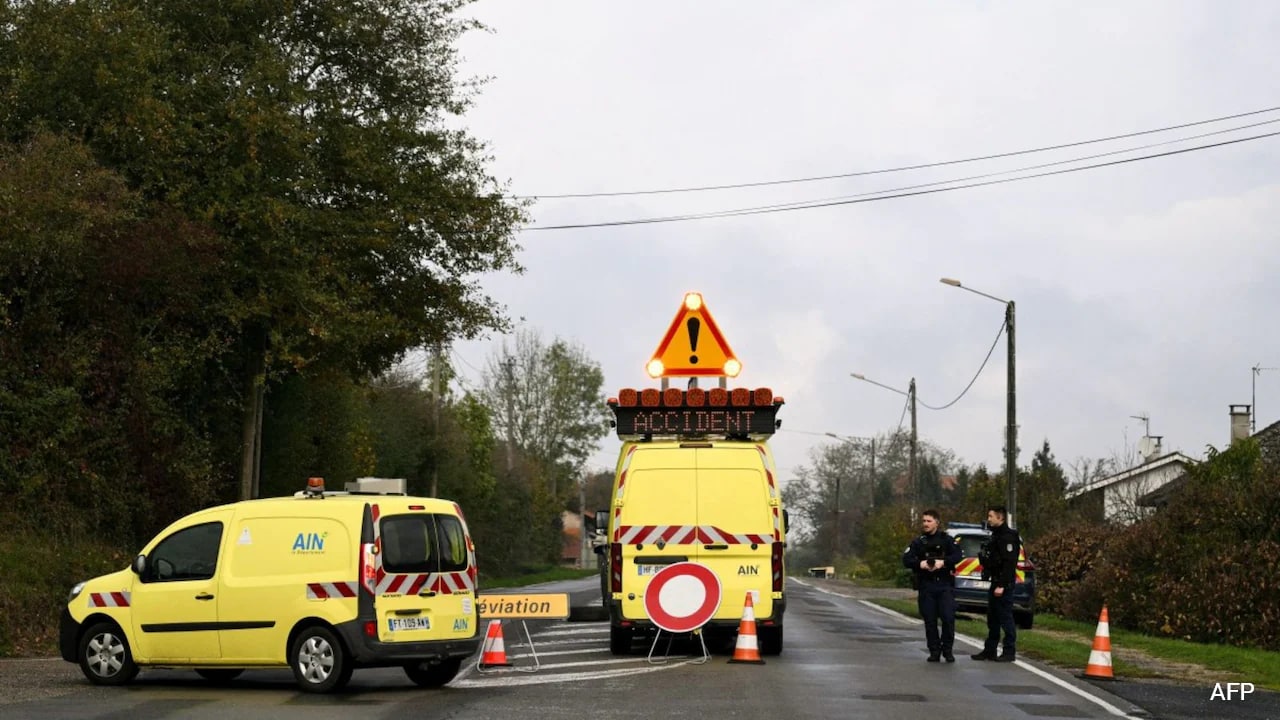
When a school bus crashes in rural France and plunges into a roadside ditch, killing two people, the local news reports arrive with the sterile, clinical efficiency of an autopsy. They give us the coordinates. They count the emergency vehicles. They tally the injured and the dead in neat, digestible digits before moving on to the weather forecast or the latest parliamentary debate in Paris.
Stop. Look closer at the ditch.
Because a headline reading "Two dead as school bus crashes and plunges into a ditch in France" is not merely a traffic report. It is the sound of that unspoken contract shattering across an entire community, exposing a fragile system of rural transit, human fallibility, and physics that we prefer not to think about while we pour our second cup of coffee.
The Anatomy of a Seven-Minute Routine
To understand what happens when forty tons of steel leaves the asphalt, you have to step onto the road before the sirens start.
Consider a hypothetical morning on a secondary departmental road—the kind of winding, tree-lined route départementale that stitches together French agricultural villages, from the rolling hills of the Doubs to the flat, mist-heavy plains of the Eure-et-Loir. Let us call our composite passenger Leo, fourteen years old, earpods tucked under a wool beanie, leaning his forehead against the cool window glass. Let us call the driver Marc, fifty-two, a man who has navigated these exact bends in sleet, fog, and blinding autumn sunrise for eleven years without a single scratch on his bumper.
In rural France, the school bus is not a luxury. It is the circulatory system of education. Every school day, roughly four million French students rely on public and contracted school transport to reach collèges and lycées miles away from their family farms and village squares. Unlike urban commuters who ride heavy, low-floor city transit crawling at twenty kilometers an hour through congested boulevards, rural schoolchildren travel on full-sized coaches moving at eighty kilometers an hour down two-lane roads bordered by deep drainage ditches, stone walls, and century-old plane trees.
Physics does not care about routines.
Think of a modern motorcoach not as a protective fortress, but as a massive kinetic pendulum. Its center of gravity sits high above the road surface, elevated over cavernous luggage bays and heavy chassis axles. On a dry, straight stretch of highway, that height gives passengers a panoramic view of the countryside. On a narrow rural road—where winter frost heaves the tarmac, agricultural tractors leave slick ribbons of mud on blind corners, or a sudden medical emergency strikes behind the wheel—that high center of gravity becomes an unforgiving adversary.
When a coach's front right wheel drops off the paved shoulder into soft, rain-saturated earth, the mud grabs the tire like a giant hand. The steering wheel wrenches violently. Within fractions of a second, momentum pulls the entire upper structure sideways. The vehicle does not gently slide; it tips, rolls, and drops into the trench carved alongside the road to drain rainwater.
Inside the cabin, the serene hum of diesel and sleepy teenage chatter turns instantaneously into a blender of glass, steel, backpacks, and human bodies.
What the Crash Reports Leave Out
I have walked the shoulder of a rural highway three hours after a heavy vehicle rollover, long after the ambulances had cleared the scene and the tow cranes had finished their groaning work. The silence afterward is what stays with you. You notice the absurd, heartbreaking persistence of ordinary objects: a single scuffed sneaker resting in the flattened grass, a half-crushed plastic water bottle, a loose-leaf binder splayed open in the mud with neat blue handwriting still legible in the rain.
When news breaks of two fatalities in a French school bus crash, the public immediately searches for a villain. Was the driver speeding? Was there black ice? Did an oncoming car drift across the center line?
Investigators from the Bureau d'Enquêtes sur les Accidents de Transport Terrestre (BEA-TT)—France’s dedicated land transport accident investigation agency—will spend months reconstructing the precise millimeters of skid marks, downloading data from the digital tachograph, and testing the blood and mechanics for answers. Sometimes the cause is a sudden cardiac event in the driver’s seat. Sometimes it is a patch of freezing mist in a shaded valley where the road temperature drops two degrees lower than the surrounding fields. Sometimes it is a split-second distraction on a road that leaves zero margin for error.
Yet focusing solely on the trigger misses the larger, structural vulnerability that turns a runoff into a tragedy.
In France, as across much of Europe, seatbelts have been mandatory on all newly registered school coaches for over a decade, and retrofitted onto older fleets. Laws require children to buckle up. Drivers are instructed to remind them. Audio chimes and dashboard lights warn when straps remain unlatched.
Ask any parent, any bus monitor, or any teenager what actually happens five minutes after the bus leaves the village square.
The click of a lap belt is easy to fake or unfasten once the bus pulls away. In a frontal collision, a bus’s sheer mass often protects its occupants against smaller passenger cars—a phenomenon safety engineers call "crash compatibility." A coach wins almost every head-on encounter with a sedan.
Rollovers and ditch plunges invert that equation entirely.
When a coach tips onto its side into a two-meter drainage trench, mass works against the passengers. Anyone not securely strapped into their seat becomes a projectile, thrown across the aisle against window frames, luggage racks, or other students. Even when belts are worn, the violent lateral whip of a coach dropping into a ditch subjects necks, spines, and skulls to forces that standard seatbacks were never designed to absorb on their own.
The Invisible Weight Carried by the Driver
There is another person in that front cabin whom we rarely pause to consider until tragedy forces their name into a prosecutor's press release.
Drive a forty-passenger school bus for a week, and you will never look at road safety the same way again. Behind your right shoulder sits a noisy, shifting cargo of someone else’s entire world. In front of you stretches a network of roads built largely for nineteenth-century carts and twentieth-century sedans, now shared with forty-ton freight trucks, distracted commuters checking text messages, and farm machinery wide enough to brush the white center line.
France faces a chronic, quiet shortage of school bus drivers—a shortfall that regularly leaves thousands of routes scrambling for coverage at the start of every academic year. The job demands split shifts: waking at five in the morning for the dawn run, enduring a four-hour unpaid gap in the middle of the day, and returning to the wheel at four in the afternoon when fading light and fatigue converge. The pay rarely reflects the crushing psychological responsibility of holding forty young lives in your hands for less than the cost of a municipal parking ticket per trip.
When a crash occurs, survivors and witnesses often describe the same haunting final seconds: the driver fighting the wheel with every ounce of strength, trying to keep the nose of the coach out of the trees, trying to bleed off speed before the drop. Whether the two lives lost in a crash are students, the driver, or occupants of another vehicle, the psychological shockwave ripples outward in concentric circles that no official casualty count can capture.
In a small French commune of eight hundred residents, two deaths do not remain abstract statistics. Every family knows the victims. The volunteer firefighters who pry open the emergency roof hatches with hydraulic spreaders are often the neighbors, uncles, or former classmates of the children crying inside the overturned cabin. The mayor who sets up the emergency reception hall in the local mairie has to look parents in the eye while the list of survivors is still being cross-checked against school attendance sheets.
Why "Rare" Does Not Mean "Acceptable"
If you look at the raw actuarial tables, school buses remain one of the statistically safest ways for a child to travel. French transport ministries and European road safety councils routinely point out that children are far more likely to be injured or killed riding in the back seat of their parents' private cars than aboard a regulated school coach.
Statistically, that is true. Emotionally and morally, it is cold comfort—and dangerously misleading if it lulls us into complacency.
Aviation learned decades ago that "statistically rare" is never an excuse to tolerate preventable failure modes. When a commercial airliner crashes, the entire industry treats the wreckage as a sacred text, dissecting every bolt, every weather briefing, every cockpit habit, and every guardrail until the specific chain of failure is broken forever.
Surface transport—especially rural school transit—rarely receives that level of systemic urgency.
We accept deep, unguarded ditches inches from narrow high-speed lanes as an unchangeable feature of the countryside. We accept that winter road-salting trucks prioritize major motorways and commercial corridors hours before they reach the secondary loops where school buses run at dawn. We accept seatbelts without audible, seat-by-seat occupancy sensors that alert the driver the exact second a teenager unbuckles in row seven. We accept emergency roof hatches and window-breaking hammers that terrified, concussed children in a dark, upside-down cabin may not know how to locate or operate.
Consider what happens next when we treat a rural bus crash as an isolated "freak accident" rather than a predictable intersection of geometry, weather, and human limits. Flowers are laid beside the ditch. Candles burn outside the school gates. A week of national empathy passes. Then the news cycle moves on, and the next morning at seven-thirty, another forty-ton coach rounds the same blind corner above the same unguarded trench.
Rewriting the Unspoken Contract
Safety in rural transit is not a mystery waiting for a futuristic invention. We already know what saves lives when a heavy vehicle leaves the road:
- Forgiving roadsides: Sloping road shoulders, armored guardrails on high-risk embankments, and covered drainage culverts that prevent a stray tire from hooking into soft earth and flipping a coach onto its roof.
- Active coach technology: Electronic Stability Control (ESC), lane-departure warnings, and automated emergency braking systems—now mandatory on new European heavy vehicles, yet still absent from thousands of older coaches operating on local municipal contracts.
- Seatbelt enforcement that actually works: Three-point shoulder harnesses rather than simple lap belts, paired with dashboard seat-occupancy monitors that eliminate the guesswork for drivers navigating dark rural routes.
- Intelligent winter routing: Real-time road-surface temperature sensors on rural school corridors that automatically delay morning pickups by sixty minutes when black ice or freezing fog threatens secondary roads—trading a minor disruption in the school schedule for certainty that every bus stays upright.
None of these measures make for dramatic headlines. You cannot cut a ribbon in front of a covered drainage ditch or a mandatory three-point seatbelt sensor. Quiet prevention never trends on social media.
Yet every parent standing at the end of a driveway in the blue light of morning deserves more than luck. They deserve infrastructure designed with the humbling admission that drivers are human, weather is treacherous, and physics is merciless.
Tomorrow morning across France—and across every rural county from Yorkshire to Ohio—millions of children will step up into the warm yellow light of a school bus. The doors will hiss shut. The brakes will release with a pneumatic sigh. Somewhere down the road, a ditch will wait silently beside the asphalt, indifferent to how many times the bus has passed it safely before.