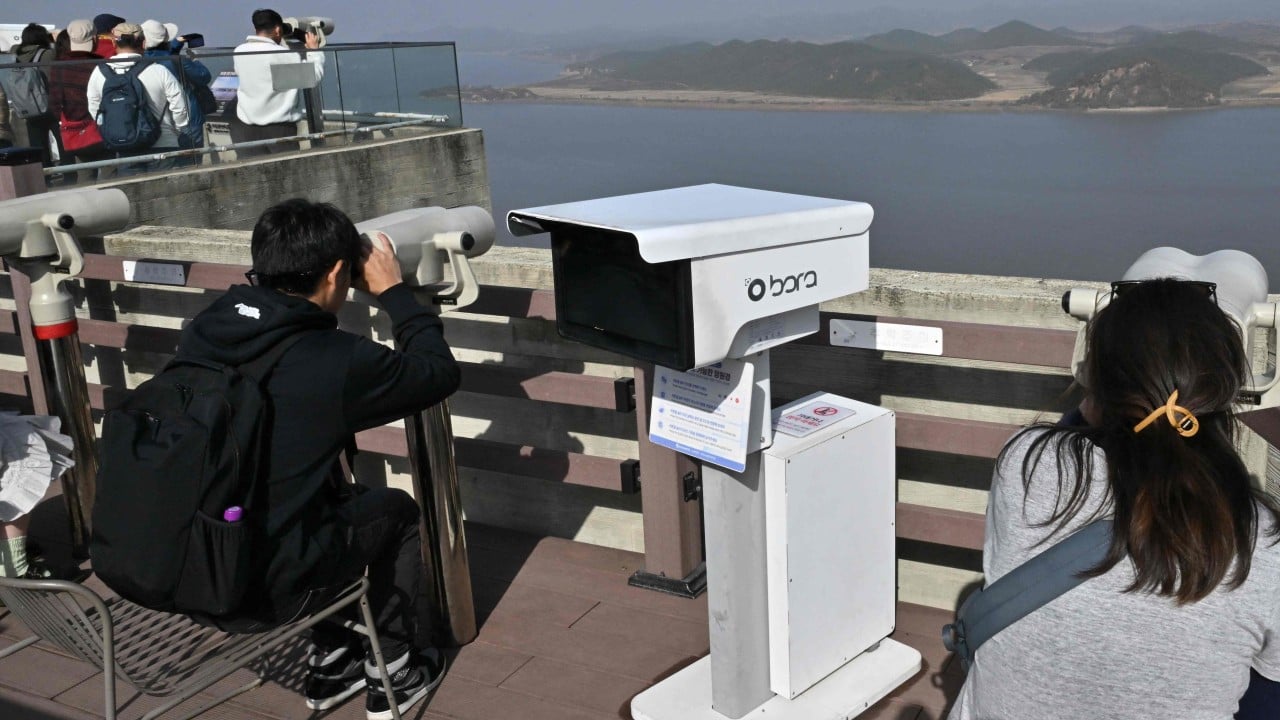
Coins drop.
The heavy brass mechanism inside the mounted binoculars clunks open, releasing a shutter that reveals a strip of land two miles away, where gray concrete bunkers squat beneath a pale autumn sky. A child in a bright yellow puffer jacket stands on her tiptoes to press her eyes against the rubber cups, her mother holding a paper cup of hot roasted barley tea just behind her, steam curling upward into the crisp November air of Gimpo. For another perspective, check out: this related article.
They are not looking at a bird sanctuary. They are not looking at a historic fortress. They are part of the tens of thousands of visitors who have surged into the Aegibong Peace Eco Park, a sprawling, architecturally sleek complex perched on a ridge just south of the Han River estuary, hoping to catch a glimpse of a North Korean missile launcher or artillery battery parked across the water.
Wait. Related coverage on this trend has been published by Associated Press.
Think about that image for a moment.
Families packing thermos flasks, school groups wearing matching baseball caps, and retired couples adjusting their hiking poles—all queuing patiently at an observation deck to stare at instruments designed for their own sudden obliteration. When news broke that visitor numbers at this specific border outpost had skyrocketed following the public display of North Korean military hardware along the northern riverbank, standard news reports treated it as a curious geopolitical footnote. A weird weekend trend. A quirky spike in dark tourism.
They missed the point entirely.
To understand why thousands of ordinary people are willingly driving north toward the edge of the world's most heavily fortified border just to squint at the machinery of war, you have to strip away the sterile vocabulary of defense analysts and look directly at the human nervous system. Living on the Korean Peninsula means living with a low-grade, chronic existential hum that never quite turns off. For decades, the threat from the north has been an abstraction—a series of grainy state-media photographs, late-night emergency text alerts that make your phone shriek on the nightstand, and televised trajectories drawn over maps of the East Sea.
When a danger remains invisible, the mind builds monsters far larger than reality.
The Architecture of a Strange Pilgrimage
I remember the first time I stood along that southern ridge, years before the sleek new glass-and-concrete observatory replaced the old military lookout post. Back then, the air smelled strictly of damp earth, diesel exhaust from passing patrol trucks, and sharp river wind. You could hear the propaganda broadcasts drifting across the water like a scratchy radio station from another century, voices distorted by distance and humidity. Even then, standing near the razor wire, the overwhelming sensation wasn't terror. It was a bizarre, grounding clarity.
Today, the Aegibong Peace Eco Park has transformed that raw frontier into something closer to a minimalist museum. Visitors walk up a gentle, zigzagging wooden ramp designed to mimic the winding path of reconciliation, passing tranquil gardens and exhibition halls before reaching the Jogang Observatory. From there, across a stretch of brackish water barely 1.4 kilometers wide at its narrowest point, lies Kaepung County in North Korea.
Consider a hypothetical visitor—let’s call him Min-jun, a forty-two-year-old software engineer from Incheon who brought his aging father here on a crisp Saturday morning. Min-jun spends his weekdays debugging code in a climate-controlled office tower, insulated from the physical world by glass and fiber optics. To him, North Korea is usually nothing more than a dip in the KOSPI index or a headline he swipes past while waiting for his morning espresso.
His father, however, remembers the air-raid drills of the 1970s, when sirens wailed across Seoul and schoolchildren crouched beneath wooden desks with their hands over their ears.
When Min-jun and his father step up to the glass wall of the observatory, the abstraction collapses. Through the high-powered lenses, the grey smudge on the horizon resolves into sharp, unmistakable geometry. You can see individual farmers walking along dirt embankments. You can see clusters of low-slung, whitewashed propaganda villages. And, on the days when Pyongyang chooses to flex its muscles along the river mouth, you can see the angular silhouettes of mobile launchers, radar arrays, or fortified artillery emplacements peeking out from behind earthen berms.
Why does seeing the weapon make people feel better, rather than worse?
Psychology offers a straightforward analogy. Imagine hearing heavy footsteps pacing outside your bedroom door in the pitch dark. Your heart hammers; your imagination conjures an intruder armed with anything and everything. Now imagine turning on the hallway light and looking through the peephole. The threat hasn't vanished—the person is still standing there—but the paralysis of the unknown evaporates the instant your eyes register exact dimensions, distance, and posture.
Psychologists call this cognitive mastery: the deep human urge to convert an amorphous, uncontrollable dread into a concrete, observable object. By driving to the border, paying a modest entrance fee, and looking directly at North Korean military hardware, South Korean citizens are reclaiming agency over their own fear. They are refusing to be passive recipients of scary headlines.
Coffee at the Edge of the Abyss
There is another layer to this phenomenon that outsiders often struggle to grasp, a uniquely Korean blend of hyper-modern normalcy layered directly atop unresolved historical trauma.
Not far from the observation decks along the Demilitarized Zone, commercial life refuses to yield an inch. Cafes serve single-origin pour-overs and matcha lattes within literal mortar range of northern guard posts. Tourists snap selfies with peace signs raised, framing the desolate hills of Hwanghae Province over their shoulders like an exotic travel backdrop. In fact, the surge in attendance at Aegibong coincided with the opening of major global coffee franchises and upgraded cultural spaces inside the security zone—a deliberate, almost defiant assertion that daily life, commerce, and leisure will outlast the cold concrete of the division.
It is easy for a foreign observer to look at a tourist sipping an iced Americano while peering at a ballistic missile transporter and label it absurd, even callous. That judgment misses the quiet resilience baked into the act.
For more than seventy years since the 1953 armistice halted active fighting without ever producing a formal peace treaty, South Koreans have perfected the art of compartmentalization. You have to. If you spent every waking hour dwelling on the fact that tens of thousands of artillery tubes are aimed at the greater Seoul metropolitan area—home to roughly half the country’s fifty-one million people—you would never build a subway system, never launch a satellite, never raise a child, and never plant a garden.
Yet compartmentalization carries a hidden cost. Over decades, numbness sets in. Younger generations in South Korea increasingly view unification not as a sacred emotional destiny, as their grandparents did, but as an expensive, complicated geopolitical headache. The border fades into white noise.
Then, something shifts on the northern riverbank.
Whether triggered by shifts in regional alliances, weapons testing cycles, or deliberate psychological signaling from Pyongyang, the sudden appearance of recognizable military hardware so close to the southern shoreline breaks through the apathy. When North Korea positions heavy weaponry or mobile launchers within plain sight of civilian observation decks, it is rarely an accident. In the theater of deterrence, visibility is a message. Pyongyang knows the lenses are pointed north. They know the photographs taken through those tourist binoculars will circulate on South Korean social media within minutes, sparking debate on evening news panels from Busan to Daejeon.
And so, a strange, silent dialogue unfolds across the water.
One side wheels out the steel to project strength and induce anxiety. The other side responds by turning the moment into a weekend family outing, complete with souvenir keychains and steaming bowls of noodles at the park cafeteria.
The Weight of What You Cannot See
Still, standing at that railing, the vulnerability is real. Anyone who claims to feel completely indifferent while looking at a weapon built to cross that narrow stretch of water in seconds is lying.
I confess that the last time I watched people crowd around the viewing scopes near the estuary, my own reaction swung wildly between admiration and unease. Watching a grandmother explain the geography of her lost childhood home to a distracted teenager pulls at your chest. Watching a group of twenty-somethings laugh and pose for a group photo while a military patrol boat cuts a white wake across the disputed maritime boundary feels jarring, almost surreal.
We want clean categories. We want war zones to look like war zones—sandbags, camouflage netting, grim-faced correspondents speaking in hushed tones. We want tourist parks to look like tourist parks—picnic blankets, ice cream stands, harmless scenery.
The Korean border refuses to grant us that comfort. It forces the sacred and the mundane, the lethal and the trivial, into the exact same frame.
Think about what happens to a person's perspective after they make that trip. Before visiting, the peninsula’s standoff feels like a chess game played by distant leaders in suits—a sterile sequence of sanctions, summits, and missile launches. After standing on that ridge, smelling the river mud, and seeing how shockingly narrow the water actually is, the stakes become visceral. You realize that the distance between peace and catastrophe isn't measured in abstract diplomatic frameworks. It is measured in meters. You can see the trees sway on the other side. You can see the glint of sunlight off a windshield or a polished metal casing.
Let’s return for a second to our hypothetical father and son, Min-jun and his dad, walking back down the wooden ramp as the late afternoon sun dips toward the Yellow Sea, turning the mudflats into sheets of hammered copper.
They haven't solved the nuclear crisis. They haven't altered the balance of power on the Korean Peninsula by a single millimeter. Min-jun still has to go back to his desk on Monday morning, and the launchers across the river—whether visible that afternoon or tucked beneath camouflage netting—remain part of the region's unforgiving reality.
Yet something subtle has changed inside both of them. The monster in the dark hallway has been seen in full daylight. The older man sees that his son finally understands the physical reality of the line that has defined their family’s entire modern history. The younger man carries home a sharper, less theoretical appreciation for the fragility of the ordinary life he takes for granted.
The Last Clunk of the Shutter
Near closing time at the park, the crowds begin to thin out. Tour buses idle in the lower parking lot, their headlights cutting through the gathering dusk as guides wave bright orange wands to herd stragglers aboard. Up on the ridge, the wind picks up off the river, carrying the sharp, metallic chill of approaching winter.
A single visitor lingers by the far railing, feeding one last coin into the brass binoculars.
Through the glass, the northern hills are dissolving into indigo shadow. The outlines of the bunkers, the dirt roads, and the distant machinery blur together until the landscape looks entirely unbroken, just one continuous stretch of ancient Korean earth sloping down to meet the tide.
Then the timer runs out.
Inside the housing, the metal shutter snaps shut with a sharp, final click, plunging the lens into total darkness—leaving the watcher staring at nothing at all, except their own faint reflection in the glass.


