The envelope feels heavier than it has any right to be.
If you have ever stood at a kitchen counter in late October, holding a thick, creamy cardstock ballot with your own name printed cleanly across the top, you know that specific weight. It smells faintly of fresh ink and municipal bureaucracy. For millions of naturalized citizens, that piece of paper is not merely a civic chore; it is the final receipt for a journey that often took decades, thousands of dollars in legal fees, and sleepless nights memorizing the branches of government.
Now, picture a different kitchen table. Let us call the woman sitting there Elena—a hypothetical composite drawn from the thousands of newly naturalized Californians whose lives intersect with the machinery of state voter rolls every election cycle. Elena took her oath in a crowded convention center in Los Angeles three years ago. She cried when she was handed her miniature flag. She registered to vote at the Department of Motor Vehicles the following Tuesday, checking the box that affirmed her newly minted citizenship.
Yet in the high-stakes legal battle that just reached a sudden, quiet end in Washington, Elena’s name—or a name remarkably like hers—sat at the center of a constitutional tug-of-war.
When the United States Supreme Court swiftly rejected an emergency effort backed by Donald Trump and his allies to target alleged noncitizen voters on California’s rolls, the headlines were brisk, clinical, and almost entirely devoid of pulse. Legal analysts noted the lack of noted dissents. Pundits tallied it as another procedural skirmish on the shadow docket.
They missed the real story.
Behind that terse, unceremonious refusal by the nation’s highest court lies a profound collision between two competing visions of American democracy: one that treats the voter roll as a fragile, sacred ledger requiring painstaking accuracy, and another that treats it as a suspect list to be purged with a broad brush on the eve of an election.
The Anatomy of a Shadow Docket Rejection
To understand why the Supreme Court moved with such striking speed—and why that speed matters so much—you have to look at the mechanics of emergency litigation.
When litigants ask the Supreme Court to intervene on an emergency basis, they are not asking the justices to write a sweeping, fifty-page treatise on constitutional history. They are asking for a brake pedal. They want the Court to freeze the status quo, halt a lower court’s ruling, or force a state to alter its election administration while the clock ticks relentlessly toward Election Day.
In this instance, the push targeted California’s voter registration lists, rooted in recurring claims that noncitizens had improperly ended up on the rolls and needed to be aggressively investigated, flagged, or removed. California election officials, alongside civil rights organizations, pushed back hard. They pointed out what election administrators across the country have testified to for years: voter roll maintenance is not a sledgehammer operation. It is watchmaking.
Lower federal courts had already declined to grant the sweeping, last-minute relief sought by the challengers. By the time the emergency application landed on the desks of the nine justices, the legal architecture was clear. The challengers were asking the federal judiciary to override state election procedures without hard, systemic evidence of widespread noncitizen voting, and to do so dangerously close to the casting of ballots.
The Supreme Court said no. Quickly. Quietly. Without a single justice publicly breaking ranks to write a dissent.
Silence from the Supreme Court is rarely accidental. When nine deeply divided jurists—justices who regularly spar over administrative law, executive power, and voting rights—decline to even note a disagreement on an emergency application, they are sending an unmistakable signal. The legal theory didn't just fall short; it failed to clear the basic threshold required for emergency intervention.
Why Database Matching Is an Illusion of Precision
Why do these lawsuits keep happening, and why do they sound so plausible at first glance?
On the surface, the argument seems intuitive. Why not just cross-reference the DMV database with the voter rolls, pull out anyone who was ever listed as a noncitizen, and scrub them from the list? If you have never worked inside data management or election administration, that sounds like common sense. Clean the list. Protect the vote. Simple.
Except human lives do not update in real time across government servers.
Consider the metaphor of a digital echo. When an immigrant applies for a driver’s license in California as a lawful permanent resident—a green card holder—the DMV records their status at that exact moment in time. Two years later, that person passes their naturalization exam, takes the oath of allegiance, and becomes a United States citizen. They register to vote.
If an outside group or an aggressive audit compares an older snapshot of DMV records against a current voter roll, that newly minted citizen triggers a false alarm. On a spreadsheet, they look like an anomaly. In reality, they are an American exercising their most fundamental right.
I have spent years watching how administrative errors cascade through ordinary people's lives. Once a government database flags you as suspect, the burden of proof quietly shifts onto your shoulders. You do not get a phone call apologizing for a clerical mismatch. You get a letter written in dense legalese warning you of potential criminal penalties, or you show up at a polling place on a Tuesday morning after dropping your kids at school, only to be told your name is missing or provisional.
Data is stubborn. Bureaucracy is slow.
When federal law—specifically the National Voter Registration Act of 1993—establishes a "quiet period" banning systematic voter purges within ninety days of a federal election, Congress was not trying to protect fraud. Lawmakers were recognizing a hard, historical truth: rushed purges right before an election inevitably catch eligible citizens in the net, leaving them zero time to fix the mistake before the polls close.
The Invisible Weight of the Purged Name
Let us return to Elena at her kitchen table.
In a hypothetical scenario where the Supreme Court had granted the emergency request, California county registrars would have been thrust into chaos. Across fifty-eight counties—from densely packed urban centers like Los Angeles and San Diego to sprawling agricultural valleys in the north—officials would have been forced to divert staff away from ballot security, poll worker training, and signature verification to conduct rushed, eleventh-hour reviews of flagged names.
And what happens to the voters caught in that dragnet?
For a naturalized citizen, receiving an official notice questioning their right to vote carries a unique, chilling weight. Many come from countries where challenging the state is dangerous, or where bureaucratic errors can derail a family’s entire future. Even when a citizen has done nothing wrong, the mere suggestion that they might be investigated for illegal voting is often enough to make them quietly fold up their ballot, leave it on the counter, and stay home.
That is the invisible cost of aggressive voter-roll challenges. You do not need to successfully remove a million people from the rolls to alter the shape of an electorate. You only need to introduce enough friction, enough fear, and enough administrative static that eligible citizens decide the risk isn't worth the trip to the ballot box.
History offers grim reminders of how this works. For decades in the American South, administrative hurdles—literacy tests, poll taxes, impossible registration windows—were defended in the sterile language of "ballot integrity" and "clean rolls." The rhetoric was always polite, always procedural, always framed around preventing hypothetical abuse. Yet the lived reality was exclusion.
Today, the tools are algorithmic rather than handwritten, and the battlegrounds are spreadsheets rather than county courthouse steps. But the underlying tension remains identical.
What the Law Actually Demands
It is entirely reasonable for Americans to want secure elections. Admitting that does not concede ground to conspiracy theories; it simply acknowledges a shared civic baseline. Every legitimate vote should count, and no ineligible ballot should dilute it.
The question has never been whether voter rolls should be maintained. They must be. People move, people pass away, and occasionally, clerical errors occur. California, like every other state, conducts ongoing list maintenance, cross-checking death records, change-of-address forms, and citizenship attestations, while referring genuine instances of double voting or ineligible registration to prosecutors.
The real dispute—the one the Supreme Court just refused to indulge—is about evidence and timing.
In American courts, extraordinary remedies require extraordinary proof. You cannot walk into a federal courthouse weeks before an election armed with speculation, flawed data matches, or sweeping generalizations about a state of nearly forty million people, and demand that judges rewrite election rules on the fly.
When the justices rejected the Trump-backed bid targeting California’s rolls, they were upholding a principle older than any modern political movement: the rule of law runs on facts, not volume. Lower courts had looked at the record and found it wanting. The Supreme Court saw no reason to rescue a failing argument from its own evidentiary weight.
A Quiet Verdict on Who Belongs
There is something strangely fitting about the fact that this decision arrived not with dramatic fanfare, but as a brief, unremarkable line on an order list.
Democracy rarely survives on grand speeches alone. More often, it survives in the unglamorous, procedural moments when institutions hold their ground against the pressure to panic. It survives when a county clerk refuses to toss out a registration without verifying the facts. It survives when a federal judge demands actual proof before disenfranchising a citizen. And it survives when the Supreme Court declines to turn an emergency docket into a political weapon.
Think back to that thick cardstock ballot sitting on a kitchen counter in California.
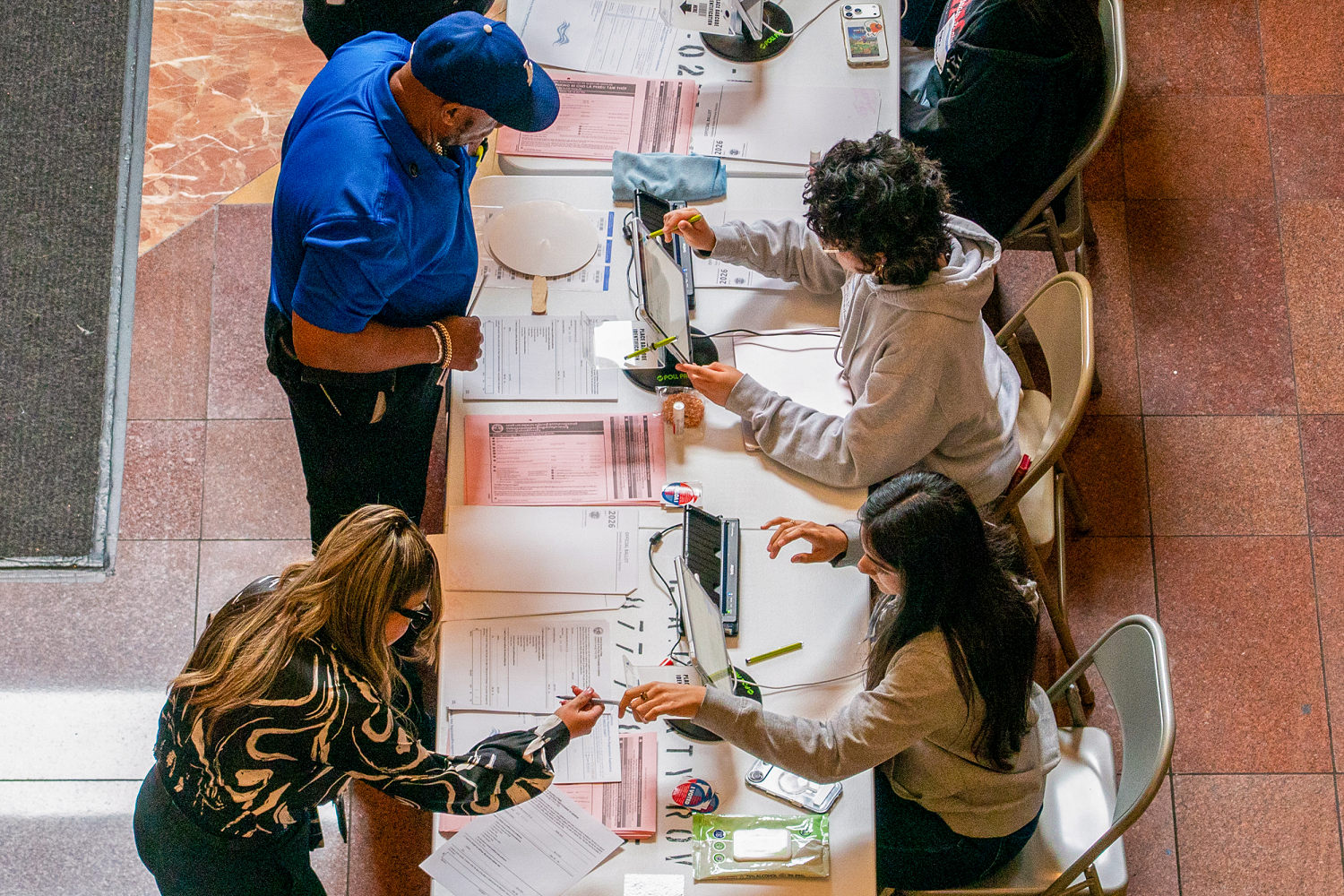
Tomorrow morning, millions of people will fill in those ovals with black ink, slide the paper into a return envelope, sign their name across the back, and drop it into a blue mailbox on their way to work. Most of them will never read a Supreme Court order list. They will never know the names of the lawyers who argued over their registration status, or the docket numbers attached to the briefs filed in Washington.
They will simply trust that when they followed the rules, kept their receipts, and raised their right hand to swear an oath to the Constitution, their name stayed right where it belonged.