A Ghost in the Fog
Stand on the high granite ridges of Dartmoor, and the wind will try to peel the coat right off your back. It is a harsh, raw expanse in Southwest England, swept by Atlantic storms that crash against the coastline and roll inland, heavy with saltwater and vapor.
Most people picture England as a place of manicured hedges, rolling green pastures, and cobblestone lanes. They think of polite rain, the kind that calls for a cup of tea. But there is a different kind of rain here. It drops through a dense, dripping canopy of ancient oak, soaking into thick carpets of pale green lichens that hang from tangled branches like long, gray beards.
This is the temperate rainforest of the United Kingdom.
It is a habitat far rarer than its tropical cousins in the Amazon. Centuries ago, these damp, misty woods stretched continuously along the Atlantic margins of Europe, covering vast swaths of Britain, Ireland, France, and Spain. Today, after centuries of overgrazing, timber extraction, and agricultural expansion, less than one percent of that original damp woodland remains. What left is shattered into tiny, isolated fragments clinging to steep valleys where sheep could not easily graze.
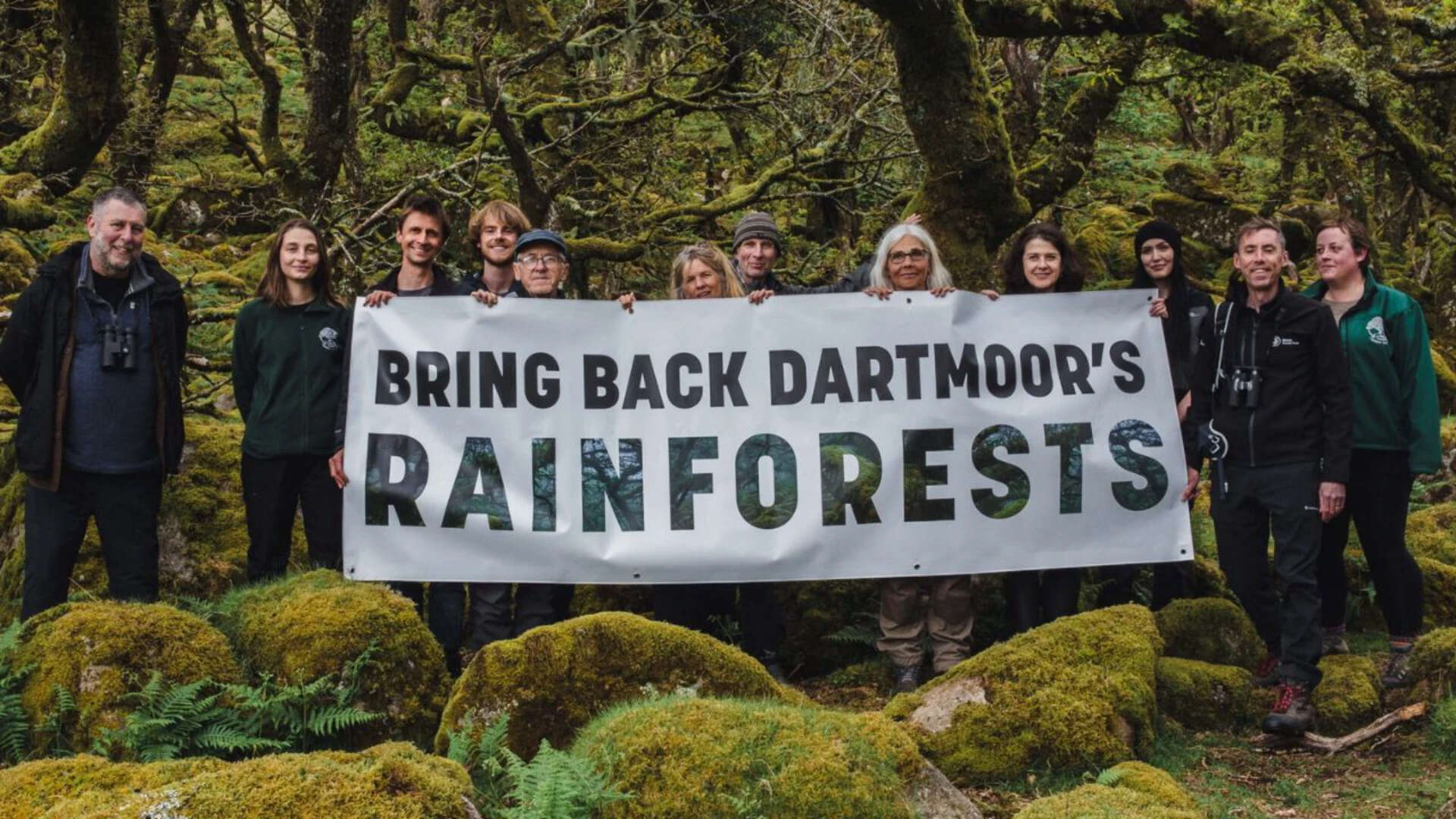
If you walk through one of these surviving pockets, like Wistman’s Wood on Dartmoor, the air tastes different. Damp. Earthy. Electric. The ground underfoot feels like a giant, soaked sponge. It is a fragile relic of a prehistoric ecosystem, holding thousands of species of mosses, liverworts, and rare lichens that exist nowhere else on the planet.
And now, against all odds, the map is beginning to change.
The Weight of Inheritance
Managing land in the modern era is rarely about romantic ideals. It is a grimy, complex equation of economics, soil chemistry, and long-standing human habits.
For hundreds of years, the Duchy of Cornwall—a private estate established in 1337 to provide an income to the heir to the British throne—functioned like most agricultural holdings. It prioritized farming yields, tenant livelihoods, and standard timber production. But when ownership of the 130,000-acre estate passed to Prince William, the mandate shifted toward a longer, stranger timeline.
Land management usually operates on five-year political cycles or quarter-by-quarter financial reports. Forestry, however, demands a terrifying kind of patience. To plant an oak tree is to perform an act of faith for a human being you will never meet.
The Duchy recently set a target that sounds almost absurdly ambitious given the cramped geography of the British Isles: double the size of its remaining temperate rainforests.
To understand what that actually takes, you have to abandon the image of a royal cutting a ribbon with giant scissors. Expanding an ancient forest isn't as simple as driving a tractor into a field and planting rows of saplings. If you plant trees too close together, they starve each other of light. If you don't fence them, deer and livestock will chew the young saplings down to the mud in a single winter. If you don't connect the new trees to old growth, the delicate mosses and lichens—the actual living engine of the rainforest—can never cross the open gap to colonize the new bark.
It requires bridging the gap between old farming traditions and modern ecological survival.
The Microscopic Engine
To see why anyone would care about a dripping, tangled wood on a cold hillside, you have to zoom in close enough to get mud on your knees.
Metaphorically speaking, an ancient temperate rainforest functions like an ecological museum where all the exhibits are wildly alive and constantly trading favors. The oaks themselves are just the structural scaffolding. The real magic happens on the bark.
Consider string-of-pearls lichen. Or lungwort. These aren't decorative accents. They are tiny, living indicators of air purity and environmental stability. Lungwort looks like a piece of bright green, textured leather attached to the side of a tree trunk. When it gets wet, it turns brilliant emerald and begins fixing nitrogen from the atmosphere, pumping essential nutrients directly into the forest floor.
These organisms grow at a glacial pace—sometimes just a millimeter or two a year. They cannot simply fly across a five-mile gap of open, wind-scoured pasture. If an isolated patch of rainforest burns, or dies, or is cleared for timber, its unique ecosystem disappears completely because there is no neighboring haven close enough to seed a recovery.
The strategy currently unfolding across the Duchy's holdings in Devon and Cornwall is focused on creating ecological corridors. By planting native broadleaf species like sessile oak, birch, hazel, and rowan along river valleys and existing woodland edges, land managers are building biological bridges.
They are creating a continuous ribbon of damp shade.
When the trees grow, the humidity rises. When the humidity rises, the fog clings to the leaves instead of evaporating in the wind. And slowly, agonizingly slowly, the mosses creep forward.
The Human Equation
It is easy to cheer for trees from the comfort of a city apartment. It is much harder when those trees replace the pasture that has fed your family's cattle for four generations.
This is where ecological projects so often fail. They treat human beings as an unwanted intrusion rather than an active part of the landscape. Farmers in the West Country have spent centuries clearing scrub, draining wetlands, and keeping the wilderness at bay. It was hard, honorable work, encouraged by governments and driven by the necessity of feeding a nation.
Telling a tenant farmer to suddenly let the scrub return can feel like asking them to abandon their heritage.
The turnaround happening in Cornwall and Devon relies on a fundamental shift in perspective. Instead of viewing grazing livestock as the enemy of the forest, conservationists and estate managers are turning to precision agriculture and managed grazing.
Imagine a small herd of native Belted Galloway cattle roaming through the fringes of a expanding woodland. In controlled numbers, these heavy, hardy animals do something miraculous. They crush aggressive bracken fern with their hooves, creating small patches of bare soil where native tree seeds can catch the wind and take root. Their dung fertilizes the soil, bringing back dung beetles, which in turn feed bats and birds.
The farmer is no longer just a producer of beef. They become a cultivator of microclimates.
The financial structure must match the ecological ambition. Through revised tenancy agreements, public grants, and long-term estate support, the economic risk is shifted away from the individual tenant. When restoring a hillside becomes as financially viable as stocking it with sheep, the cultural resistance melts away into the damp ground.
The Cold Logic of Water
There is a pragmatic, almost cold efficiency to bringing back these woods, one that extends far beyond species preservation or royal legacy.
It comes down to water.
The rivers that fall out of the high moors—the Dart, the Tamar, the Fowey—are prone to sudden, violent flash floods. As climate patterns become more erratic, winter downpours smash into bare, compacted sheep pastures and immediately rush downhill. They carry tons of topsoil with them, blowing out riverbanks, swamping lowland villages, and dumping agricultural runoff straight into the sea.
A temperate rainforest acts as a massive hydraulic brake.
When heavy rain hits a dense canopy, the leaves break the kinetic force of the water. The thick layers of moss, fallen leaves, and complex root networks absorb the deluge like a deep, natural reservoir. Studies show that soils beneath ancient broadleaf woods can absorb water at rates up to sixty times faster than soils under heavily grazed pasture.
The forest holds the storm. It releases the water slowly, over weeks instead of hours, filtering it through yards of organic matter before it ever reaches the river channel.
downstream towns don't flood as often. The water running out of the tap in a village miles away is cleaner, requiring fewer chemical treatments. The riverbed remains stable enough for Atlantic salmon to lay their eggs in the gravel.
Restoring the forest isn't a retreat from modern life. It is critical infrastructure, built out of timber, moss, and rain.
The Long View
If you stand today on a newly set-aside plot of Duchy land, you will not see a majestic cathedral of green.
You will see modest green plastic tubes protecting fragile saplings no taller than your waist. You will see muddy ditches, muddy boots, and wet fences stretched across open hillsides. You will hear the sharp wind whipping through dry winter grass.
It looks underwhelming. Real restoration always does at the beginning.
There are no shortcuts in this work. You cannot algorithmically accelerate the growth rate of an oak tree, nor can you command the delicate lungwort to spread any faster than its natural pace. The people driving the fence posts into the cold earth today will likely never see these woods reach their full, dripping glory. They are working for the benefit of eyes that have not yet opened.
But if you look closely at the base of an old, gnarled oak at the edge of the existing reserve, where the new saplings have been planted, you can see the future taking shape.
A tiny tongue of bright green moss is reaching out across a patch of damp, newly protected soil. It moves without noise, without haste, taking ground that was lost centuries ago. The fog comes rolling in from the Atlantic, thick and dark, smelling of sea salt and old earth. The young trees bend slightly in the draft, catch the mist on their bark, and hold on.