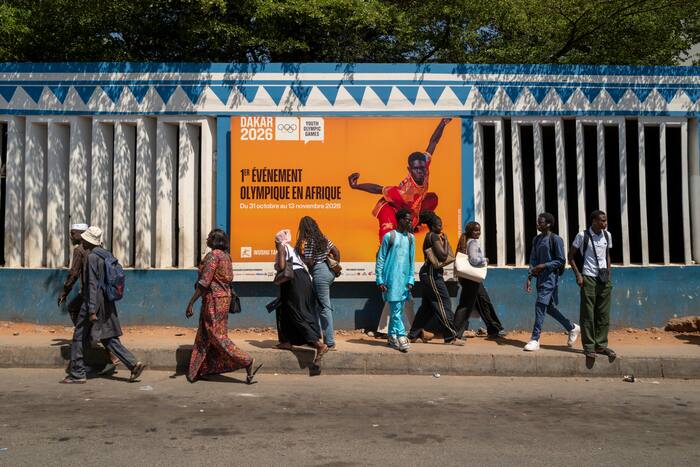
Senegal is hosting Africa’s first Olympic event—the 2026 Youth Olympic Games—while millions of its citizens struggle to afford basic groceries, housing, and electricity. Dakar won the bid in 2018 with a promise to showcase a rising, modern West Africa, yet global inflation, soaring public debt, and domestic political upheaval have transformed a celebratory milestone into a high-stakes financial gamble. As construction crews finalize venues across Dakar, Diamniadio, and Saly, everyday Senegalese households are asking a blunt question about whether prestige on the global stage justifies austerity at the kitchen table.
The friction is visible on the streets of the capital. Just miles from newly paved highways and refurbished sporting complexes, open-air markets tell a different story of economic strain. The price of broken rice, cooking oil, sugar, and imported wheat has climbed steadily over the past several years, squeezing working-class budgets to their breaking point. For a government led by President Bassirou Diomaye Faye and Prime Minister Ousmane Sonko—who swept into power in 2024 on an anti-establishment, populist platform promising economic sovereignty and relief for the poor—inheriting the Olympic bill presents an acute political paradox.
The Anatomy of a Cost of Living Squeeze
To understand the resentment simmering beneath the Olympic banners, you have to look at how an ordinary household in Dakar survives. Senegal imports a massive share of its staple food and energy requirements. When global supply chains fractured and commodity prices spiked earlier in the decade, the shockwaves hit West Africa with disproportionate force.
Wages did not keep pace. In the informal sector, which employs the overwhelming majority of Senegal's workforce, daily earnings remained stagnant while transport fares, rent in expanding suburbs, and utility bills crept upward. Even with periodic government price caps on essentials like rice and bread, enforcement in neighborhood shops remains inconsistent. Families have responded by cutting back on protein, pulling children from private schools, and leaning heavily on remittances sent home by relatives working in Europe and North America.
This economic anxiety fueled the historic political shift of 2024. Young voters—in a country where the median age is under twenty—demanded jobs, lower living costs, and an end to perceived state extravagance. They did not vote for shiny stadiums. They voted for affordable living.
Why Governments Chase Mega-Events Anyway
From the outside, pouring hundreds of millions of dollars into a sporting event during an inflationary crunch looks irrational. Inside the corridors of power, however, the logic is cold and calculated. Hosting an International Olympic Committee event is rarely about the two weeks of competition. It is an accelerated infrastructure play disguised as a sports festival.
Dakar 2026 was originally scheduled for 2022 before the pandemic pushed it back by four years. That delay proved both a blessing and a curse. It gave organizers extra time to build, yet it also exposed the project to years of compounding construction inflation and currency fluctuations.
The state’s strategic argument rests on three pillars:
- Forced Urban Modernization: Dakar is a crowded peninsula choking on traffic and outdated drainage. Linking the Olympic venues to Diamniadio—a futuristic satellite city built roughly 30 kilometers outside the capital—allows the government to justify massive spending on expressways, regional rail links, and modern utilities that would otherwise stall in bureaucratic limbo.
- Global Capital Signaling: Successfully executing an Olympic-sanctioned event tells international bondholders, multilateral lenders, and foreign corporations that Senegal is stable, capable, and open for business. In the eyes of finance ministries, that reputation lowers future borrowing costs.
- Tourism and Service Sector Expansion: By splitting events between Dakar, Diamniadio, and the coastal resort hub of Saly, planners aim to upgrade hotel capacity and position Senegal as a premier conference and leisure destination in Francophone Africa.
The math looks clean on a ministry presentation slide. On the ground, the return on investment is notoriously difficult to verify.
The Hidden Ledger of Olympic Infrastructure
Olympic budgets are famous for sleight of hand, and Dakar 2026 is no exception. Organizers frequently separate the operational budget—paying for security, athlete logistics, broadcasting, and event management—from the capital infrastructure budget, which covers roads, stadiums, and the Youth Olympic Village.
The International Olympic Committee contributes funding toward operational costs and youth programming, softening the direct blow to the treasury. Meanwhile, the Senegalese government absorbs the heavy lifting on physical construction, often relying on bilateral loans, public-private partnerships, and state-backed financing. When officials claim the Games are cost-effective because they rely largely on existing or already-planned facilities, they are technically telling the truth while obscuring the opportunity cost.
Every franc committed to renovating the Iba Mar Diop Stadium or building athlete housing at the University of Cheikh Anta Diop is a franc unavailable for rural health clinics, agricultural subsidies, or debt reduction. Consider a hypothetical example of how public budgets work under pressure. If a finance ministry has a fixed pool of borrowing capacity from international lenders, dedicating a major tranche of that credit to sports-related transit corridors means delaying water sanitation upgrades in secondary cities like Saint-Louis or Kaolack. The debt still sits on the national balance sheet, and taxpayers still service the interest long after the athletes fly home.
A New Administration Inherits an Old Promise
When Bassirou Diomaye Faye took office in April 2024, his administration immediately ordered comprehensive audits of public finances, extractive industry contracts, and major state projects initiated under former President Macky Sall. The reviews uncovered deeper fiscal deficits and higher public debt ratios than previously disclosed, forcing the new government to tighten spending and renegotiate terms with international financial institutions.
Canceling or drastically scaling back Dakar 2026 was never a realistic option. By 2024, contracts were signed, concrete was poured, and pulling out would have triggered catastrophic diplomatic fallout with the IOC while forfeiting sunk costs. Instead, the new leadership pivoted to damage control and rebranding.
Prime Minister Sonko and his cabinet framed the Games not as an elite vanity project, but as a pan-African triumph that must deliver tangible local value. Officials pressured contractors to prioritize Senegalese labor, emphasized the post-Games conversion of the Olympic Village into desperately needed student housing, and scrubbed budgets for obvious excesses. It is a delicate balancing act. The government must project total competence to international partners while convincing a skeptical, cash-strapped electorate that it is guarding every public franc.
What History Tells Us About the Olympic Hangover
Defenders of Dakar 2026 insist that the Youth Olympic Games are fundamentally different from the bloated Summer Olympics that bankrupted past hosts. They are right about the scale. The Youth Olympics feature roughly half the athletes of a full Summer Games, require no massive 80,000-seat flagship stadium, and actively discourage ostentatious spending.
Yet history offers sobering warnings for developing economies that host any tier of global mega-event.
- White Elephant Syndrome: Facilities built or upgraded to strict international federation specifications require specialized, expensive maintenance. Without a thriving domestic commercial sports league to fill seats every weekend, arenas rapidly deteriorate.
- Inflationary Spikes During Event Windows: The influx of thousands of international delegates, media personnel, and visitors temporarily drives up local prices for short-term rentals, restaurant food, and private transport, hitting local residents twice.
- The Post-Event Construction Cliff: Thousands of low-skilled construction jobs materialize in the frantic eighteen months leading up to the opening ceremony. The week after the closing ceremony, those jobs vanish overnight, leaving young laborers back on the street without permanent employment.
Senegal’s oil and gas production, which recently came online offshore, has been touted as the fiscal cushion that will rescue the national budget and subsidize living costs. Even there, expectations have outpaced reality. Significant hydrocarbon revenues take years to flow into state coffers after international energy companies recover their upfront exploration costs. The oil boom cannot pay today’s grocery bills, nor can it erase the immediate debt service on Olympic infrastructure.
The Real Measure of Success in Dakar
For the International Olympic Committee, Dakar 2026 is already a public relations victory. Bringing the Olympic rings to African soil for the first time fills a glaring historical void and taps into the youngest, fastest-growing demographic market on earth. The broadcast footage will be vibrant, the cultural ceremonies rich, and the athletic competition fierce.
For the baker in Pikine, the teacher in Rufisque, or the unemployed university graduate in central Dakar, the metrics of success have nothing to do with medal counts or international applause. They will judge Dakar 2026 by whether the new transit lines actually cut their daily commute in half, whether the promised student dormitories open on time without corruption scandals, and whether the state can prevent the Games from triggering another wave of debt-driven austerity.
Prestigious events can project the image of a prosperous nation to the outside world, but they cannot manufacture prosperity from thin air. Until Senegal’s economic growth translates into cheaper food, reliable jobs, and real purchasing power for the families living outside the security perimeter, the triumph of Africa's first Olympics will remain bittersweet on the ground.