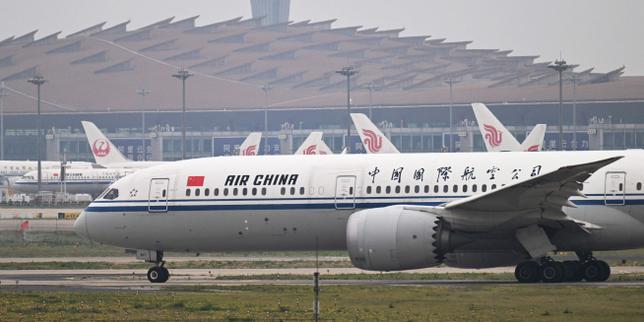
Boeing needed a knockout blow in Beijing to silence the skeptics and stop the bleeding. Instead, it got a polite tap on the shoulder.
When President Donald Trump stood before the cameras on May 14, 2026, and announced that Chinese President Xi Jinping had committed to ordering "200 big ones," the celebratory tone didn't reach Wall Street. Within hours, Boeing shares tumbled more than 4%. The math is simple and brutal. For months, the market had been whispering about a 500-aircraft mega-deal that would effectively clear out Boeing’s inventory and cement its return to the world's second-largest aviation market. By securing only 200 jets, the planemaker hasn't just missed a target; it has exposed the fragile reality of its recovery.
The Expectation Gap
The problem with political theater is that the audience usually knows the script. Ahead of this summit, the stage was set by Treasury Secretary Scott Bessent and a delegation of CEOs including Boeing’s Kelly Ortberg and GE Aerospace’s Larry Culp. Everything pointed toward a historic reconciliation that would see China resume its role as Boeing's primary growth engine.
Before the trade wars and the 737 MAX safety crises, China accounted for roughly 20% of Boeing's deliveries. Today, that figure has withered to about 2% of the undelivered backlog. Investors were looking for a "reset" order of 500 planes to bridge that chasm. When the actual number came in at less than half of that, the optimism evaporated. A 200-plane order is a survival ration, not a feast.
Leverage and the Airbus Shadow
Beijing is a master at using aircraft orders as diplomatic currency. This 200-jet commitment was less about aviation and more about the "fragile trade truce" struck last October. By keeping the order relatively small, China maintains its leverage. It knows Boeing is desperate to fill delivery slots, and it knows that Airbus is waiting in the wings.
The European rival hasn't been sitting still. Airbus already has a final assembly plant in Tianjin and has spent the last decade eating Boeing’s lunch in the narrowbody sector. For China, splitting the difference between the two manufacturers is a strategic necessity. It prevents a monopoly, ensures a steady supply for its own soaring travel demand—projected to require 9,000 new planes by 2045—and keeps both Washington and Brussels on their toes.
The Structural Weight of Reality
Beyond the headlines, Boeing is fighting a war on multiple fronts that no single order can win.
- Production Bottlenecks: Even if China had ordered 500 planes, Boeing’s ability to build and deliver them remains under intense scrutiny. Years of quality control issues and supply chain snags have left the company with a massive backlog of over 6,800 unfilled orders.
- Macroeconomic Headwinds: With oil prices hovering above $105 per barrel, airlines are becoming more cautious. The demand for "big ones"—the expensive widebody 777X and 787 Dreamliners—is sensitive to the cost of fuel and the health of global trade.
- The Certification Cycle: We still don't know the exact mix of these 200 jets. If they are mostly 737 MAX narrowbodies, it helps the cash flow but does little to prove Boeing can still dominate the high-margin widebody market.
A Meaningful Step or a Distraction
There is an argument to be made that any order from China is a victory. It’s the first major commercial commitment from Beijing in nearly a decade. For a company that has been effectively locked out of a critical market since 2017, 200 planes represent a foot in the door.
However, in the world of high-stakes aerospace, "better than nothing" is a dangerous mantra. The market's reaction reflects a deeper fear that Boeing's best days in China are behind it, replaced by a cycle of small, politically motivated crumbs that are granted or withheld based on the latest tariff dispute.
The summit in Beijing was supposed to be the moment Boeing reclaimed its crown. Instead, the company is left explaining why 200 planes—a number that would be a triumph for almost any other firm—is a disappointment. For Boeing to truly recover, it needs to stop being a pawn in trade negotiations and start being a manufacturer that can deliver on its promises without a presidential escort. The market has signaled that it is tired of waiting for the big breakthrough. It wants to see the planes on the tarmac, not just in a press release.