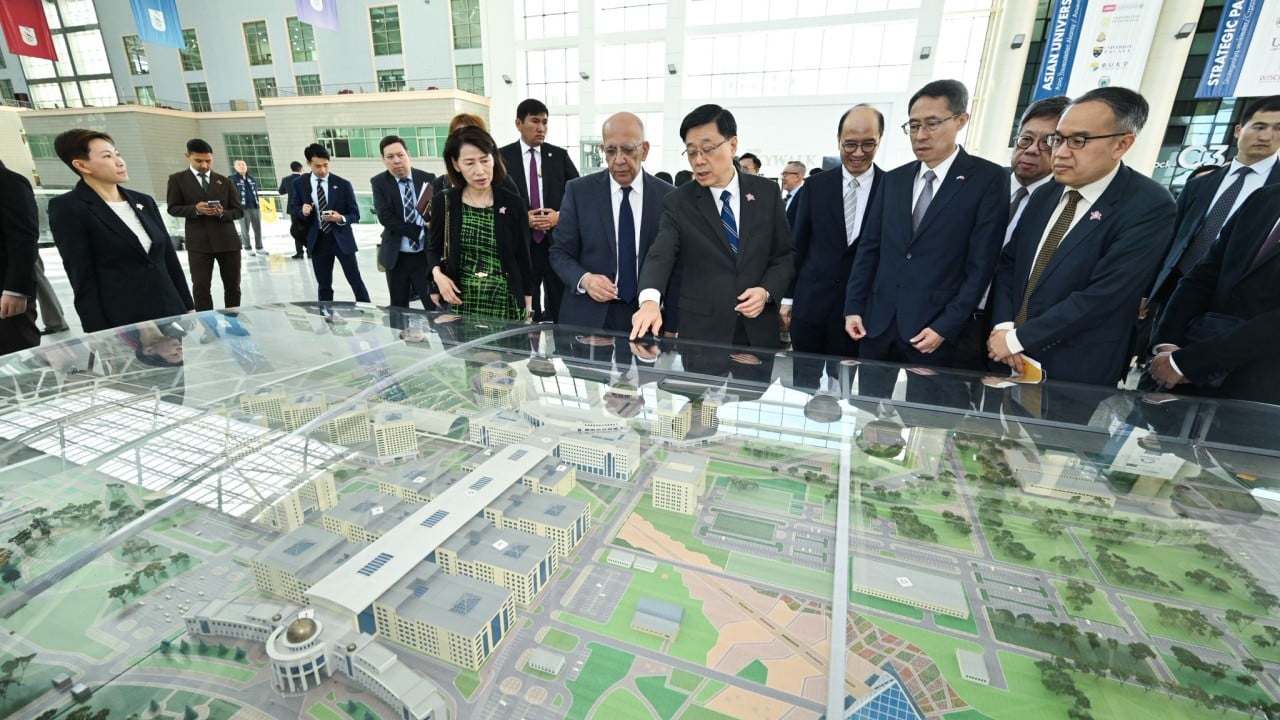
Hong Kong is shifting its economic weight toward the Eurasian steppe, serving as the financial conduit for mainland Chinese corporations seeking expansion into Central Asia. Chief Executive John Lee recently revealed that numerous mainland firms from a high-profile trade delegation to Kazakhstan and Uzbekistan are actively pursuing listings on the Hong Kong Stock Exchange (HKEX). This movement addresses a critical challenge for Chinese industry: circumventing Western sanctions and trade barriers by securing international capital in a friendly jurisdiction to fund expansion along the Belt and Road corridors.
This represents a structural realignment of Hong Kong's capital markets. As traditional Western investment flows dry up amid lingering geopolitical friction, the city is forced to redefine its value proposition. It is no longer just a gateway for global capital entering China. Instead, it is transforming into an external operational base for Chinese capital migrating outward to emerging frontiers.
The GoGlobal Task Force And The Search For Neutral Capital
Government press releases frequently highlight standard diplomatic phrases like "super-connector" relationships, but the operational reality involves a highly coordinated bureaucratic mechanism. The GoGlobal Task Force, established by the Hong Kong government, has quietly onboarded more than 200 mainland Chinese firms. Its purpose is to guide domestic companies through the regulatory and legal adaptations required to utilize Hong Kong as a launchpad for overseas operations.
The immediate objective focuses on initial public offerings (IPOs). Mainland enterprises, ranging from heavy equipment manufacturers to green tech operations and electric vehicle suppliers like Li Auto, faced structural limitations when relying solely on domestic onshore capital. Mainland stock exchanges in Shanghai and Shenzhen remain heavily insulated, subjected to strict capital controls and shifting regulatory priorities that can abruptly halt IPO pipelines.
Hong Kong offers an entirely different financial framework. The city maintains an open capital account, full convertibility of the Hong Kong dollar, and a legal system rooted in English common law.
For a mainland enterprise eyeing infrastructure or logistics contracts in Tashkent or Astana, raising capital in Hong Kong provides freely convertible currency. This capital can be deployed globally without navigating the bureaucratic labyrinth of China's State Administration of Foreign Foreign Exchange (SAFE). The recent delegation concluded 96 bilateral agreements and memorandums of understanding valued at more than $1.65 billion. These figures underscore a deliberate, state-backed migration of corporate operations.
Why Central Asia Needs The Pipeline
The economic dynamics of Central Asia are shifting rapidly. Nations like Kazakhstan and Uzbekistan are actively attempting to move beyond their historical reliance on extractive industries, such as oil, gas, and mineral wealth. They are looking to build domestic digital infrastructure, green energy grids, and localized manufacturing hubs.
The Infrastructure Deficit
To modernize successfully, these countries require vast amounts of foreign investment, a need that matches the strategic goals of Chinese planners. Consider the following structural alignments:
- Privatization Pipelines: Uzbekistan is currently executing a widespread privatization program targeting state-owned assets, including airports and major logistics networks.
- Asset Dual-Listings: These state enterprises require sophisticated international venues to list their shares, raise capital, and attract institutional investors.
- Capital Constraints: Local bourses, such as the Tashkent Stock Exchange or the Astana International Financial Centre (AIFC), lack the deep liquidity pools necessary to fund multi-billion-dollar infrastructure overhauls independently.
By connecting the HKEX with Central Asian regulatory frameworks, the Hong Kong government seeks to position the city as the primary offshore venue for these privatization efforts. This approach would allow central Asian state firms to raise funds from regional pools while offering mainland Chinese institutional investors direct access via existing stock connect mechanisms.
The Underside Of The Eurasian Pivot
This economic integration presents several complex challenges. The financial and operational realities on the ground in Central Asia contrast sharply with optimistic official statements.
+------------------------------------------------------------------------+
|                      THE EMANCIPATION OF CAPITAL                       |
+------------------------------------------------------------------------+
|  Mainland China Onshore               |  Hong Kong Offshore Platform    |
|  - Closed capital account             |  - Free capital convertibility  |
|  - Stringent capital outbound checks  |  - Unrestricted fund movement   |
|  - Direct regulatory oversight        |  - Common law framework         |
+------------------------------------------------------------------------+
Language barriers present an immediate practical obstacle. Corporate operations in Central Asia are heavily dependent on Russian and localized languages like Kazakh and Uzbek, creating friction for corporate entities accustomed to Mandarin or English-language compliance regimes.
Furthermore, currency volatility remains an ongoing concern. The Kazakh tenge and Uzbek som have historically experienced sharp fluctuations driven by commodity price shocks and regional geopolitical tensions. For a Hong Kong-listed entity reporting earnings in Renminbi or US dollars, managing balance sheet exposure across these volatile currencies requires advanced hedging instruments that local financial markets cannot easily provide.
Most critically, the banking infrastructure across portions of the Silk Road economic belt remains underdeveloped. Cross-border clearing mechanisms can be slow, expensive, and vulnerable to secondary compliance checks by correspondent Western banks wary of regional sanctions risks. This reality complicates the process of moving funds seamlessly between manufacturing sites in Samarkand, corporate holding companies in Hong Kong, and factories in Guangdong.
A Structural Realignment Born Of Necessity
The strategic shift toward Central Asia represents a practical pivot for Hong Kong. For decades, the city thrived by acting as a intermediary between Western institutional capital and high-growth Chinese tech and real estate firms. That specific business model faces structural headwinds. High interest rates in the United States, coupled with fundamental geopolitical shifts, have altered global capital allocation strategies.
Hong Kong cannot afford to wait for Western capital to return to its previous volumes. The city is actively diversifying its institutional base by looking toward markets that are structurally aligned with Beijing's foreign policy priorities.
This is not a temporary marketing campaign. It is a long-term economic realignment. By matching mainland China's industrial capacity with Central Asia's resource wealth and development needs, Hong Kong is attempting to build a self-contained financial ecosystem. This system operates outside the traditional boundaries of Western financial architecture, creating an alternative trade and funding network across Eurasia.