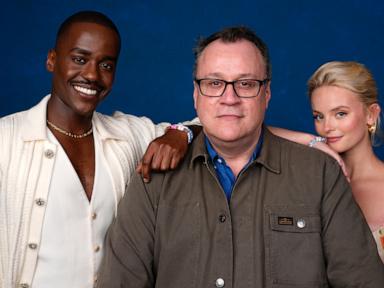
The BBC has effectively put Doctor Who into administrative hibernation, wiping the upcoming Christmas special from the television schedules and cutting ties with returning showrunner Russell T Davies. The official announcement, masked in the polite corporate language of a "competitive tender" process for the show's production rights, confirms the immediate departure of independent production house Bad Wolf and the cancellation of a festive broadcast that Davies now admits never actually existed. This sudden, structural unraveling comes just two semesters after the collapse of the co-production and international streaming distribution partnership with Disney Plus, leaving British broadcasting's most enduring flagship without a lead actor, an external financier, or a creative driver.
What appears on the surface to be a routine creative transition is, in reality, a systemic failure of modern television financing. The strategy to transform a quirky, fundamentally British public service asset into a global streaming powerhouse has backfired, leaving the intellectual property severely damaged and financially unsustainable in its current form.
The Phantom Christmas Special and the Ghost Script
The most damning revelation of the current crisis is not that the 2026 Christmas special was canceled, but that it was deployed as a corporate shield. When the financial lifeline from Disney Plus evaporated in October 2025 following poor international viewership numbers, the BBC assured anxious audiences that a brand-new festive episode written by Davies was locked into the pipeline.
It was a fiction. Davies broke the industry silence by admitting on social media that the special was a placeholder designed to project stability during a period of acute corporate panic. There was no script. No actors were ever approached. No production crew was booked.
Using non-existent programming to placate fans and stabilize brand equity highlights the sheer desperation behind the scenes. For a series that historically relied on the annual Christmas broadcast to anchor its linear television presence and drive merchandise sales, skipping the festive window entirely represents a massive operational retreat. It is a confession that the machinery required to build the show has completely ground to a halt.
The Streaming Empire That Failed
The roots of this collapse trace back to the 2022 deal that brought Disney money into Cardiff. The partnership was supposed to solve the chronic underfunding that always limited the show's visual ambitions when compared to American science fiction franchises. Instead, it introduced an irreconcilable conflict of institutional objectives.
The BBC needed a program that could justify its mandatory domestic license fee by appealing to a broad, multigenerational British family audience on Saturday nights. Disney required a high-concept, highly polished asset capable of driving global streaming subscriptions on a platform dominated by Star Wars and Marvel properties.
To satisfy international tastes, the production values skyrocketed, but the narrative identity suffered. The domestic audience, long accustomed to the charmingly domestic, eccentric tone of the series, shrank rapidly under the weight of American-styled narrative arcs and expensive, CGI-heavy spectacles. When the international viewing figures failed to meet the aggressive acquisition targets set by Burbank executives, Disney exercised its exit clause after just two seasons.
This left the BBC holding a franchise that had been structurally modified to cost millions of pounds per episode, but without the international partner required to foot the bill. The public broadcaster cannot fund a Hollywood-budget production on a domestic license fee budget that is frozen and under constant political threat.
The Poisoned Chalice of Continuity
Compounding the financial disaster is a creative deadlock that has made the lead role un-castable. Following the departure of Ncuti Gatwa in May 2025, industry talent agencies have increasingly viewed the central role of the Doctor as a professional dead end.
The final episode of the recent season concluded with a polarizing creative choice. Rather than transitioning to a new performer via the traditional narrative mechanism, the character regenerated into the likeness of Billie Piper, an actress inextricably linked to the show's 2005 revival.
This narrative choice has left the franchise stranded. A new showrunner taking over via the competitive tender process will not be inheriting a clean slate; they will be inheriting a tangled web of unresolved cliffhangers involving historical cast members, cosmic plots about a fictional "Reality War," and unresolved character threads.
| Metric | The 2005 Revival Era | The 2024-2026 Streaming Era |
|---|---|---|
| Primary Funding Source | UK License Fee / BBC Studios | Disney Plus Co-Production Deal |
| Production Model | In-House / BBC Wales Production | External Independent (Bad Wolf) |
| Target Audience | Domestic Linear Family Viewers | International SVOD Subscribers |
| Narrative State | Clean slate, minimal continuity baggage | Dense lore, active unresolved cliffhangers |
No top-tier television writer wants to spend their first two years resolving another creator's highly specific, abandoned storylines. The creative community recognizes that the expectations from an intensely fractured fanbase, combined with the microscopic media scrutiny unique to BBC institutions, offers plenty of risk with very little artistic upside.
The Tender Illusion
The decision to put the program out to competitive tender is being spun by management as an investment in the long-term health of the brand. It is an administrative necessity masquerading as strategy. Under the terms of the BBC's Royal Charter, major structural changes to long-running programming blocks require open commercial competition to ensure value for money.
By removing Bad Wolf from the equation and opening the floor to new production bids, the broadcaster is hoping an external media conglomerate will arrive with a fresh pool of capital and a magical solution to the distribution problem. But this hope ignores the realities of the 2026 entertainment market.
The streaming bubble has burst. Entertainment companies are aggressively scaling back external licensing deals, consolidating their intellectual properties, and cutting production budgets across the board. The idea that a major independent production group will eagerly bid for the right to make a highly complex, expensive sci-fi show where the BBC retains all the lucrative underlying intellectual property, global licensing, and consumer merchandising rights is financially naive.
The BBC wants an external partner to take on the production risk while keeping the commercial rewards for its commercial arm, BBC Studios. In the current economic environment, that is a remarkably tough sell.
A prolonged absence from the screen is now inevitable. Industry estimates suggest that navigating the legal technicalities of the tender process, appointing a new production company, hiring a creative team, casting a lead actor, and completing the extensive post-production work means the series will not return until at least 2028 or 2029.
The danger of this gap is structural decay. When a television show disappears from the public consciousness for half a decade, it loses its place in the cultural ecosystem. The production infrastructure in Wales, painstakingly built over twenty years, will disperse to other studio projects. The specialized writing, design, and special effects talent will move on.
The BBC succeeded in reviving the program in 2005 because the television world was still organized around linear channels and shared national viewing experiences. Trying to repeat that miracle in a completely fractured digital media ecosystem, while carrying the weight of a failed global expansion, is an entirely different proposition. The institutional will to keep the property alive exists, but the financial architecture to support it has completely collapsed.