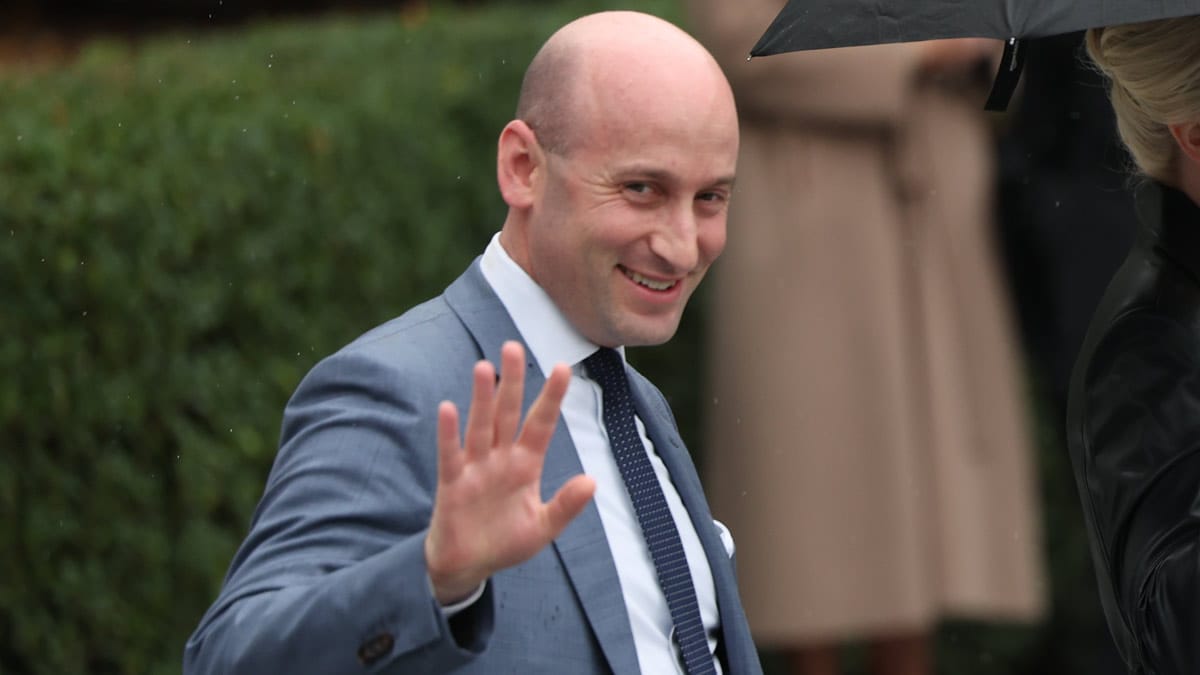
Donald Trump elevated Stephen Miller to the top ranks of his second-term White House operation for a single, overriding reason. Institutional loyalty now outranks traditional political management in the modern West Wing. By placing Miller at the center of policy execution and staffing control—even as Susie Wiles took the formal title of Chief of Staff—Trump dismantled the conventional model of presidential governance. Most mainstream commentary misses the actual mechanism at work here. The competitor's premise assumes a standard bureaucratic appointment, yet Trump did not hire a manager to mediate between competing factions. He installed an ideological enforcer to eliminate the friction that derailed his first four years in office.
To understand this shift, you have to look at the mechanics of the West Wing during the first Trump administration. Between 2017 and 2021, the role of Chief of Staff functioned like a revolving door. Reince Priebus lasted six months. John Kelly tried to impose military discipline on a leader who despises structure, lasting less than two years. Mick Mulvaney served in an "acting" capacity because Trump refused to commit to him fully, and Mark Meadows spent his tenure managing political crises rather than executing a coherent policy agenda.
Every one of those men shared a fatal flaw from Trump's perspective. They viewed the Chief of Staff role through the lens of traditional Washington institutionalism. They believed their job was to filter bad ideas, protect the president from legal exposure, and maintain lines of communication with Capitol Hill leadership and the permanent bureaucracy.
Trump viewed those guardrails as sabotage.
The Architecture of Frictionless Execution
When Trump returned to power, his primary objective was speed. He and his inner circle concluded that the first administration lost nearly two years simply figuring out how the levers of the federal government worked. Career civil servants slowed down executive orders. Cabinet secretaries hired deputies who quietly undermined White House directives. Legal counsels issued cautious memos that stalled aggressive action at the southern border and within federal agencies.
Stephen Miller spent four years outside government studying those exact failure points. Operating through his legal organization, America First Legal, Miller did not just file lawsuits against the Biden administration. He mapped the administrative state. He identified which statutory authorities a president could invoke unilaterally, which regulatory bottlenecks could be bypassed, and where career officials held structural choke points over policy implementation.
By elevating Miller to Deputy Chief of Staff for Policy and Homeland Security Advisor—a dual portfolio that gives him effective control over the domestic and national security machinery—Trump bypassed the need for a traditional Chief of Staff to serve as a policy gatekeeper. Susie Wiles manages the political calendar, donor relations, and the president's immediate orbit. Miller runs the machine.
This division of labor solves a problem that has plagued populist presidents for decades. Outsiders arrive in Washington promising radical disruption, only to find themselves captured by the very apparatus they swore to dismantle. Miller is not an outsider anymore. He is a veteran operative who knows how to use the rules of the federal bureaucracy to break its inertia.
Why Institutionalists Misread the Move
Political analysts in Washington routinely underestimate Miller because they evaluate him using outdated metrics. They look at his lack of executive management experience. They point out that he has never run a corporation, governed a state, or managed a sprawling federal department with tens of thousands of employees. In a conventional White House, a Chief of Staff or senior deputy needs those skills to keep the trains running on time.
That critique assumes the goal is smooth administration. It is not.
The goal is ideological alignment. In the first term, the White House Personnel Office operated largely independent of the policy shops, resulting in thousands of political appointees who were standard-issue Republicans rather than committed populists. When friction arose between the Oval Office and the agencies, those appointees sided with the agencies.
Miller's elevation ensures that personnel and policy are fused. Under this structure, an agency head cannot simply slow-walk an executive directive because the deputies sitting directly beneath them report—either formally or informally—back to Miller's policy apparatus. The traditional buffer between the president's rhetoric and the government's actual output has been stripped away.
Consider how executive orders are drafted. In a standard administration, a policy proposal travels from the White House to the relevant cabinet department, gets reviewed by agency lawyers, circulates through the Office of Management and Budget, and returns to the Oval Office weeks or months later, often watered down to survive judicial review.
Miller inverted that process. By drafting orders internally with a tight circle of loyalists before the cabinet agencies even see them, the West Wing presents federal departments with a fait accompli. The agencies are no longer asked whether a policy is feasible. They are told to execute it by Friday.
The Myth of the Moderating Influence
Every time a president makes a hardline appointment, pundits immediately begin speculating about who will serve as the "adult in the room" to moderate the administration's sharpest edges. During the first term, figures like Gary Cohn, H.R. McMaster, and James Mattis filled that narrative role for the press. They leaked their frustrations to reporters, signaling to Washington that they were quietly containing the president's impulses.
Trump hated those stories. To a leader whose entire brand is built on strength and total control, news coverage praising subordinates for restraining him is an existential insult.
Miller never leaked stories suggesting he was restraining Trump. He survived all four years of the first term—an almost unheard-of feat in a chaotic environment—because he mastered a specific art form. He took Trump's broad, often visceral political instincts and translated them into dense, legally defensible regulatory language.
When Trump spoke broadly about ending birthright citizenship or restricting asylum access, Miller found the obscure provisions in the Immigration and Nationality Act of 1952 to make those ideas actionable. He did not tell the president what he could not do. He figured out how to do it. That dynamic explains why Miller enjoys a level of trust that few other aides have ever achieved. He is an extension of the president's will, entirely devoid of competing political ambitions. He is not running for Senate. He is not angling for a lucrative corporate board seat. His entire career is tethered to the success of Trump's agenda.
The Historical Precedent Nobody Mentions
To find an accurate comparison for how this West Wing operates, you have to look past recent presidencies and examine the Nixon administration in 1973, or the early days of Franklin D. Roosevelt's New Deal.
When Roosevelt faced a entrenched federal bureaucracy that he suspected was hostile to his economic reforms, he did not rely on existing cabinet departments. He created parallel structures, staffed them with fierce loyalists, and concentrated power directly inside the Executive Office of the President. Similarly, Richard Nixon grew so frustrated with the State Department and the civil service that he consolidated foreign policy inside Henry Kissinger's National Security Council and attempted to centralize domestic control under H.R. Haldeman and John Ehrlichman.
In both cases, the consolidation of power inside the White House was a deliberate response to institutional resistance.
Miller's portfolio represents the modern evolution of that tactic. By combining domestic policy oversight with homeland security authority, his office sits at the intersection of almost every major priority of the administration. Trade tariffs, immigration enforcement, civil service reform, and federal regulatory rollbacks all pass through the same narrow bottleneck.
Critics argue this creates a massive single point of failure. When you eliminate dissenting voices inside the West Wing, you also eliminate the early warning systems that catch catastrophic policy blunders before they hit the public.
That is a legitimate risk. Without a strong Chief of Staff pushing back against unworkable timelines or flawed legal theories, an administration can easily overreach, triggering immediate injunctions in federal court or sparking a backlash in financial markets. The rollout of the first travel ban in January 2017—which Miller helped orchestrate without consulting the Department of Homeland Security or the Justice Department—remains the textbook example of what happens when speed takes precedence over interagency coordination. Airports descended into chaos, federal judges blocked the order within days, and the administration suffered a self-inflicted wound in its opening week.
The Gray Areas of Centralized Power
Acknowledging that risk does not change the underlying reality of why Trump made the move. From the president's vantage point, the danger of moving too fast and getting blocked by a judge is far preferable to moving slowly and accomplishing nothing.
If a federal court strikes down an aggressive executive action, Trump gets a political fight he can use to rally his base against "activist judges." If a cautious Chief of Staff kills the policy in a closed-door meeting before it ever sees the light of day, Trump gets nothing at all.
This is the fundamental disconnect between how political analysts view governance and how Trump views power. Analysts measure success by legislative durability, bipartisan consensus, and institutional stability. Trump measures success by disruption, dominance of the news cycle, and visible movement on his core promises.
Miller understands this calculus completely. He does not care if a policy triggers a three-year legal battle in the Ninth Circuit. In fact, forcing the courts to rule on expansive theories of executive authority is part of the long-term strategy. Even if half of those initiatives are eventually struck down, the administration permanently shifts the baseline of what is considered politically acceptable.
The Personnel Lever
The most consequential aspect of Miller's role has nothing to do with speechwriting or television appearances. It is his influence over Schedule F and the reclassification of the federal workforce.
In any administration, the president appoints roughly 4,000 political officials to oversee a civilian workforce of more than two million people. Those two million career employees enjoy strict civil service protections that make them nearly impossible to fire for policy disagreements.
During the final months of his first term, Trump signed an executive order creating a new employment category—Schedule F—for career officials in policy-making roles. Reclassifying those positions strips away their civil service protections, turning them into at-will employees who can be dismissed immediately if they resist White House directives.
Joe Biden rescinded the order on his first day in office, before it could be fully implemented. Bringing it back and actually executing it requires a level of bureaucratic ruthlessness that traditional White House Chiefs of Staff simply do not possess. A conventional manager worries about agency morale, union lawsuits, and the loss of institutional memory.
Miller views institutional memory as the enemy. Under his framework, replacing resistant career officials with pre-vetted ideological allies is not a secondary administrative task. It is the prerequisite for every other policy goal. If you control who stays and who goes inside the Department of Justice, the Department of Homeland Security, and the Office of Management and Budget, you do not need to micromanage daily operations. The bureaucracy polices itself.
What Happens When the Guardrails Vanish
The restructuring of the West Wing around loyalists like Miller and political operators like Wiles marks the end of an era in American politics. For decades, both parties operated under an unspoken agreement that the presidency required a certain degree of institutional restraint. Chiefs of Staff were chosen precisely because they possessed the stature to tell the president "no" and make it stick. James Baker did it for Ronald Reagan. Leon Panetta did it for Bill Clinton. Rahm Emanuel did it for Barack Obama.
Those days are gone.
By handing the policy reins to a hardliner who spent years preparing to dismantle the administrative state from the inside, Trump signaled that his second term would not be moderated by the office itself. The friction that defined his first four years—the leaks, the public disagreements with cabinet secretaries, the stalled executive orders—was not an accident of personality. It was a structural conflict between a populist president and an institutionalist staff.
Trump resolved that conflict by removing the institutionalists from the room. The West Wing no longer has a gatekeeper trying to protect the system from the president, leaving the federal bureaucracy to face an executive branch engineered entirely for unilateral force.



