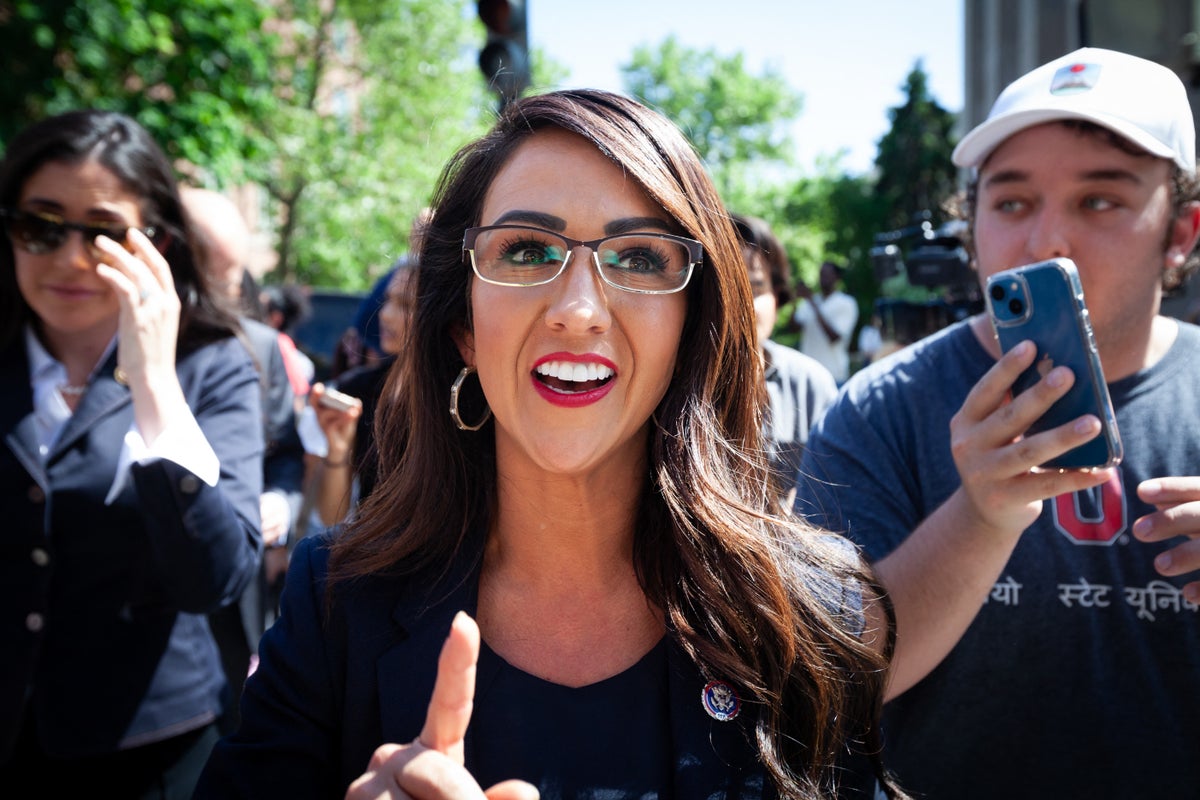
The political marriage between Donald Trump and Representative Lauren Boebert has hit a wall, exposing a fundamental shift in how power operates within the modern America First movement. While superficial headlines frame their recent friction as a standard primary campaign squabble, the reality cuts far deeper into the mechanics of congressional independence and executive retaliation. Trump openly called for a primary challenger to unseat Boebert in Colorado’s Fourth Congressional District, branding her weak-minded and a carpetbagger. This sudden, public rupture is not merely a flash-in-the-pan social media outburst. It is the direct consequence of a high-stakes legislative rebellion involving the Jeffrey Epstein federal files, fractured congressional alliances, and targeted executive pushback.
For years, Boebert operated as one of Trump’s most reliable legislative gladiators. Yet, the friction turned into an open civil war when Boebert defied the president to campaign for Representative Thomas Massie in Kentucky. Trump had vowed to purge Massie from the party due to the Kentucky congressman's repeated defiance on major spending bills and foreign policy. When Boebert flew to Kentucky to stand alongside Massie, Trump reacted with swift fury, publicly offering his coveted endorsement to anyone willing to jump into the Colorado primary against her.
Boebert quickly brushed off the threat, stating her primary position was locked in. Strategically, she is correct on the immediate calendar. The candidate filing deadline for Colorado’s June 30 primary has already passed, meaning she faces no formal Republican challenger on the ballot. However, treating this as a simple scheduling fluke misses the broader, more volatile narrative. The breakdown between the president and the firebrand congresswoman reveals a major shift where absolute personal loyalty is colliding with ideological purity.
The Epstein Files and the Fracture of Loyalty
The breaking point did not happen overnight in Kentucky. The structural integrity of the Trump-Boebert alliance began cracking behind closed doors over a highly sensitive piece of legislation, the forced release of the federal government’s sealed Jeffrey Epstein files.
Massie and Boebert spearheaded an aggressive bipartisan push to unearth the millions of pages of documents held by federal agencies regarding the late, convicted sex offender. While Trump eventually signed off on the release of millions of pages, his administration actively resisted the unredacted exposure of specific, highly sensitive archives. Boebert, utilizing her seat on the House Oversight Committee, refused to back down.
The confrontation reached a boiling point when Boebert was summoned to a closed-door meeting in the White House Situation Room. According to congressional insiders, administration officials applied heavy pressure to get her to drop the aggressive oversight campaign. Boebert refused. She publicly stated that she left that meeting determined to maintain integrity with voters and finish what she started, regardless of the political cost.
This insistence on pushing the investigation forward directly led to the targeting of her committee work. Boebert and the House Oversight Committee recently voted to subpoena former Attorney General Pam Bondi regarding redaction errors and missing files from the Epstein archive. The move infuriated the executive branch. By refusing to let the issue die, Boebert signaled that her commitment to a specific populist promise outweighed her deference to executive control.
Water Rights and State Level Retaliation
When a member of Congress breaks rank, the executive branch rarely relies solely on public reprimands. Power is exercised through the federal purse, a reality the residents of Colorado’s lower Arkansas Valley learned firsthand.
Shortly after the friction over the Epstein files and congressional oversight intensified, Trump issued a rare veto on a bipartisan water infrastructure bill. The legislation, which passed both chambers of Congress with unanimous support, was designed to secure clean drinking water for roughly 50,000 residents in a rural, conservative pocket of Boebert's region. The administration justified the veto by claiming the project was economically non-viable and that the financial burden should fall entirely on the state of Colorado.
However, Boebert took to the House floor to expose a different reality. She noted that the administration had previously signaled total support for the water project, changing its position only after she and other independent conservatives bucked executive orders on Capitol Hill.
"This was purely political and it's very unfortunate," Boebert stated on the House floor, taking aim at colleagues who refused to override the veto. "Folks are afraid of getting a mean tweet or attacked. And I came here to deliver for my constituents."
The use of critical infrastructure funding as a political cudgel highlights the precarious position independent populists occupy. Boebert attempted to leverage state-level developments to heal the rift, tying the water funding to the fate of former Mesa County Clerk Tina Peters. When Colorado Governor Jared Polis commuted Peters’ controversial nine-year prison sentence, Boebert publicly credited Trump’s pressure campaign and expressed hope that the resolution would free up the frozen water funds. It was a clear attempt to offer an olive branch, but the political damage had already been done.
The Problem With Total Alignment
The underlying tension between Trump and Boebert illustrates the long-term flaw in a political movement built entirely around personal authority. For standard politicians, survival relies on fundraising, committee assignments, and local constituent work. For the modern America First Republican, survival has historically required absolute synchronization with the head of the movement.
This dynamic creates an unsustainable environment for lawmakers who view themselves as independent constitutionalists. Thomas Massie, whom Boebert defended, has long argued that a congressman's duty is to the text of the Constitution and the local taxpayer, not to the whims of the executive branch. When Boebert chose to stand with Massie, she was not rejecting the "America First" agenda; rather, she was arguing that the agenda belongs to the voters, not a single individual.
[Executive Control] <---> [Absolute Loyalty Expected] <---> [Targeted Retaliation (Vetoes/Threats)]
                                     |
                                     v
                        [Independent Populism]
                        (Massie/Boebert Rebellion)
                                     |
                                     v
                 [Constituent Deadlocks / Ballot Security]
This philosophical divide creates a tactical trap. By demanding total alignment, the executive branch risks alienating the very fighters who built its legislative majority. Boebert's team has tried to walk a fine line, telling media outlets that it is entirely possible to support the president's overarching agenda while maintaining personal friendships with principled constitutionalists who vote differently.
The Long Game for Colorado's Fourth District
While Boebert is safe from an official primary challenger in June due to statutory deadlines, the long-term threat to her political career remains potent. A president's animist rhetoric can depress base turnout or fuel a disciplined write-in campaign, though the latter is historically difficult to execute successfully.
The real danger lies in the general election and subsequent cycles. Colorado’s political terrain has grown increasingly volatile. By stripping away the shield of an official endorsement, Trump has effectively signaled to corporate donors, local establishment Republicans, and moderate independent voters that Boebert is isolated. In a general election, that isolation can be lethal, particularly for a candidate who recently switched districts to find safer electoral ground.
Boebert’s calculation is that her brand of conservative populism is strong enough to survive without an official blessing from Mar-a-Lago. She is betting that the voters of eastern Colorado care more about her aggressive stance on federal transparency and government overreach than they do about social media rebukes. It is a massive gamble. In the current political ecosystem, defying the leader of the party rarely ends in a draw, and the true test of Boebert's political survival will be determined by whether voters value legislative independence over party discipline.


