Western armies are running out of heavy armor, but the solution gathering dust in manufacturing facilities is not a lack of steel. It is an industry-wide hesitation to fully commit to unmanned platforms and modern modular upgrades for legacy fleets.
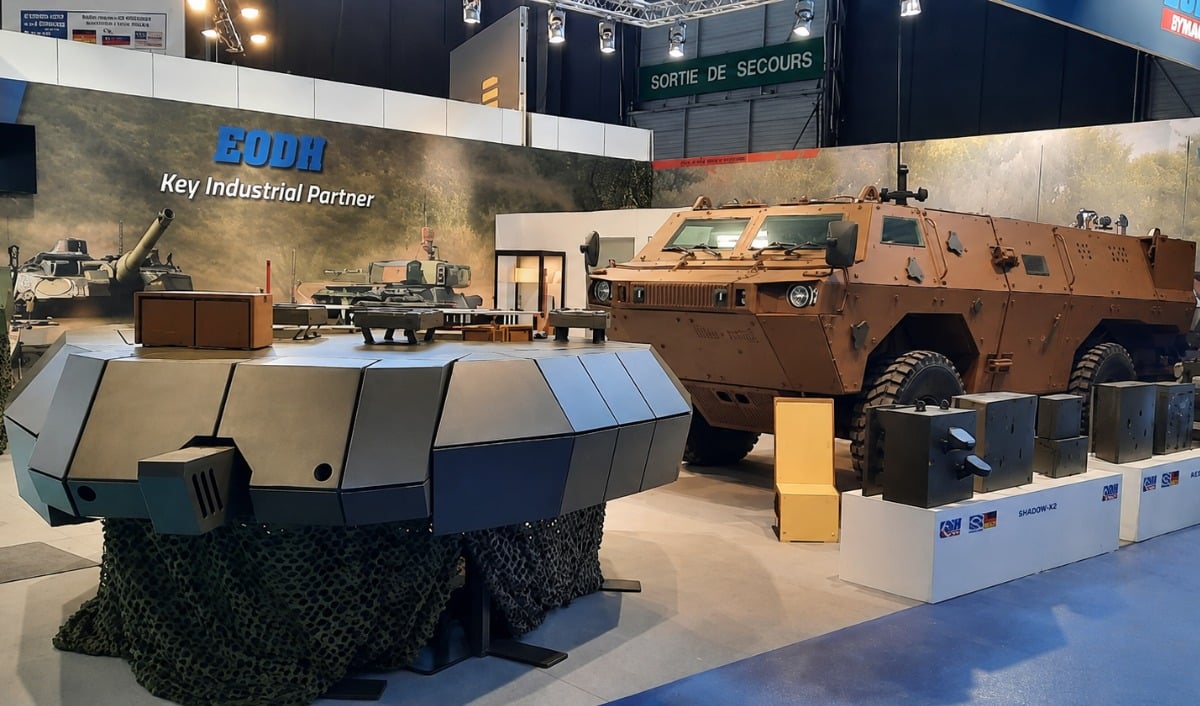
While defense ministries scramble to procure next-generation main battle tanks that will not hit full-rate production for another decade, the immediate reality of modern warfare demands a completely different approach. At the Eurosatory defense exhibition in Paris, Greek defense firm EODH showcased this friction. By mounting their ASPIS Modular New Generation protection suite onto legacy platforms and displaying heavily modified chassis built for remote deployment, the company demonstrated that the future of mechanized warfare rests on retrofitting old iron and stripping out the human crew. If you found value in this article, you might want to check out: this related article.
The standard industry response to the armor depletion seen in Eastern Europe has been to write massive checks for brand-new vehicles. This strategy ignores the crushing realities of industrial bottlenecks, supply chain constraints, and the sheer time required to build a modern fighting vehicle from scratch. The true crisis is not a shortage of ideas, but a massive industrial bottleneck that leaves frontline units exposed to top-attack munitions, loitering weapons, and massed drone swarms while waiting for future platforms that remain years away from deployment.
The Mirage of Next Generation Platforms
Military procurement remains obsessed with the flawless future vehicle. Governments routinely allocate billions to development programs that promise unmatched capabilities twenty years down the line, yet these long-term investments do little to solve the immediate vulnerabilities of the current fleet. The war in Ukraine has shown that the attrition rate for armored vehicles is higher than any peacetime procurement model anticipated. Waiting for a perfect, clean-sheet design is a luxury that current geopolitical realities do not allow. For another look on this event, check out the recent update from ZDNet.
The industrial base simply cannot scale fast enough to replace lost hulls with new builds. A modern main battle tank requires specialized steel, complex electronics, and precision optics that rely on highly consolidated supply chains. When a state order is placed, the delivery timeline is measured in years, sometimes close to a decade. This reality leaves a dangerous capability gap that can only be filled by taking existing inventories and aggressively modernizing them.
Upgrading legacy platforms is often viewed by procurement officers as a secondary measure, a temporary stopgap until real money can be spent on new designs. This perspective miscalculates the value of a proven chassis. An older vehicle like the Leopard 1A5 or the ubiquitous M-113 armored personnel carrier represents paid-for mechanical infrastructure. By stripping these vehicles down to their core frames and rebuilding them with digital backbones, modern powerpacks, and advanced modular armor, manufacturers can deliver a platform that rivals or exceeds new builds at a fraction of the cost and time.
Shifting From Passive Iron to Active Shielding
The foundational design principles of classic armor are dead. For nearly a century, vehicle protection was a simple math problem: add more steel or composite material to the front arc to defeat incoming kinetic rounds. The proliferation of low-cost loitering munitions and top-attack anti-tank guided missiles has turned that logic on its head, exposing the thin roofs of multi-million-dollar vehicles to devastating strikes from above.
EODH highlighted this shift by displaying their ASPIS protection architecture on a Leopard 1A5 turret mock-up. The approach abandons the idea of relying solely on heavy passive plates. Instead, it utilizes a hybrid configuration that combines advanced lightweight passive materials with an active layer designed specifically to intercept threats before they make contact with the primary hull.
The mechanism relies on a network of distributed millimeter-wave radar sensors positioned on the vehicle roof. These sensors monitor the upper hemisphere, detecting the high-angle trajectory characteristic of modern top-attack weapons and commercial drones modified to drop explosive payloads. When an incoming threat breaches the defensive perimeter, the system triggers directed explosive charges to neutralize the projectile mid-air.
Incoming Threat -> Radar Detection -> Millimeter-Wave Analysis -> Directed Charge Detonation -> Threat Neutralized
This type of modular system can be integrated into existing tanks without requiring a complete redesign of the vehicle structure. The ability to replace damaged armor modules in field conditions by the vehicle crew themselves addresses the logistical nightmare of modern combat repair. If a vehicle must be sent back to a rear-depot facility every time its armor takes a hit, the operational availability of the armored formation collapses.
The Conversion of Legacy Hulls Into Unmanned Assets
The most significant bottleneck on the modern battlefield is not mechanical failure, but the human cost of crew casualties. As a result, the industry is seeing an architectural shift where older armored personnel carriers are being reimagined as uncrewed ground vehicles. The mechanical simplicity of older platforms makes them ideal candidates for optionally manned or fully remote operations.
Consider the modernization blueprint proposed for the M-113 platform. The classic vehicle is notorious for its vulnerability to modern mines and heavy artillery fragments. However, by replacing the original powertrain with a 375-horsepower engine coupled with a continuously variable transmission, the baseline mobility of the vehicle is transformed. More importantly, the integration of an electronic control unit connected via a digital data bus allows the vehicle to be operated via drive-by-wire technology.
This digital transformation changes the role of the legacy vehicle entirely. A platform that was once a vulnerable infantry transport can now be deployed as a heavy unmanned ground vehicle. By removing the crew compartment entirely, the internal space can be reallocated to specialized mission payloads.
- Loitering Munition Carriers: Transporting and launching drone swarms from a protected, mobile chassis.
- Anti-Tank Guided Missile Platforms: Operating weapon systems under heavy armor without exposing operators to counter-battery fire.
- Electronic Warfare Nodes: Carrying high-powered jamming equipment into advanced positions to disrupt enemy communications and drone navigation.
- Forward Artillery Observation: Deploying telescopic sensor masts equipped with thermal cameras and ground surveillance radars to feed real-time target data back to command networks.
The transition to uncrewed systems is often hampered by the military desire for autonomous perfection. Software developers spend years attempting to build AI navigation systems capable of traversing complex terrain without any human intervention. The immediate, pragmatic solution is remote operation via secure, multi-layered data networks. By focusing on reliable drive-by-wire conversion rather than full autonomy, defense forces can field heavy uncrewed systems today using the thousands of legacy hulls currently sitting in reserve depots.
Industrial Realities and the Cost Equation
The financial math of modern defense spending is broken. A single new-build Western main battle tank can carry a price tag exceeding ten million dollars, a figure that severely limits the numbers any nation can afford to procure. When these expensive platforms face destruction from a drone that costs less than a used car, the economic sustainability of mechanized warfare comes into question.
Modernizing existing fleets offers a clear alternative to this financial trajectory. Rebuilding a legacy vehicle like the Leonidas APC with a modern Caterpillar C7 engine and a remote weapon station costs a fraction of a new vehicle purchase. This approach allows smaller nations or those with constrained defense budgets to maintain relevant combat power without bankrupting their economies.
Furthermore, these upgrade programs can be executed within domestic military workshops and local industrial facilities. This distributes defense spending into the local economy and builds domestic technical expertise, ensuring that a nation can maintain and repair its own equipment during a prolonged conflict. Relying on foreign original equipment manufacturers for every minor component or software update creates a dangerous dependency that can quickly paralyze an army during a crisis.
The challenge lies in convincing military leadership to accept upgraded legacy platforms as frontline assets. There is an inherent institutional bias toward shiny, brand-new hardware. This bias ignores the fact that a refurbished hull equipped with modern sensors, active protection, and a digital network interface can perform the exact same mission as a next-generation platform, but can be fielded in numbers that actually matter on a real battlefield.
The Friction of Integration
Implementing these upgrade packages is not without significant engineering challenges. The primary obstacle is the physical limitation of older chassis designs. Adding advanced armor modules, remote weapon stations, and high-powered sensor suites increases the weight of the vehicle, which can strain the original suspension and drivetrain components if they are not properly reinforced.
Every addition of technology requires power. Older military vehicles were designed with electrical systems that can barely support a basic radio suite, let alone multiple radar sensors, active protection processors, and high-frequency jamming units. A successful modernization program requires a complete overhaul of the electrical architecture, often necessitating the installation of dedicated auxiliary power units or high-capacity lithium-ion battery packs to allow the vehicle to run its electronics in a silent watch mode without idling the main engine.
These integration issues require precise, creative engineering. It is not enough to simply bolt new equipment onto an old hull. The entire vehicle must be treated as an integrated system, balancing weight distribution, electrical loads, and cooling requirements to ensure that the upgraded platform remains reliable under harsh field conditions. The companies that succeed in this market are not those that design the flashiest components, but those that master the unglamorous work of mechanical and electrical integration.
The defense industry stands at a crossroads. The choice is between continuing to chase incredibly expensive, long-term development programs or embracing the rapid, modular modernization of the heavy armor assets that are already available. As frontline attrition continues to outpace industrial production, the choice may soon be made for them.