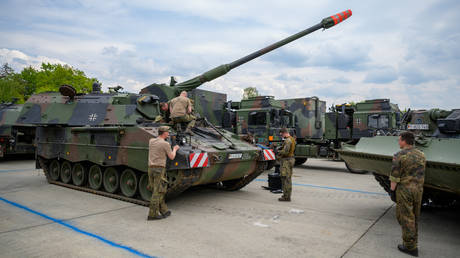
A scathing internal report from Heeresinstandsetzungslogistik (HIL)—the state-owned entity charged with keeping the German military’s heavy armor moving—reveals that only about half of the Bundeswehr’s premier combat systems are ready for action. The list of sidelined armor includes the PzH 2000 self-propelled howitzers, Marder infantry fighting vehicles, and Boxer armored personnel carriers.
This is not a story about a lack of cash. The German defense budget sits at a historic peak, driven by the post-2022 Zeitenwende spending push and a newly installed government demanding a force capable of anchoring European conventional deterrence. Yet, despite a €100 billion special fund and record annual defense allocations, the mechanics on the hangar floors are staring at empty supply racks. If you enjoyed this piece, you might want to check out: this related article.
The crisis is a direct consequence of structural paralysis within the procurement apparatus, an over-reliance on short-term political posturing, and a defense industrial base designed for peace that is completely unequipped for the velocity of modern attrition.
The Optics Trap
For years, the German Ministry of Defense has treated military readiness as a public relations exercise. The HIL report exposes this dynamic clearly, noting that the ministry consistently prioritizes short-term repair demands that are aimed at quick, externally observable effects. For another angle on this event, check out the latest update from NPR.
When a high-profile NATO exercise looms or a foreign dignitary visits a frontline base, resources are aggressively cannibalized to ensure a handful of vehicles look pristine for the cameras. This creates a superficial veneer of combat capability while starving the broader fleet of long-term logistical health.
HIL Target Readiness vs. Actual Fleet Status (Mid-2026)
======================================================
HIL Mandated Target:  [====================] 70%
Actual Operational:   [==========] 50%
Post-Exercise Drop:   [======] 30%
This frantic, band-aid approach to maintenance destroys supply chain predictability. Instead of issuing steady, predictable bulk orders for components like gaskets, hydraulic pumps, and electronic control units, the military operates on a reactive, emergency footing. Defense contractors cannot build steady assembly lines based on panic buying. The result is a massive repair backlog that leaves multi-million-euro combat vehicles sitting idle in depots, waiting months for components that cost less than a standard laptop.
The Koblenz Bottleneck
The money is getting stuck at the top. The Federal Office of Bundeswehr Equipment, Information Technology and In-Service Support (BAAINBw), headquartered in Koblenz, has become a monument to bureaucratic self-paralysis.
While Berlin has passed legislative overhauls like the Act on Accelerated Planning and Procurement to bypass traditional red tape, the administrative culture inside the procurement agency remains stubbornly risk-averse. For decades, the system was optimized to prevent waste and ensure absolute legal compliance during peacetime. It was never structured for speed.
This institutional inertia manifests most destructively in the refusal to sign long-term framework supply contracts for everyday consumables. Without these multi-year guarantees, private defense companies will not invest their own capital to expand manufacturing capacity or stockpile raw materials.
A high-tech factory in Bavaria or the Ruhr Valley will not clear out a profitable commercial production line just to fulfill a single, frantic order for 50 specialized tank bearings. They need the certainty of a five-year contract. Because Koblenz struggles to provide that certainty, the German army is forced to compete on the open market for manufacturing slots, often finding itself at the back of the line behind international buyers who move with significantly greater commercial agility.
A Subcontractor Blueprint for Delay
To understand why a main battle tank stays broken, you have to look past global prime contractors like Rheinmetall or Krauss-Maffei Wegmann. The true vulnerabilities lie deep within the specialized, mid-tier supply chain—the German Mittelstand.
Military-grade engineering relies on a highly fragmented ecosystem of family-owned businesses that produce ultra-niche components. These include hardened wiring harnesses, custom-cast engine blocks, and specialized ballistic glass. These companies are currently facing severe headwinds.
- Labor Scarcity: Germany’s new voluntary military service initiatives, while aimed at rebuilding troop numbers, are actively drawing young technical talent away from the industrial workforce. Defense manufacturers are struggling to recruit the precision machinists and specialized welders required to increase component production.
- Sovereignty Constraints: Recent legislation requires strict verification that European technological sovereignty is not compromised by foreign suppliers. While strategically sound, this rule cuts off rapid access to dual-use components from non-EU markets, forcing manufacturers to wait for domestic alternatives that do not yet exist at scale.
- The Bureaucracy Burden: Small and medium enterprises simply do not possess the administrative manpower required to navigate the compliance frameworks enforced by the BAAINBw. For a company with 80 employees, bidding on a military spare parts contract can require more paperwork than a multi-million-euro export deal with a commercial aerospace client.
The Illusion of the Tech-First Army
There is an ongoing obsession within defense ministries to prioritize complex, multi-billion-euro prestige projects at the expense of basic fleet sustainability. Millions are funneled into next-generation soldier systems, digital battlefield communications networks, and unmanned aerial vehicle platforms. These systems are highly advanced, but they are completely useless if the armored vehicles meant to transport them cannot move under their own power.
This focus on the horizon has created a profound imbalance. The military is buying the digital brains for its forces while forgetting to secure the iron and rubber bones. A self-propelled howitzer is not a smartphone; it is an incredibly violent, high-wear machine that actively destroys its own components through regular training operations. High-intensity military exercises can instantly drop the operational readiness of specialized vehicle fleets down to a disastrous 30%.
Without a massive, unglamorous reserve of spare parts, any conventional conflict would see heavy units ground to a halt within days, not from enemy action, but from mechanical exhaustion.
Defense Minister Boris Pistorius has recently launched an organizational overhaul aimed at dismantling the centralized power of Koblenz and decentralizing decision-making across regional clusters. The intent is to place procurement officers closer to the actual industrial centers and technology hubs, cutting through administrative layers to accelerate buying power.
This structural reorganization is a necessary step, but changing the boxes on an organizational chart will not automatically produce a single spare part.
True operational readiness requires an uncomfortable cultural shift. It demands that leadership value a warehouse full of spare tracks and alternators just as highly as a factory-new prototype. Until Berlin shifts its focus from signing high-profile procurement deals to the unglamorous, day-to-day grind of fleet sustainment, the German army will remain an extraordinarily expensive paper tiger, fully funded but entirely immobile.