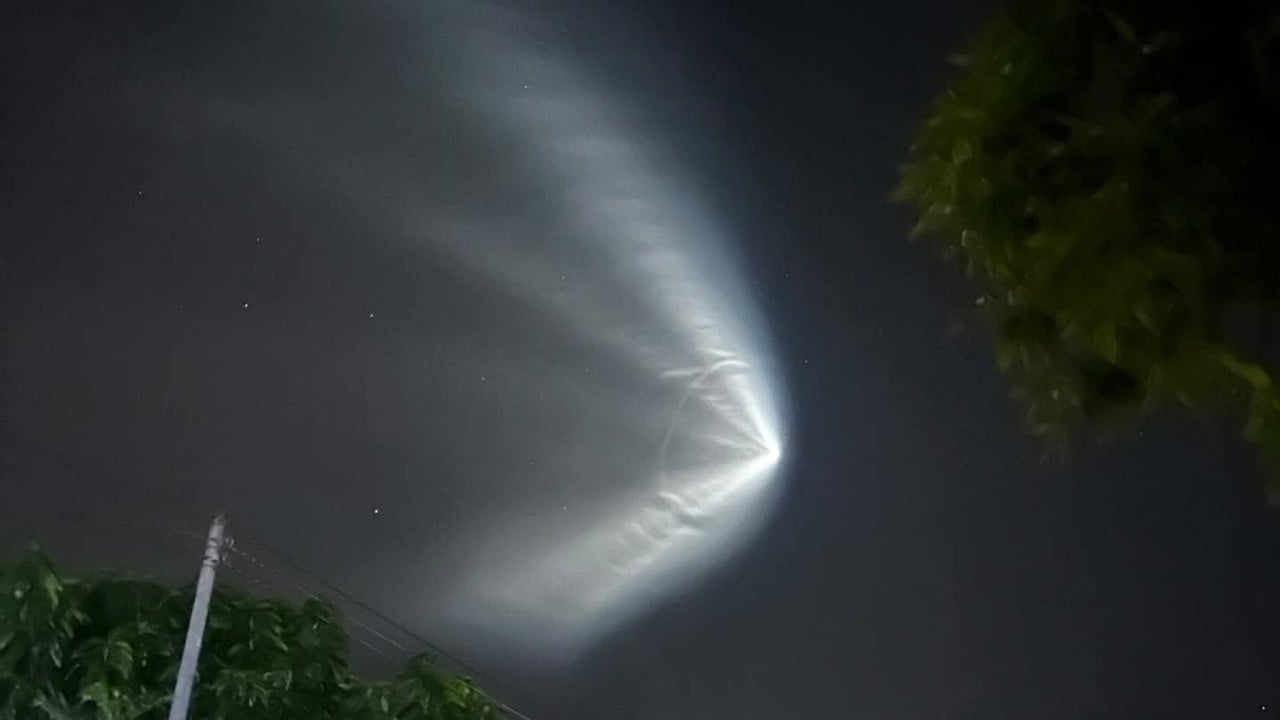
The luminous, jellyfish-shaped plume photographed drifting across the night sky over Sabah, Malaysia, was not an unidentified flying object or an extraterrestrial craft. Malaysian authorities confirmed the phenomenon was caused by exhaust gases from a Chinese Long March rocket catching high-altitude sunlight long after the sun had set on the ground below. While local social media erupted with viral speculation, aerospace analysts recognize this optical illusion—known in rocketry as the twilight phenomenon—as a predictable byproduct of orbital mechanics and rapidly accelerating spaceflight activity across the Indo-Pacific region.
Understanding why a routine launch creates an otherworldly spectacle requires looking at the intersection of atmospheric physics, rocket propulsion, and geographic timing.
The Physics Behind the Space Jellyfish
On the ground in Kota Kinabalu or Sandakan, night has already fallen. Darkness is complete. Yet sixty miles straight up, in the upper reaches of the mesosphere and thermosphere, the sun is still shining brightly over the curve of the Earth.
When a multi-stage orbital rocket climbs through these upper layers during the narrow window just after sunset or right before dawn, its exhaust plume enters a near-vacuum. At sea level, atmospheric pressure squeezes rocket exhaust into a tight, roaring column of fire. At altitudes exceeding 50 miles, there is virtually no air pressure left to contain the expanding gases. The exhaust billows outward rapidly, stretching dozens of miles across the upper atmosphere in a bulbous, tentacled shape that mimics the anatomy of a glowing jellyfish.
Sunlight strikes these microscopic ice crystals and unburned propellant particles suspended in the vacuum. Because the observer on the ground stands in Earth's shadow while the plume sits illuminated high above, the glowing cloud stands out against a pitch-black sky with startling clarity.
Why Chinese Launches Frequently Trigger Viral Sightings
The geometry of orbital launches from southern China makes Southeast Asia a prime viewing gallery for this exact visual effect. China operates the Wenchang Spacecraft Launch Site on Hainan Island, situated on the northern edge of the South China Sea. Rockets lifting off from Wenchang—including the heavy-lift Long March 5, Long March 7, and commercial Long March 8 variants—routinely fly south-southeast trajectories to reach low-inclination or geostationary transfer orbits.
That flight path carries the ascending boosters directly over the South China Sea, passing parallel to the coastline of Malaysian Borneo, including Sabah and Sarawak, before heading toward the Philippines and the western Pacific.
Timing does the rest. Launch windows are dictated by orbital mechanics, not public relations. When a payload requires a dusk or pre-dawn insertion, coastal populations across Borneo get a front-row seat to upper-stage ignition and stage separation events.
Anatomy of an Internet Rumor
Every few months, a similar video sweeps across X, TikTok, and WhatsApp groups from California to Kazakhstan. The cycle is always identical. A smartphone camera captures a silent, glowing apparition moving smoothly across the stars. Within minutes, captions claiming alien visitation, secret atmospheric weapons, or impending natural disasters rack up millions of views.
In Sabah, the reaction followed this exact playbook. Residents filmed the bright blue-white halo expanding above the horizon, sharing clips accompanied by urgent questions about national security and extraterrestrial contact.
Official confirmation from Malaysia's space agency—the Malaysian Space Agency (MYSA)—and defense officials eventually grounded the narrative. They cross-referenced the timestamp of the sightings against international orbital launch registries and airspace advisories, matching the event to a scheduled Chinese orbital mission.
Yet the speed at which misinformation outpaced official verification highlights a persistent vulnerability in public communication. Space agencies rarely issue proactive public advisories when a neighboring nation's rocket will be visible overhead, even when launch trajectories and twilight conditions make a spectacular light show almost certain.
The Role of Notice to Airmen Advisories
Aviation authorities knew something was happening long before the first viral video hit social media. Standard international protocol requires launching nations to issue NOTAMs (Notices to Airmen) days ahead of liftoff. These bulletins define temporary danger zones where spent rocket stages or fairings might splash down in international waters.
For launches out of Hainan Island, drop zones routinely bracket corridors in the South China Sea between Vietnam, the Philippines, and Malaysian Borneo. Commercial pilots flying regional routes adjust their flight paths accordingly. Meanwhile, millions of people living directly beneath the visible horizon of those trajectories receive zero notice, leaving them entirely unprepared when the sky suddenly lights up.
Why Sightings Are Surging Across Southeast Asia
If it feels like these bizarre sky phenomena are happening more frequently, that is because they are. The global launch cadence has undergone a structural shift over the past five years, and Southeast Asia sits directly beneath one of the busiest orbital corridors on Earth.
China has aggressively expanded its launch manifest to build out the Tiangong space station, deploy the BeiDou navigation constellation, and construct massive low-Earth orbit broadband networks like Guowang and Qianfan to rival SpaceX's Starlink. Completing mega-constellations requires dozens of launches every single year.
Simultaneously, coastal launch infrastructure in southern China has expanded to handle commercial payloads alongside state missions. More rockets flying south out of Wenchang means more upper-stage burns occurring at twilight over the South China Sea.
Consider a hypothetical scenario involving a commercial satellite operator launching a batch of 30 communications satellites from Hainan at 6:45 PM local time. By the time the rocket's second stage ignites roughly three minutes into flight, the vehicle is already hundreds of miles downrange off the coast of Borneo at an altitude of 70 miles. On the ground in Kota Kinabalu, twilight has faded into night, creating the exact lighting geometry required to turn routine orbital insertion into a viral phenomenon.
What Actually Causes the Colors and Shapes
Not every space jellyfish looks the same. The visual signature depends heavily on the specific propellant chemistry and the staging sequence of the launch vehicle.
- Kerosene and Liquid Oxygen (RP-1/LOX): Used in the first stages and boosters of many Long March rockets, this combination produces dense exhaust rich in soot and water vapor. When illuminated by high-altitude sunlight, it creates bright white, yellow, or pale blue-green clouds.
- Hypergolic Propellants: Older rocket families rely on unsymmetrical dimethylhydrazine (UDMH) and nitrogen tetroxide. These toxic fuels leave distinct, sharp-edged plumes that can appear orange or reddish-brown depending on the sun's angle.
- Liquid Hydrogen and Liquid Oxygen (LH2/LOX): Used in high-efficiency upper stages, hydrogen burns into pure water vapor. In the freezing vacuum of the upper atmosphere, that water instantly freezes into tiny ice crystals, scattering sunlight into brilliant, iridescent blues and whites.
The dramatic ripples and rings visible inside the jellyfish plume are not caused by wind. At 60 miles up, there is no weather. Instead, those concentric shockwaves are created by the rocket's attitude-control thrusters firing short bursts to stabilize the vehicle, or by the violent pressure wave released when a spent first stage separates and the second-stage engine roars to life.
Distinguishing Rockets From Meteors and Space Debris
Public confusion is understandable because several distinct aerospace events produce bright lights in the night sky, and they look remarkably different once you know what to look for.
| Phenomenon | Visual Appearance | Speed & Duration | Cause |
|---|---|---|---|
| Twilight Rocket Plume | Massive, stationary or slow-drifting glowing cloud with a bright core and trailing tentacles | Lasts 3 to 10 minutes; fades slowly as the rocket enters Earth's shadow | Expanding exhaust gas illuminated by high-altitude sunlight |
| Re-entering Space Debris | Bright fireball breaking into multiple glowing fragments leaving parallel fiery trails | Crosses the sky in 30 to 90 seconds | Spent rocket bodies or satellites burning up from atmospheric friction |
| Bolide / Bright Meteor | Instantaneous, intense flash of light, sometimes ending in a brief smoke trail | Lasts 1 to 3 seconds | Natural space rock vaporizing in the upper atmosphere |
| Starlink Satellite Train | Straight, tightly spaced line of faint moving dots resembling a string of pearls | Glides steadily across the sky over several minutes | Newly deployed satellites reflecting sunlight before raising orbit |
Understanding this distinction matters because re-entering debris poses a physical hazard to property and populations on the ground, whereas a twilight rocket plume is harmlessly occurring dozens of miles above commercial airspace.
The Geopolitical Reality Overhead
Beyond the atmospheric optics lies a more pragmatic reality for nations bordering the South China Sea. The skies over Sabah are no longer quiet, peripheral airspace. They have become a heavily trafficked highway for orbital hardware.
Tracking these launches is a standard function of modern space situational awareness. Defense radars, astronomical observatories, and civilian space agencies across Malaysia, Singapore, Indonesia, and the Philippines routinely monitor upper-stage trajectories to ensure spent boosters fall safely into designated maritime zones rather than near populated coastlines or busy shipping lanes.
In 2022, debris from an uncontrolled Chinese Long March 5B core stage re-entered the atmosphere directly over Malaysia and Indonesia, scattering surviving metal fragments across parts of Sarawak and West Kalimantan. That incident heightened regional sensitivity whenever unidentified streaks of light appear over Borneo. When residents see a glowing anomaly over Sabah today, their reaction is shaped not just by science fiction tropes, but by recent memory of actual hardware falling from the sky.
How to Verify Sightings in Real Time
When an unexplained light appears over the horizon, you do not have to wait days for an official press release to figure out what you are looking at. Independent aerospace trackers and open-source intelligence communities monitor every orbital launch globally in real time.
- Check live launch schedules: Platforms like Next Spaceflight and Spaceflight Now maintain minute-by-minute countdown clocks for every orbital mission worldwide, including launches from Wenchang, Xichang, and Jiuquan.
- Cross-reference launch azimuths: Open-source analysts publish hazard maps derived from aviation NOTAMs before liftoff. If a red drop-zone polygon sits in the South China Sea northwest of Borneo and a rocket launched within the last ten minutes, the mystery is solved.
- Observe the motion: A twilight plume expands outward like ink dropped in water while moving steadily along a predictable arc. It never makes sharp, right-angle turns, and it abruptly vanishes the moment the rocket climbs into or drops out of the sun's terminator line.
The next time a glowing apparition hangs over the South China Sea, skip the alien conspiracy threads and check the international launch manifest.