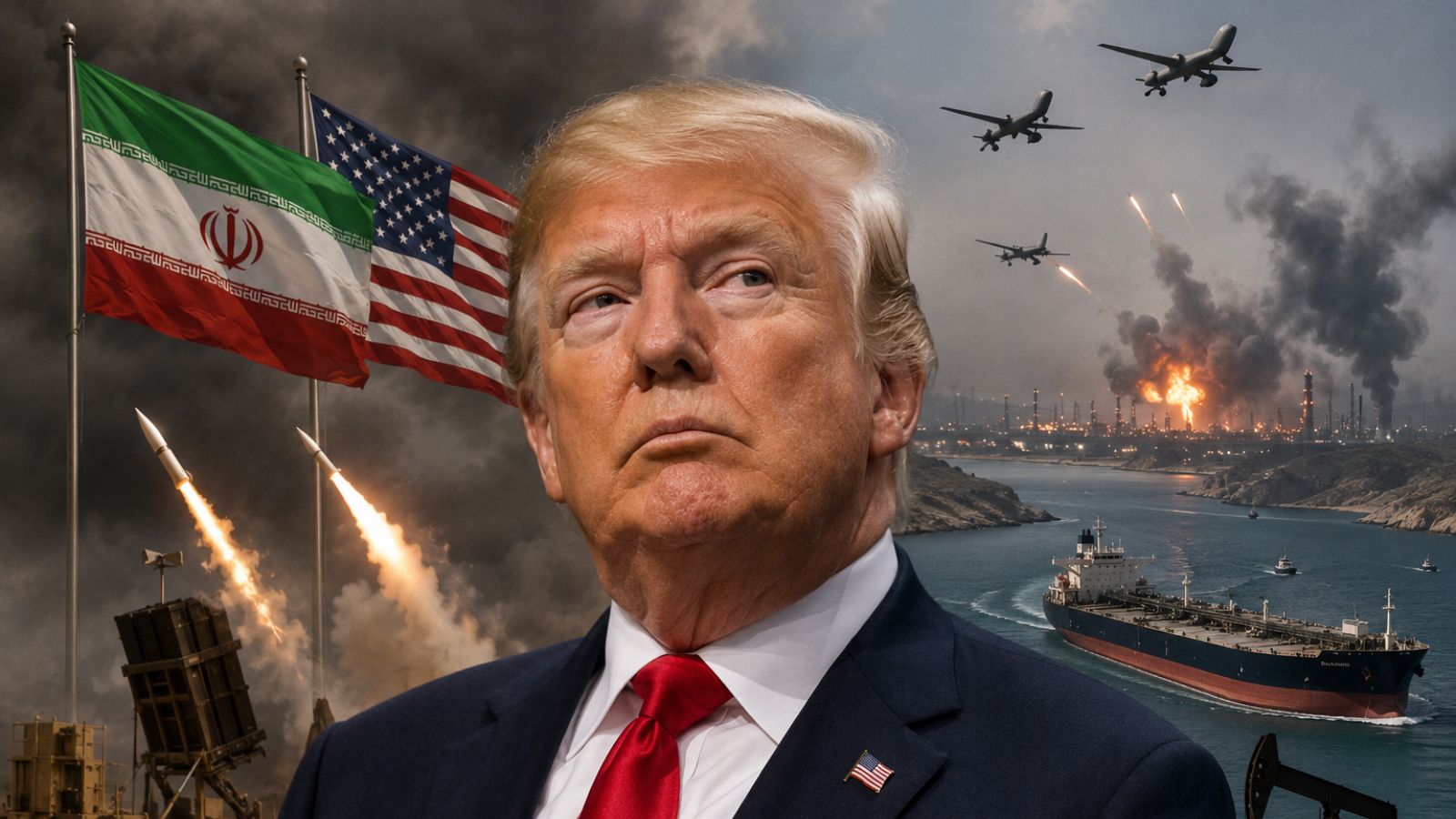
The maritime choke points of the Middle East have long been theater for geopolitical chess, but a terrifying reality has emerged where global trade, military miscalculation, and narrative warfare are colliding at the expense of civilian lives. On Friday, US President Donald Trump used his platform on Truth Social to accuse Iran of launching a failed drone strike against Indian-flagged commercial vessels exiting the Strait of Hormuz, branding the maneuver as "totally unacceptable." Yet beneath the surface of this fiery rhetoric lies a far more uncomfortable truth: Indian merchant mariners are trapped in the crossfire of an aggressive American naval blockade, and Washington is actively using accusations against Tehran to deflect from a major diplomatic rift with New Delhi.
The immediate trigger for the crisis is a series of lethal engagements in the Gulf of Oman that have shattered the veneer of "precision" warfare. Within a span of seventy-two hours, three distinct commercial tankers manned by dozens of Indian seafarers have been disabled or destroyed. The human cost is no longer abstract. On Wednesday, a US military strike targeted the Palau-flagged tanker MT Settebello, hitting its engineering and steering compartments. The kinetic impact killed three Indian sailors, including 23-year-old Aditya Sharma.
This devastating incident followed the disabling of the MT Marivex on Monday and was succeeded on Thursday by yet another American strike on the MV Jalveer, a tanker sailing under the Guinea-Bissau flag with 20 Indian crew members on board.
The Anatomy of a Blockade
To comprehend how civilian seafarers became military targets, one must dissect the mechanics of the current naval enforcement strategy. The United States military, operating through Central Command (CENTCOM), has maintained a strict naval blockade around Iranian ports since mid-April. This enforcement mechanism was deployed after Tehran attempted to choke off commercial shipping through the Strait of Hormuz, a critical passageway through which roughly 20 percent of global petroleum flows.
According to official CENTCOM data, the blockade has been unyielding. American forces have disabled nine merchant vessels and forcibly redirected 135 others since the operation commenced. The tactical execution relies heavily on carrier-based aviation. In the case of the MT Settebello and MT Marivex, F-18 Super Hornets launched from the USS Abraham Lincoln were ordered to neutralize the vessels' propulsion capabilities.
The Western military justification is entirely procedural. CENTCOM maintains that these tankers were operating in direct violation of the blockade, carrying sanctioned Iranian crude oil, and repeatedly ignoring voice commands and maritime warnings to alter course.
The standard protocol for disabling a non-compliant merchant ship involves hitting specific, low-occupancy areas to minimize casualties.
[Carrier Air Wing Strike Profile]
F-18 Super Hornet ----> Fires Precision-Guided Munition
                             |
                             v
               Target: Vessel Engineering/Steering Spaces
                             |
                             v
               Result: Catastrophic Engine Room Destruction
                       (Unintended Civilian Crew Casualties)
The lethal flaw in this doctrine is the human element. Modern oil tankers do not run on automated ghosts; they are operated by engineers, oilers, and wipers who spend their shifts deep inside the vessel's hull—precisely where the precision munitions are aimed. When a laser-guided bomb punches through a steering flat or an engine room casing, anyone in the immediate vicinity faces catastrophic overpressure and thermal energy.
Washington and New Delhi in the War Room
The fallout from these strikes has triggered a severe diplomatic fracture between the United States and India. India provides the global shipping industry with its second-largest pool of seafarers, making its workforce highly vulnerable to regional escalations.
South Block did not swallow the American explanation of "operational necessity." On Friday, for the second time in three days, the Indian Ministry of External Affairs took the extraordinary step of summoning US Chargé d'Affaires Jason Meeks to lodge a fierce, formal protest. Indian diplomats explicitly told Meeks that the American military's use of "lethal and deadly force" against commercial vessels manned by civilian crews was completely indefensible.
This creates an intense paradox for the Trump administration. The White House is trying to maintain a united front with New Delhi as part of its broader Indo-Pacific strategy, yet American jets are killing Indian citizens in international waters.
Enter the Truth Social intervention. By publicizing a "totally rebuffed" Iranian drone attack against Indian ships on Friday morning, the White House effectively shifted the media spotlight. The narrative was instantly pivoted away from the dead sailors in Oman and refocused on Iranian aggression. While the alleged drone attack may well have occurred, its strategic utility as a political shield for Washington is undeniable. It allows the administration to frame the US military not as an aggressive blockading force killing civilians, but as the essential guardian of the very mariners it is actively targeting.
The Sabotaged Peace Memo
The maritime violence is happening alongside a chaotic diplomatic backchannel. Hours before his comments on the shipping attacks, Trump launched a scathing rhetorical assault on Tehran for allegedly leaking the contents of a highly sensitive, 14-point peace framework aimed at ending the three-month-old conflict.
"The terms that Iran leaked out to the Fake News have NOTHING to do with the terms that were agreed to, in writing," Trump stated, labeling the Iranian negotiators as "very dishonorable people to deal with."
Information obtained from regional media outlets, including Iran’s Mehr and Fars news agencies, reveals that a draft Memorandum of Understanding (MoU) had indeed been circulating. The 14-point document outlined an ambitious 60-day cooling-off period during which a comprehensive nuclear deal would be negotiated. In exchange for halting hostilities and reopening the Strait of Hormuz, the framework reportedly promised significant US sanctions relief and the unfreezing of $24 billion in Iranian assets held in foreign banks.
Crucially, the Iranian leaks implied that the draft did not place immediate, stringent caps on Tehran's domestic nuclear enrichment program—a detail that sparked instant domestic backlash in Washington and drew fierce private protests from Israeli Prime Minister Benjamin Netanyahu.
The public dispute over the leak highlights the fundamental lack of trust defining these talks. Washington insists that any viable agreement must include verifiable, permanent restrictions on Iran’s nuclear ambitions and missile programs. Tehran, conversely, views the temporary reopening of the Strait of Hormuz as its primary economic leverage and refuses to surrender ultimate administrative control over the waterway.
The Economic Toll of the Ghost Fleets
The structural reality driving this violence is the proliferation of the "shadow fleet"—a vast, opaque network of aging tankers using flags of convenience, obscure corporate structures, and deactivated transponders to move sanctioned oil. Vessels like the MT Settebello and MT Marivex fly the flags of states like Palau or Guinea-Bissau, but their economic lifelines run directly between Middle Eastern suppliers and global buyers.
For the ordinary seafarer, employment on these vessels is not a geopolitical statement; it is economic survival. Indian mariners routinely sign contracts with third-party manning agencies that obscure the true ownership and risk profile of the destination routes. When a ship enters a blockaded zone with its Automatic Identification System (AIS) turned off to avoid detection, the crew members are rarely fully informed of the immediate military risks.
The global economy is paying a steep price for this invisible war. Insurance premiums for transiting the Gulf of Aden and the Gulf of Oman have surged to prohibitive levels, forcing major shipping syndicates to re-route vessels around the Cape of Good Hope. This detour adds up to two weeks to transit times, inflating fuel consumption and upending tightly calibrated global supply chains.
The Directorate General of Shipping in India has now issued an emergency maritime security advisory for the 18,000 Indian seafarers currently operating in the region, urging maximum vigilance. Yet vigilance cannot stop a precision-guided munition from an F-18, nor can it deter a loitering munition launched from an Iranian drone pad.
The tragedy unfolding in the Gulf is that the current strategy treats civilian mariners as disposable pawns in a wider economic siege. As long as Washington enforces a kinetic blockade and Tehran retaliates with asymmetric drone operations, the international waters off Oman will remain a shooting gallery where the bodies of merchant sailors are used as currency for geopolitical leverage.