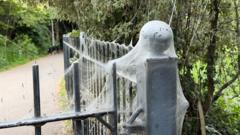
Walk through a public park in late spring or early summer and you might stumble upon a scene that looks like a set from a low-budget horror film. Entire hedges, shrubs, and even massive hardwood trees can appear draped in a thick, ghostly white webbing. It is a visual that triggers an immediate, visceral reaction in most people. We are conditioned to associate webs with spiders and infestation. We assume the trees are dying under the weight of a parasitic takeover.
The reality is less a tragedy and more an annual feat of biological engineering. These structures are the work of bird-cherry ermine moths, spindle ermine moths, or occasionally the oak processionary moth. While the sight is jarring, the ecological impact is almost always negligible. These caterpillars spin silk as a communal fortress, a protective barrier designed to keep predators like birds and wasps at bay while the larvae gorge themselves on foliage. Within weeks, the silk vanishes, the caterpillars pupate, and the trees begin a rapid process of regrowth. You might also find this similar article useful: Tehran Seismic Swarm and the Brutal Reality of the Big One.
Understanding why this happens requires looking past the surface-level panic and into the specific life cycles of these insects.
The Engineering Behind the Silk Curtains
The caterpillars responsible for these sprawling shrouds are usually from the Yponomeuta genus. They are tiny, often pale with black spots, and individually insignificant. However, their strength lies in their numbers. As soon as they hatch, they begin weaving. As reported in latest coverage by TIME, the implications are worth noting.
This silk isn't just a byproduct of movement. It is a deliberate survival strategy. By encasing their food source—the leaves—in a thick mesh, they create a microclimate that protects them from the elements and hides them from hungry birds. It is an efficient, temporary livestock pen where the "livestock" eats the walls.
By the time a passerby notices a tree is "covered," the damage to the leaves is already done. The caterpillars have finished their peak feeding cycle. They will soon retreat into cocoons, leaving the silk to be weathered away by rain and wind. Because these moths typically target specific species like bird-cherry or hawthorn, they rarely jump to your prized garden roses or vegetable patches.
Why the Tree Is Not Dying
It looks like a skeletal remains of a tree, but it is actually a dormant survivor. Most healthy trees have evolved to handle a single season of defoliation.
Trees store energy in their root systems. When an ermine moth colony strips a tree of its leaves in May or June, the tree triggers a "second flush" of growth. By mid-July, most affected trees have sprouted a fresh set of leaves, looking almost indistinguishable from their neighbors. This is a evolutionary stalemate. The caterpillars get their meal, and the tree gets to live another year.
The danger only arises if a tree is already stressed by drought or disease, or if the defoliation happens three or four years in a row. In those rare cases, the tree might lack the carbon reserves to bounce back. For the average park-goer, however, the "dead" tree they see in June will be green again before the kids go back to school.
Distinguishing the Harmless from the Hazardous
Not all silk is created equal. While the ermine moth is a nuisance to the eyes, another species requires a more cautious approach.
The oak processionary moth (OPM) also creates silk nests, but these are usually found specifically on oak trees. Unlike the harmless ermine moths, OPM caterpillars are covered in thousands of tiny hairs containing a protein called thaumetopoein. If these hairs come into contact with human skin or are inhaled, they can cause painful rashes, eye irritation, and respiratory issues.
Identifying the difference is straightforward for the observant. Ermine moth webs are often vast, thin, and drape over entire branches or hedges. OPM nests are typically more localized, appearing as white, tennis-ball-sized clumps on the trunks or thick branches of oak trees. If you see a web on a hedge or a cherry tree, it is almost certainly the harmless variety. If you see it on an oak, keep your distance and keep your dog on a lead.
The Futility of Chemical Intervention
When homeowners or local councils see these webs, the first instinct is often to reach for the sprayer. This is usually a mistake.
Applying broad-spectrum insecticides to a webbed tree is an exercise in futility and ecological collateral damage. The silk itself is remarkably water-resistant; chemicals often just bead off the surface without reaching the caterpillars inside. Furthermore, by the time the web is large enough to be noticed, the caterpillars are often nearing the end of their larval stage anyway.
Spraying kills the beneficial insects—the very predators like hoverflies and parasitic wasps that help keep moth populations in check for the following year. A more effective, albeit labor-intensive, method for small gardens is simply to prune out the affected branches or use a high-pressure water hose to break up the nests. Once the web is broken, the caterpillars are exposed to birds and the local climate, which usually ends the "infestation" naturally.
The Role of Climate and Cycles
These outbreaks are not a sign of a collapsing ecosystem. They are cyclical. Insect populations often follow a "boom and bust" pattern. A mild winter followed by a warm, dry spring creates the perfect conditions for a massive survival rate among moth eggs.
We are currently seeing a trend where these cycles are becoming more pronounced. As spring temperatures rise earlier in the year, the window for caterpillar development shifts. This can lead to larger, more visible webs that appear earlier in the season than they did thirty years ago.
It is a reminder that our parks and gardens are not static dioramas. They are active, shifting battlegrounds of survival. The silk might look like a blight, but it is actually a sign of a functioning, albeit messy, biological system.
Actionable Steps for Gardeners and Walkers
If you find a webbed tree on your property or in a local space, follow these steps before calling for professional removal.
- Identify the host tree. If it is anything other than an oak, the risk to your health is virtually zero.
- Check for movement. If the caterpillars are small, yellow-green, and have black spots, they are ermine moths.
- Leave it alone. If the tree is in a public space, the local council is likely already aware. They generally only intervene if the tree is an oak (OPM) or if the silk is obstructing a high-traffic footpath.
- Monitor the recovery. Watch the tree over the next six weeks. You will see the silk tatter and turn grey, followed quickly by the emergence of new, green buds.
The next time you see a tree draped in white, resist the urge to see it as a disaster. It is a temporary transformation. The tree is simply playing its part in a very old story of survival, and it has no intention of dying just because it looks a bit "alarming."
Don't touch the webs on oaks, but don't fear the silk on the hedges.