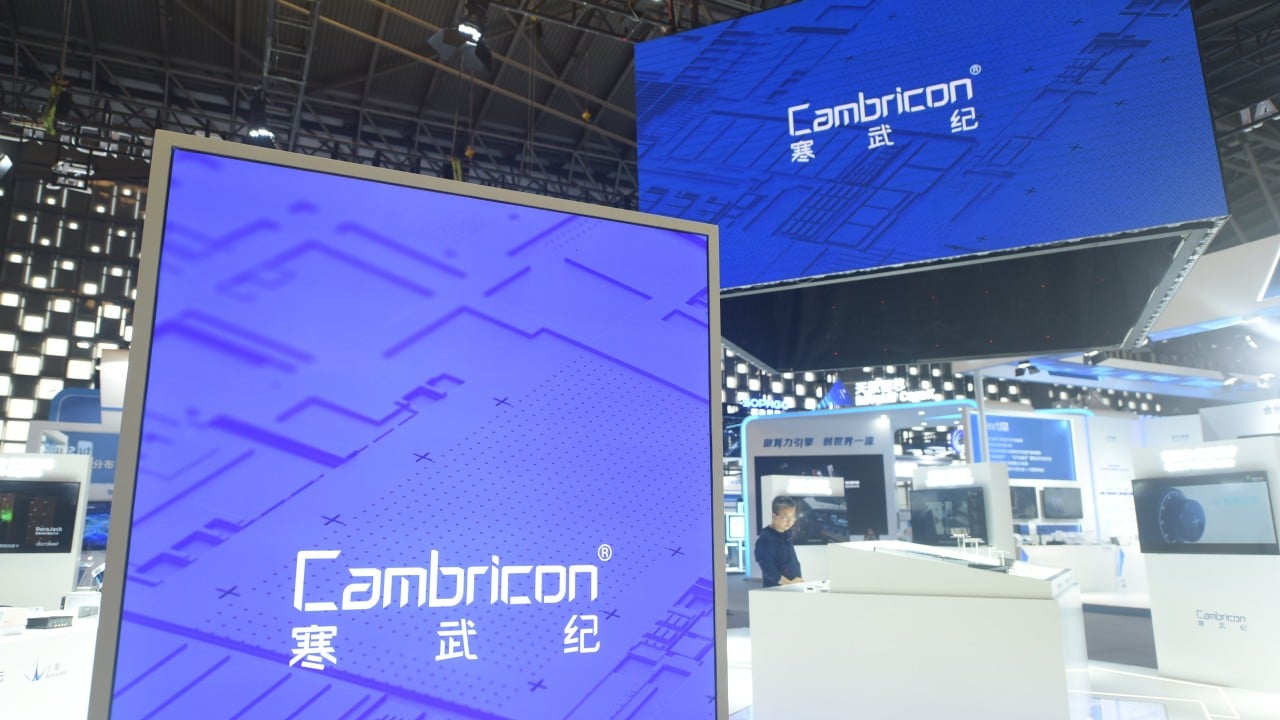
Nvidia is losing its absolute dominance over the Chinese artificial intelligence market, but not for the reason most Western observers think. While Washington intends for strict export controls to choke Beijing's algorithmic progress, the reality on the ground has flipped the script. The true catalyst driving major Chinese hyperscalers away from Silicon Valley's silicon is not ideological defiance. It is a calculated pivot to domestic supply chains engineered by companies like Huawei and Cambricon, which are capitalizing on artificial market scarcity.
For years, Nvidia held a near-monopoly in Chinese data centers, capturing over 95 percent of the AI market. Today, that share has fallen to roughly 55 percent, according to industry data from International Data Corporation. Chinese tech giants like Alibaba, Tencent, and ByteDance are no longer waiting for the next round of American trade restrictions to sever their computing infrastructure. Instead, they are actively funding, testing, and deploying domestic alternatives that have reached a critical threshold of production viability.
Inside the Silicon Black Market and the Stockpile Strategy
The narrative that Chinese AI chip design is purely native requires a closer, more skeptical look. In late 2024 and early 2025, independent industry teardowns exposed a complex web of global dependencies hidden inside China's most advanced domestic hardware. When analysts disassembled Huawei's flagship Ascend 910C processor, they discovered the silicon dies inside were actually fabricated by Taiwan Semiconductor Manufacturing Company back in 2020, routed through third-party intermediaries before export pathways tightened.
Huawei managed to construct a competitive third-generation AI processor by packaging two older, stockpiled 7-nanometer dies onto a single piece of hardware. This approach extends the lifespan of their product line, but it introduces an expiration date. Industry research suggests that these specific, high-performance stockpiles are finite. To survive long-term, domestic chipmakers must transition entirely to local foundries like Semiconductor Manufacturing International Corporation.
That transition introduces severe manufacturing bottlenecks. Fabricating complex AI accelerators requires extreme precision, and local production yields remain a closely guarded industrial bottleneck. While advanced global foundries hit yield rates above 60 percent on leading-edge nodes, industry trackers estimate domestic production yields for advanced processors hover closer to 20 percent. For every five chips that come off the assembly line, only one is fit for a server rack.
Cambricon and the Rise of Dedicated Accelerators
While Huawei focuses on large-scale vertical integration, specialized players are carving out distinct niches in the server rack. Cambricon Technologies has shifted from a loss-making startup to a primary supplier of specialized inference hardware. By abandoning general-purpose graphics processing units and building application-specific architecture focused entirely on matrix and vector calculations, the company has managed to wring massive efficiencies out of older manufacturing nodes.
Cambricon has targeted a massive ramp-up in volume, aiming to triple its output to meet the surging demands of domestic software developers. By focusing hardware design specifically on high-frequency training and inference workloads rather than general graphics rendering, these dedicated processors reduce power consumption and optimize memory usage. It is a pragmatic workaround. If you cannot make the transistors smaller, you must make the architecture smarter.
The Software Bridge and the Broken CUDA Moat
Nvidia’s most formidable competitive advantage was never just its hardware. It was CUDA, the proprietary software ecosystem that millions of AI developers have used globally for two decades. Rewriting an enterprise-scale AI model to run on non-Nvidia hardware used to require months of manual engineering, making a migration away from Silicon Valley financially prohibitive.
That software moat is evaporating inside the Chinese domestic ecosystem. The arrival of highly efficient, open-source models like DeepSeek has fundamentally altered how engineering teams approach hardware optimization. Rather than forcing developers to write code directly for proprietary architectures, the industry has standardized around intermediate software layers and open frameworks like PyTorch and PaddlePaddle.
Major cloud providers have developed automated compilation tools that translate code across different hardware platforms with minimal performance loss. Consequently, Chinese software engineers can now deploy production-level inference workloads across mixed server clusters containing chips from multiple local vendors without rewriting their core algorithms.
Market Realities by the Numbers
The fragmentation of the Chinese hardware market has established a clear tier system among domestic component manufacturers. The unipolar dominance of a single foreign supplier has been replaced by a highly competitive local ecosystem.
| Manufacturer | Primary Product Focus | Approximate Annual Volume | Ecosystem Integration |
|---|---|---|---|
| Huawei | Ascend 910 series clusters | 600,000 units | Full-stack cloud infrastructure, proprietary MindSpore framework |
| Cambricon | Siyuan inference accelerators | 150,000 units | Deep integration with ByteDance and major internet platforms |
| Nvidia | Export-compliant H20 units | 2,200,000 units | Standard fallback, hampered by intentionally downgraded bandwidth |
Nvidia continues to ship millions of its modified, export-compliant H20 processors into the Chinese market, but these chips are intentionally throttled to comply with Washington's regulatory thresholds. They offer only a fraction of the interconnect bandwidth found in standard Western data center hardware. When local cloud engineers chain thousands of these downgraded chips together into large clusters, the communication bottlenecks become severe. For Chinese tech giants planning multi-billion-dollar infrastructure investments, a domestic cluster that operates at full speed offers a more predictable performance curve than an imported chip designed from the ground up to be slow.
The Transition to System Architecture over Individual Silicon
Faced with lithography constraints that prevent them from matching the raw transistor density of Western processors, domestic engineers are shifting their focus from individual silicon optimization to system-level engineering. If a single chip cannot process a workload fast enough, the solution is to build a more efficient network to connect thousands of them.
Huawei’s recent deployment of optical-mesh cluster designs allows massive groups of processors to share memory pools seamlessly. By treating an entire data center floor as a single, distributed computing unit rather than a collection of isolated servers, domestic infrastructure developers are offsetting chip-level performance deficits with massive networking throughput.
This systemic approach receives direct underwriting from regional governments, which are building massive intelligent computing centers across China's western provinces. These public infrastructure projects are mandated to buy local components, guaranteeing steady revenue streams for domestic chip designers regardless of short-term commercial market fluctuations. This protected environment gives local firms the financial runway needed to iterate through hardware bugs, optimize device drivers, and refine their manufacturing techniques.
Nvidia’s attempts to regain its footing with further modified silicon face diminishing returns. The economic incentive structure has fundamentally shifted. Once an enterprise software ecosystem migrates its code, retrains its engineering talent, and commits its capital infrastructure to a domestic hardware platform, the cost of switching back to a foreign vendor becomes too high to justify, no matter how fast the imported silicon claims to be.