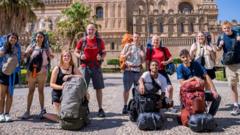
The final sprint of a reality television production is usually a heavily orchestrated affair. Production crews scout the paths weeks in advance, fixer networks stand by with satellite phones, and editing bays prepare to splice together a narrative of frantic, down-to-the-wire tension.
Yet, as nineteen-year-old childhood friends Jo Diop and Kush Burman lunged through a snow-covered forest toward a log cabin in Hatgal, Mongolia, the exhaustion on their faces was entirely unscripted. By the time they signed the ledger to claim the title of winners for the sixth series of the BBC hit Race Across the World, they had spent eight weeks traversing 7,460 miles of land and sea. They had started in Palermo, Sicily, with nothing but the cash equivalent of a one-way flight to Ulaanbaatar, zero smartphones, and no access to credit cards.
They finished just three hours ahead of the father-daughter duo, Andrew and Molly. For a series that has slowly seen its core premise challenged by hyper-aware contestants and increasingly predictable routes, this specific iteration did something unexpected. It exposed the raw, systemic friction of global transit in an era where analogue travel has been entirely phased out by digital infrastructure.
The Mirage of the Analogue Traveler
To understand why this series felt different, one must look at the mechanical reality of the format. The show relies on a deliberate anachronism. By stripping contestants of internet access and modern booking apps, the production forces them into a world that no longer exists for local populations.
In previous series, this created a quaint, nostalgic television product. Contestants used paper maps, spoke broken language to bus drivers, and relied on the hospitality of strangers.
This year, the route through Europe and Asia shattered that illusion. Countries like Kazakhstan and Uzbekistan have rapidly modernized their transit networks around localized mobile applications. Train timetables are no longer posted on physical boards in regional stations; they are updated in real-time via regional apps. Tickets are bought through digital wallets, not cash windows.
By forcing contestants to use physical currency and paper schedules, the show did not just make the race harder. It alienated the racers from the actual infrastructure of the countries they crossed.
When Jo and Kush found themselves stranded due to non-existent train schedules early in the final leg, it was not because the trains did not run. It was because the physical station windows they were forced to use no longer held accurate data. The modern world has moved to the cloud, leaving the analogue racer stranded in a bureaucratic ghost town.
The Currency Paradox
The structural genius, and underlying cruelty, of the format is the budget constraint. Each pair is handed exactly 100 percent of the airfare economy value for the journey.
Historically, teams succeeded by working local jobs to replenish their funds. In this series, the economic reality of the regions visited turned that strategy into a liability.
| Team | Final Position | Key Route Highlight | Budget Strategy |
|---|---|---|---|
| Jo & Kush | 1st Place | Palermo to Hatgal via Uzbekistan | High-speed sacrifices, minimal hostel stays |
| Andrew & Molly | 2nd Place | Lost time via wrong localized transit | Balanced spending, heavy reliance on local cars |
| Katie & Harrison | 3rd Place | Dominated early legs via Turkey | Blew budget early on comfort transit |
| Mark & Margo | 4th Place | Advanced despite extreme isolation | Handled near-bankruptcy by working manual jobs |
Mark and Margo, the in-laws who finished fourth, nearly faced total financial collapse before reaching Mongolia. The issue was not their lack of willingness to work. The issue was the changing nature of casual labor in developing economies.
In the early seasons of the franchise, a team could barter a afternoon of farm work for a bed and a hot meal. Today, formal identification, insurance, or digital payment compliance makes casual, under-the-table labor a massive risk for local business owners. The moments where we saw teams stacking wood or cleaning guesthouses were less about genuine economic survival and more about the production team finding rare, compliant local partners willing to participate in a television shoot.
The Logistics of the Invisible Hand
Spectators often wonder how much of the race is managed by the invisible hand of Studio Lambert, the production company behind the show. The reality is a complex logistical dance that takes place just out of frame.
Every duo traveling across a remote border in Georgia or Turkey is accompanied by a local fixer, a director, and a camera operator. When Andrew and Molly were mistakenly driven to the wrong town during the final leg—causing Molly to break down in tears as their lead evaporated—the production crew had to follow them into that mistake without intervening.
"We just wanted to get to Mongolia, so winning was just an extra joy," Kush noted after the finale.
That sentiment reflects a deeper truth about the production. The psychological toll of being isolated from global communication networks for two months is immense. The youngest players won not because they were the most adept navigators, but because their nineteen-year-old stamina allowed them to endure sleep deprivation and physical hunger better than the older duos.
The Death of the Travel Show
For decades, television travelogues were defined by the patrician observations of hosts like Anthony Bourdain or Michael Palin. They explained the world to the viewer from a position of relative comfort and intellectual distance.
Race Across the World turned that dynamic on its head by making travel stressful, dirty, and deeply transactional. It proved that the modern audience has no interest in seeing a pristine, curated version of international travel. They want to see the panic of missing a midnight bus in Samarkand.
Yet, the series faces an existential threat moving forward. As biometrics, digital-only transit systems, and cashless societies become the global standard, the format will eventually hit a wall. You cannot buy a ticket from a ticket machine that only accepts a QR code if you are banned from holding a phone.
The production will either have to adapt by allowing restricted, localized digital tools, or accept that the race will become entirely artificial—a simulation of travel rather than travel itself.
Jo and Kush did more than win twenty thousand pounds in the Mongolian snow. They survived the final era of truly analogue exploration on a planet that has already mapped every corner of its surface into a digital grid.