Saskatchewan is quietly engineering an aggressive pivot toward small modular nuclear reactors (SMRs) to replace its aging coal fleet, but the true linchpin of this multi-billion-dollar buildout is not the technology itself. It is the sudden, strategic demand for equity ownership by the province’s First Nations. For decades, industrial resource extraction across Western Canada followed a predictable pattern of bureaucratic consultation, token compensation, and lingering local resentment. That era is over. Indigenous leaders representing 74 First Nations in the province have made it clear that they will no longer sit on the sidelines as passive observers or simple hourly laborers. They are positioning themselves to become institutional owners, infrastructure partners, and primary supply chain operators in what is shaping up to be Canada's next major energy frontier.
This shift reshapes the economic landscape of Western Canada. The provincial Crown utility, SaskPower, is currently grinding through an intricate multi-year planning phase, evaluating potential sites near Estevan for its first commercial SMR—the GE Hitachi BWRX-300. A final construction decision is slated for 2029, with a target operation date in the mid-2030s. To bridge the massive generation gap as federal regulations squeeze traditional fossil fuels, Saskatchewan recently pushed the operational lifespan of its existing coal-fired plants out to 2050. This creates a high-stakes, high-cost runway. Without absolute certainty in its regulatory and local execution, the province risks hitting a catastrophic power deficit.
Beyond the Consultation Box
Historically, major infrastructure projects treated Indigenous communities as obstacles to navigate or checkboxes to satisfy under Canada’s legal "duty to consult" framework. This approach frequently resulted in litigation, project delays, and deep systemic friction. The current dynamic around Saskatchewan’s nuclear strategy is fundamentally different because Indigenous leadership changed the rules of engagement before the concrete mixers even arrived.
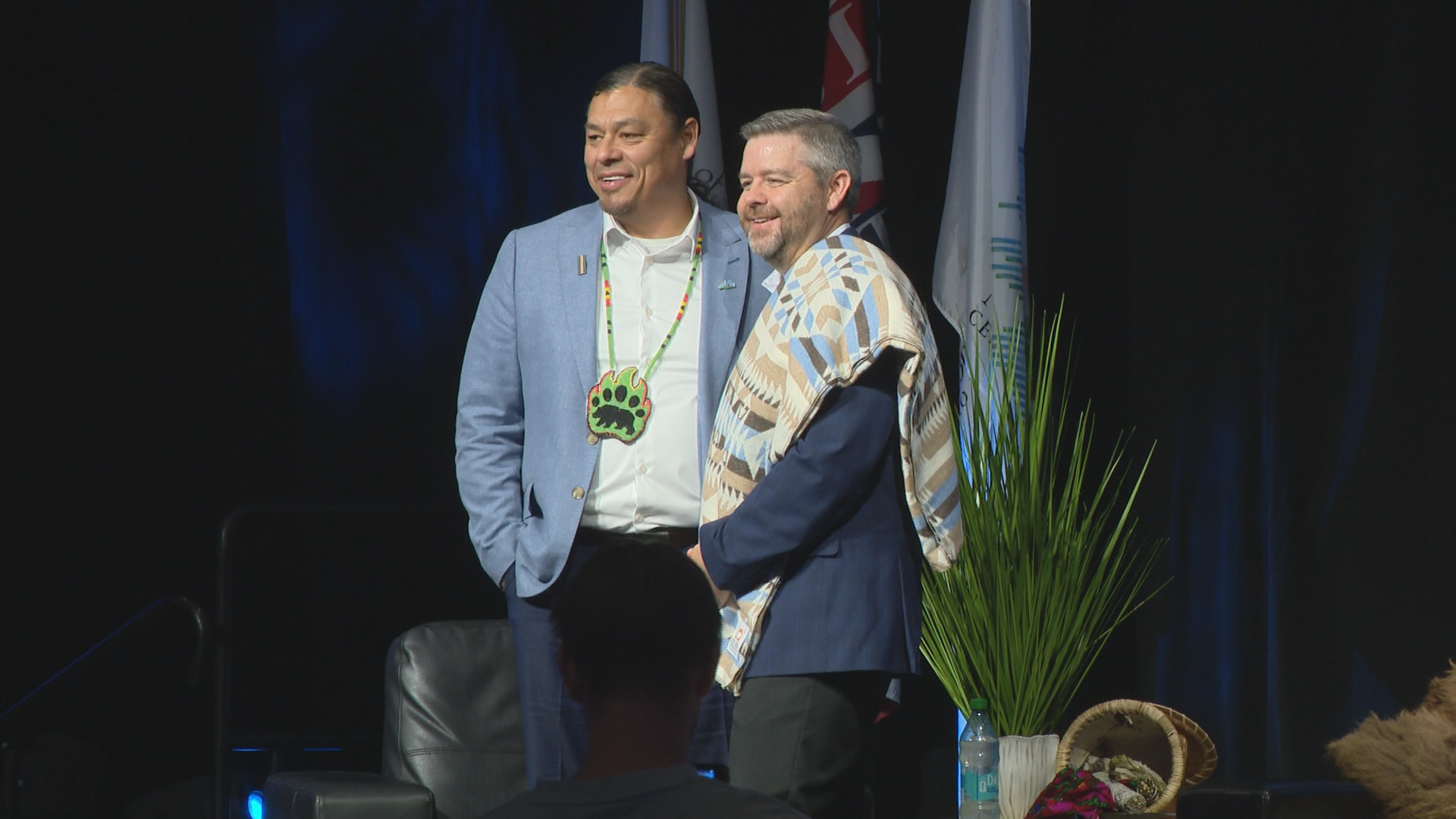
Sheldon Wuttunee, president and CEO of the Saskatchewan First Nations Natural Resource Centre of Excellence, explicitly stated that First Nations are driving past the boundaries of traditional consultation. They want direct ownership of major infrastructure assets, including specialized nuclear equipment and transmission corridors. The rationale is intensely practical. First Nations are developing their own large-scale commercial and industrial operations that require massive amounts of reliable, baseload electricity. By securing equity in the generation source, they guarantee their own energy security while creating a permanent, multi-generational revenue stream that flows directly back to their communities.
This demand for ownership carries heavy political leverage. The Constitution Act of 1867 grants provinces clear jurisdiction over electricity generation, but Canada's legal system has repeatedly affirmed that major industrial projects cannot proceed smoothly without deep, systemic Indigenous consent. Provincial politicians recognize this reality. Crown Investments Corp. Minister Jeremy Harrison has been actively engaging with tribal councils, openly acknowledging that a growing network of First Nation-owned entities will form the bedrock of the nuclear supply chain. The province is already signaling that a major milestone agreement with a prominent tribal council is imminent.
The Operational Reality of the Nuclear Supply Chain
Transitioning from a supporter of wind and solar developments to an active player in utility-scale nuclear energy is a massive technical hurdle. First Nations in Saskatchewan already boast a formidable track record in the renewable sector, commanding significant equity in roughly 900 megawatts of clean energy projects currently built or under construction across the province, including massive solar farms. However, a solar array is a relatively straightforward civil engineering project. A nuclear facility operates under an entirely different stratosphere of regulatory scrutiny, quality control, and liability.
To close this operational gap, initiatives like the Ready4SMR program have been deployed through partnerships between the First Nations Power Authority, the Organization of Canadian Nuclear Industries, and the Saskatchewan Industrial Mining Suppliers Association. This isn't a basic job-training initiative. It is an industrial vetting program designed to elevate Indigenous-owned manufacturing, engineering, and logistics companies to meet strict international nuclear standards.
The program breaks down into a calculated, two-phase process:
| Phase | Core Objective | Key Deliverables |
|---|---|---|
| Phase 1 | Capability Assessment | Auditing existing Indigenous businesses to map current technical capacities and flag specific operational deficits. |
| Phase 2 | Technical Alignment | Injecting specialized industrial training, quality assurance mentorship, and the precise certifications required to handle nuclear-grade contracts. |
The immediate goal is to establish a rigorous "safety culture" within local firms. In the nuclear industry, a minor manufacturing defect or a documentation error can stall a project for months, bleeding millions of dollars a day. By embedding these strict protocols into local companies years before SaskPower makes its official 2029 build decision, the province is attempting to build a bulletproof domestic supply chain that minimizes imported labor and foreign components.
A High Stakes Energy Bridge
Saskatchewan’s energy architecture is currently in a state of forced transition. The province depends heavily on fossil fuels to keep its grid stable during brutal sub-zero winters. The political decision to extend the life of Saskatchewan's coal-fired plants to 2050 serves as an admission that wind, solar, and biomass alone cannot meet the province's baseline industrial load. The opposition New Democratic Party has criticized this extension, arguing it undercuts aggressive renewable timelines. But from an engineering standpoint, the grid requires a massive, unyielding anchor.
Small modular reactors are intended to be that anchor. Because SMRs are manufactured in modules and shipped directly to a site, they avoid the decades-long construction timelines and runaway budgets that crippled legacy, gigawatt-scale nuclear mega-projects. If the Estevan deployments succeed, the province intends to scale the technology further north to support remote mining operations and isolated communities that currently rely on expensive, carbon-heavy diesel generators.
The strategy includes building out the long-term northern grid infrastructure. Plans are underway to upgrade transmission lines along critical corridors, such as the Highway 155 route, and to link Island Falls to the E.B. Campbell hydroelectric facility. The ultimate objective is a looped northern power grid. This grid would stabilize electricity distribution to underserved areas and unlock access to the region’s deep wealth of critical minerals, creating a massive economic feedback loop.
The Long Term Risk Profile
No nuclear strategy is without substantial financial and political risk. Even with small modular designs, the initial capital expenditure is staggering. SaskPower is a provincial Crown corporation, meaning any major budget overruns will be borne directly by Saskatchewan taxpayers and utility ratepayers.
Furthermore, entering into true equity partnerships with 74 distinct First Nations requires navigating an incredibly complex web of localized priorities, treaty rights, and community expectations. Indigenous communities are not a monolith. While leadership bodies like the Centre of Excellence aggressively pursue the economic independence that comes with infrastructure ownership, individual communities will still demand rigorous answers regarding environmental impact, localized waste management, and the long-term protection of traditional treaty lands.
The provincial government is attempting to hedge these risks by diversifying its short-term options. Concurrently with the nuclear planning, SaskEnergy is conducting a comprehensive feasibility study to expand natural gas infrastructure into northwest Saskatchewan and underserved Indigenous communities that lack reliable heating options. This dual-track approach—pushing natural gas pipelines into the northwest while anchoring the southern grid with nuclear development—reveals a government that understands it cannot afford to put all its chips on a single technological bet.
The success of Saskatchewan’s ambitious energy transformation will not be determined by the technical efficiency of the GE Hitachi reactor core. It will be decided by whether the provincial government can successfully execute an unprecedented model of industrial co-ownership with First Nations. If they falter in building this corporate and legal framework over the next three years, the 2029 commercial decision will stall, the coal plants will face mounting regulatory pressure, and the province's industrial grid will face an incredibly volatile future. Capital must align with local sovereignty, or the projects will simply rust on the drawing board.