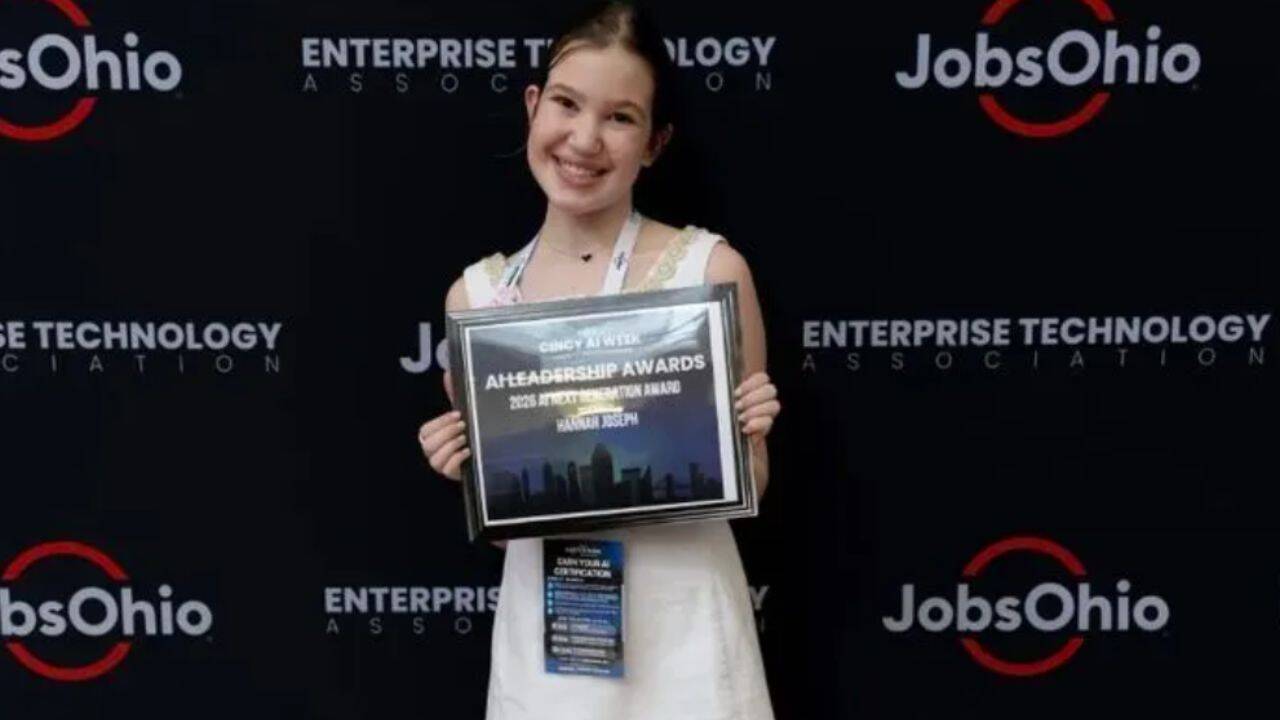
When Hannah Joseph stepped into Cincy AI Week as an Ohio high school sophomore, she was not carrying a corporate venture capital pitch deck or a multi-million-dollar monetization strategy. She brought something far rarer to a room full of enterprise software executives: a practical solution to the silent digital segregation sweeping our communities. Her grassroots nonprofit, Seniors Go Digital, bridges the chasm between older adults and basic survival technology. That refusal to stay quiet earned her the 2026 AI Next Generation Award at the Cincinnati AI Leadership Awards, making her the first teenager recognized in the history of the event.
Yet the true story extends far past a feel-good local headline about youth achievement. This initiative exposes the profound failure of modern consumer technology companies to design for aging populations. While Silicon Valley pours billions into speculative machine learning models and hyper-monetized interfaces, a growing demographic gets left behind at the pharmacy checkout line, the doctor's portal, and the banking app.
The Mechanics of Digital Isolation
Modern software engineering suffers from chronic short-sightedness. Interfaces assume perfect vision, rapid motor control, and an intuitive, native understanding of abstract iconography. Swiping, long-pressing, and hidden menu drawers create high-friction environments for anyone whose formative years predated touchscreens.
When older adults encounter these systems, they rarely receive patient, human-centered onboarding. Instead, they face an unyielding wall of automated phone trees, password resets, and multi-factor authentication loops that lock them out of their own accounts.
Enterprises view this demographic as a low-priority edge case. Profit margins drive product roadmaps, and retirees do not fit the high-velocity subscription model that venture capitalists demand. This vacuum creates a market failure of staggering proportions. Millions of citizens find themselves functionally disenfranchised simply because they cannot navigate a smartphone operating system that updates its layout every six months.
How Grassroots Action Outpaces Enterprise Software
Seniors Go Digital attacks this structural failure through direct, peer-to-peer intervention. Operating with a network of student volunteers, the organization skips corporate theory and focuses entirely on functional literacy. Volunteers teach older adults how to text grandchildren, spot online phishing scams, and interact with foundational artificial intelligence tools without feeling intimidated.
This model succeeds because it relies on empathy rather than algorithmic optimization. A teenager sitting down at a kitchen table to demonstrate how to adjust font sizes or verify a secure website provides a level of patient instruction that an automated software tutorial can never replicate.
The initiative proves that technology adoption among older demographics is not constrained by a lack of capacity to learn. It is constrained by hostile design and a complete absence of localized support systems. When given a safe environment to ask basic questions without judgment, older adults master these tools with surprising speed.
The Brutal Truth About AI Leadership
Corporate leadership awards usually celebrate companies that scale user acquisition metrics or optimize ad-click pipelines through generative models. Recognizing a youth-led nonprofit focused on basic digital inclusion signals a necessary shift in how our industry measures actual impact.
Technology cannot claim to be innovative while simultaneously locking out a quarter of the population. True leadership requires looking past quarterly revenue reports to address the social friction generated by rapid digitization. Joseph did not win because she built a complex neural network. She won because she identified a glaring societal fracture and refused to wait for a legacy institution to fix it.
The industry must stop treating accessibility as a compliance checkbox and start treating it as a core engineering mandate. Until major tech firms redesign their products around the realities of an aging global population, grassroots efforts will remain the only lifeline keeping vulnerable citizens connected to modern society.