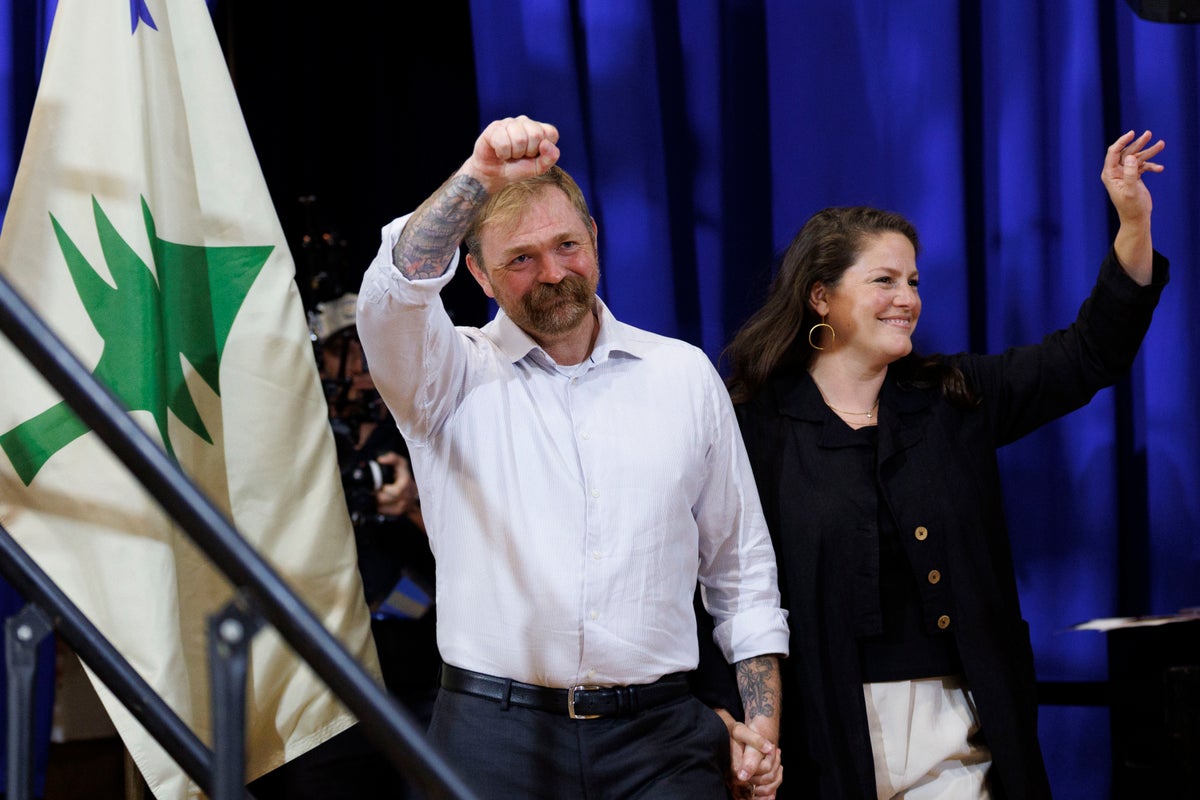
Donald Trump recently broke his own rhetorical rulebook by labeling Graham Platner, Maine’s Democratic Senate nominee, "a pig." For years, this specific brand of animalistic degradation was a weapon the former president used almost exclusively against women who crossed him. By shifting this insult to a male combatant, Trump is not just throwing random mud. He is executing a calculated tactical pivot designed to neutralize a unique political threat. Platner, a rugged Marine veteran and working-class oyster farmer, presents a populist profile that could actively siphon off working-class male voters from the Republican base.
To understand why this insult matters, one must look past the vulgarity and analyze the mechanics of the modern populist campaign. Trump’s political dominance relies heavily on his monopoly over the "authentic working man" aesthetic. When a Democratic challenger emerges looking like a casting director's dream for a rural blue-collar hero, the standard Republican playbook breaks down. You cannot easily label a four-tour combat veteran who digs for shellfish as an elite coastal liberal. Instead, the strategy shifts to total character assassination, transforming the challenger's perceived strength into an absolute liability.
The Strategy Behind the Slur
For decades, political insults were handled with a degree of surgical precision. Trump changed that by introducing raw, visceral schoolyard taunts to the national stage. Yet, his methods have always followed a predictable pattern. Women who challenged his authority were routinely subjected to domestic or agricultural slurs, aiming to diminish their professional standing by reducing them to physical or behavioral caricatures. Men were usually hit with labels implying weakness, such as "little," "low energy," or "sleepy."
Calling a male opponent a pig is a deliberate departure from this formula. It is an attempt to trigger immediate revulsion in the minds of independent voters who are currently weighing Platner's populist economic platform against incumbent Republican Senator Susan Collins. The insult seeks to bypass policy debates entirely, steering the public conversation into the mud where the Trump campaign feels most comfortable.
The Populist Threat from the Coast of Maine
The urgency behind this rhetorical shift is found in the numbers and the geography. Maine’s electorate is notoriously independent, frequently split between the progressive southern coast and the deeply conservative, working-class Second Congressional District. Susan Collins has survived five terms by walking a tightrope between these two worlds, but her position has grown increasingly precarious as national polarization deepens.
Platner’s primary victory disrupted the traditional Democratic strategy. Rather than running a polished, establishment-friendly moderate, Maine Democrats are fielding a candidate who actively rails against corporate monopolies and private equity firms. His background provides a shield against the typical cultural grievances lobbied by the right.
- Military Credentials: Eight years of service, including three combat tours in Iraq and one in Afghanistan.
- Blue-Collar Reality: An active owner-operator of an oyster farm who frames his campaign around material economic survival rather than identity politics.
- Anti-Establishment Rhetoric: A platform built on ending foreign interventions and reviving local labor unions, directly mimicking the economic nationalism that won Trump the presidency in 2016.
This combination of traits makes Platner dangerous to the GOP coalition. If a Democrat can win over the loggers, fishermen, and veterans of northern Maine, the Republican path to maintaining or reclaiming the Senate becomes extraordinarily narrow.
Exploiting the Vulnerabilities
The pig insult did not materialize in a vacuum. It was deployed precisely because Platner’s campaign has been rocked by severe, self-inflicted character controversies that left him exposed to this exact line of attack. Investigative reporting has revealed a pattern of behavior that severely undermines his carefully cultivated "everyman" appeal.
Earlier this year, reports surfaced detailing highly explicit text messages Platner sent to multiple women on the private messaging application Kik, occurring shortly after his marriage. These revelations were quickly followed by accounts from former partners describing instances of volatile and intimidating behavior. For a candidate whose entire appeal rests on a foundation of raw, authentic honor, these disclosures represent a catastrophic breach of trust with the electorate.
Trump’s use of the farm animal moniker is a direct attempt to weaponize these personal scandals. It synthesizes the reported behavior into a single, easily digestible, and highly derogatory keyword. It tells working-class voters that the candidate's rugged exterior is merely a mask hiding a deeply flawed character.
The High Stakes of the Collins Defense
The national Republican apparatus understands that saving Susan Collins requires total destruction of her opponent's moral authority. Collins has faced immense pressure from her own party for occasionally breaking ranks with the populist wing, including her recent vote to block a controversial security funding bill favored by the executive branch. Despite these internal frictions, national strategist Matt Mackowiak has noted that Collins understands the precise boundaries of political survival in her home state.
The National Republican Senatorial Committee has already begun spending heavily to reinforce this contrast. They are running advertisements highlighting Platner’s elite prep school past in Connecticut, aiming to shatter his working-class branding before it can take root in the rural counties. The goal is to present voters with a stark choice: an experienced, predictable institutionalist in Collins, or a volatile, scandal-plagued insurgent in Platner.
A Calculated Gamble in the Mud
The danger for the Republican strategy is the potential for backlash among moderate suburban women, a demographic that Collins absolutely requires to win. Every time Trump inserts himself into a state race with highly charged, aggressive language, he risks alienating the moderate voters who find the rhetoric exhausting.
Yet, the Trump campaign has clearly calculated that the reward outweighs the risk. By focusing entirely on Platner’s character flaws, they effectively shift the spotlight away from economic anxieties and onto a raw referendum on personal morality. If voters view the race as a choice between policy platforms, Platner stands a chance of peeling away working-class conservatives. If the race becomes a referendum on whether Platner is fundamentally a decent human being, his campaign faces an insurmountable wall.
The battlefield in Maine is no longer about the economy or institutional independence. It is an ugly, personal war of attrition where the traditional boundaries of political discourse have been entirely erased.
Graham Platner wins Maine Democratic Senate primary
This news broadcast details Graham Platner's victory in the primary election, providing essential context on the controversial candidate who has drawn Donald Trump's focus.