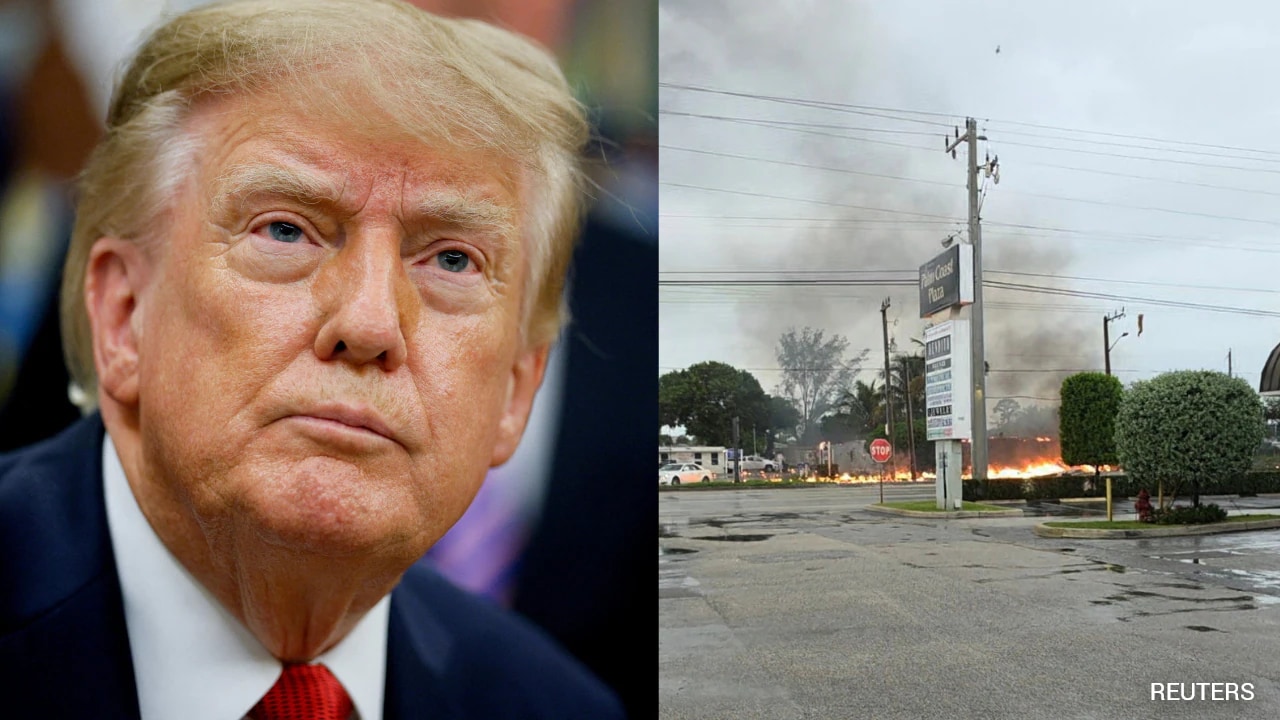
Timing drives almost every viral headline on the internet, and nothing sparks wild speculation faster than a plane crash near a high-profile political residence. When reports broke that a jet went down roughly 11 kilometers—about seven miles—from Mar-a-Lago just an hour after Donald Trump left Florida, social media instantly lit up with conspiracy theories.
Here's the reality behind the headlines. A private jet did crash into a wooded area near Palm Beach International Airport shortly after Trump's departure, tragically killing those on board, yet federal aviation investigators found zero connection between the crash and the former president's travel. The proximity in both time and distance was a grim coincidence dictated by the geography of South Florida's busiest airspace.
If you've ever flown into West Palm Beach, you already understand why this happens. Palm Beach International Airport (PBI) sits right across the Intracoastal Waterway from Palm Beach Island, where Mar-a-Lago is located. They aren't just in the same general area. They're practically neighbors.
Why Proximity Near Palm Beach Airport Isn't Unusual
Let's look at the actual map of Palm Beach County. Mar-a-Lago occupies a narrow strip of land between the Atlantic Ocean and the Lake Worth Lagoon. Directly west across the water lies Palm Beach International Airport.
The straight-line distance from the runway threshold at PBI to the front gates of Mar-a-Lago is roughly four miles. An 11-kilometer radius around the estate encompasses the entire airport, several major highways, densely populated residential neighborhoods, and sprawling nature preserves to the west.
When any aircraft takes off or lands at PBI, it is inherently operating within a few miles of Mar-a-Lago. Trump's own aircraft, widely known as Trump Force One, uses PBI as its primary base whenever he stays in Florida. Because both VIP flights and general aviation traffic share the exact same runways and approach corridors, any aviation incident in the West Palm Beach terminal area will automatically occur within a short drive of the resort.
Breaking Down the Timeline of the Crash
Understanding the sequence of events strips away the sensationalism. Presidential and former presidential movements are tightly choreographed by the United States Secret Service and the Federal Aviation Administration (FAA).
When a high-profile protectee departs an airport like PBI, the FAA implements strict Temporary Flight Restrictions (TFRs) around the airfield. These restrictions temporarily halt or reroute civilian air traffic to ensure the departing aircraft has clear airspace. Once the VIP aircraft climbs out of the local terminal area and the TFR lifts, normal airport operations resume immediately.
In this specific incident, the timeline played out across a routine operational window:
- The VIP Departure: Trump departed Palm Beach International Airport aboard his private Boeing 757, clearing the local airspace without incident.
- Resumption of Normal Traffic: Following standard protocol, air traffic controllers resumed regular arrivals and departures for private, corporate, and commercial jets waiting on the tarmac or holding nearby.
- The Accident Sequence: Roughly 60 minutes after Trump's wheels-up time, a private business jet operating in the vicinity experienced a catastrophic emergency and crashed roughly 11 kilometers away from the Mar-a-Lago property.
An hour in aviation is an eternity. By the time the smaller jet went down, Trump's aircraft was hundreds of miles away, cruising at altitude well outside Florida airspace.
How Airspace Security Actually Works Around Mar-a-Lago
Many people assume the skies above Mar-a-Lago are permanently closed to all air traffic. That's a common misconception. While permanent restrictions exist over places like the White House and the U.S. Capitol in Washington, D.C., Palm Beach operates differently.
When Trump is not in residence, the airspace over Mar-a-Lago is completely open. Commercial airliners on final approach to PBI regularly fly directly over the estate at low altitudes, sometimes below 1,500 feet, depending on wind direction. Residents on the island complain about the jet noise constantly.
When Trump is at Mar-a-Lago, the FAA activates a VIP TFR. Even then, the restriction doesn't shut down Palm Beach International Airport. Instead, it creates an inner ring—typically a one-to-three-nautical-mile radius—where unauthorized aircraft cannot loiter, while allowing scheduled commercial flights and vetted private jets to enter and exit PBI through specific, screened corridors.
Because PBI is a major hub for private aviation—especially during the winter months when seasonal residents flock to South Florida—dozens of business jets take off and land there every single hour. The traffic density is massive. Statistically, if an accident occurs in Palm Beach County, it's going to involve a private aircraft operating near PBI, and it's going to happen within a few miles of Mar-a-Lago.
Why Viral Headlines Distort Aviation News
Media outlets know how algorithms work. A headline stating "Private Jet Crashes 7 Miles From Palm Beach Airport" gets ignored by anyone outside South Florida. Change the reference point to "11 km Away From Mar-a-Lago" and add "An Hour After Trump Left," and suddenly the story generates millions of clicks worldwide.
Both statements are technically true. Neither is fabricated. Yet framing the story around a political figure implies a causal link or a near-miss security breach that simply didn't exist.
This kind of framing creates two major problems for readers trying to understand what actually happened:
- It obscures the real aviation safety story. When a business jet crashes, the critical questions revolve around mechanical failure, pilot training, weather conditions, or maintenance logs. Tying the crash to a politician's schedule buries the actual cause under partisan noise.
- It manufactures false security panic. Readers unfamiliar with West Palm Beach geography imagine a rogue plane breaching a restricted military zone just minutes after a motorcade drove past. In reality, the crash site was miles away on the mainland, completely separate from the island's security perimeter.
How the NTSB Investigates Crashes Near High-Profile Locations
Whenever an aircraft goes down near a site protected by the Secret Service, federal agencies follow a strict, predictable protocol. You don't need to guess who takes charge.
First, local fire rescue and law enforcement secure the crash site to handle immediate life-safety threats and contain fuel fires. Because of the proximity to a Secret Service protectee's residence, federal agents routinely liaise with local police right away to verify the aircraft's tail number and flight plan. Once they confirm the plane was a standard civilian flight with no nexus to protective operations, the Secret Service steps back completely.
From that point forward, the National Transportation Safety Board (NTSB) and the FAA own the investigation. NTSB investigators examine three primary areas:
- The Airframe and Engines: Wreckage is recovered and transported to a secure facility to check for structural fatigue, engine failure, or flight control malfunctions.
- The Cockpit Data: Investigators retrieve the Cockpit Voice Recorder (CVR) and Flight Data Recorder (FDR), if installed, alongside air traffic control radar tracks and radio transmissions.
- The Pilot and Operator History: The NTSB reviews the flight crew's certifications, medical records, recent flight hours, and the aircraft's maintenance logs.
Preliminary reports from the NTSB typically drop within two to three weeks of an accident, sticking strictly to verifiable facts—weather visibility, radar altitude, and radio calls—while the final probable cause report takes 12 to 24 months to publish.
Spotting Sensationalism in Breaking Aviation Stories
The next time you see a breaking news alert linking a plane crash to a celebrity, politician, or major landmark, run it through a quick mental checklist before sharing it.
Start by opening a map. Measure the distance between the crash site and the nearest major airport, not the nearest famous house. Nine times out of ten, you'll find the aircraft was on a standard arrival or departure path for an airfield right next door.
Check the flight tracking data. Platforms like FlightAware and ADS-B Exchange make public radar tracks accessible to anyone with an internet connection. You can look up the exact tail number, see where the plane took off, check its altitude before it went down, and verify whether it ever deviated from normal air traffic control instructions.
Wait for the FAA's preliminary statement. Within hours of any fatal crash, the FAA publishes a brief, factual notice on its website listing the aircraft type, the departure and destination airports, and the number of people on board. Reading those three sentences gives you more reliable information than an entire thread of viral speculation.


