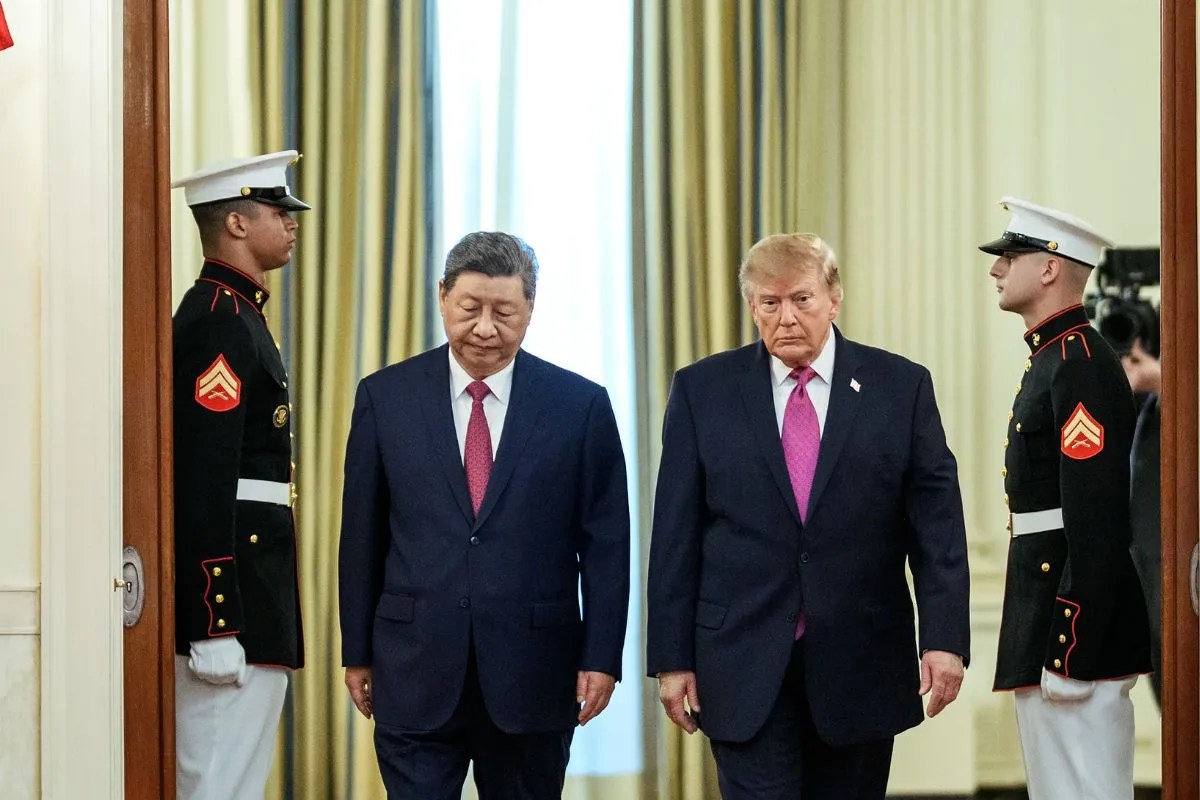
Seeing Donald Trump, Xi Jinping, and Vladimir Putin share the same stage at the November 2026 APEC summit in Shenzhen grabbed headlines everywhere. News outlets immediately wondered if this unprecedented three-way meeting would finally deliver a peace deal for Ukraine.
Here is the blunt truth. It didn't.
If you read past the dramatic photo-ops and sweeping rhetoric about global harmony, the Shenzhen trilateral summit was less about ending active wars and more about three superpowers protecting their own immediate interests. While Trump declared they were "really making history" and promised open dialogue to end conflicts, the actual joint "peace declaration" signed by the U.S., China, and Russia didn't even mention the wars in Ukraine or Iran.
Let's strip away the diplomatic theater and examine what actually happened behind closed doors at Kylin Villa, why Ukraine was left off the final page, and what each leader really walked away with.
The Big Misconception About the Shenzhen Summit
Most coverage framed the Shenzhen meeting around a single question. Can Trump, Xi, and Putin broker a sudden peace?
That framing misses how modern superpower diplomacy actually works. When three leaders with deeply conflicting agendas sit down for just over an hour, they aren't drafting a 50-page ceasefire treaty. They're trading leverage.
Before the summit even kicked off, U.S. Secretary of State Marco Rubio and Chinese Foreign Minister Wang Yi laid the groundwork for a conversation focused on broad strategic stability and nuclear risk reduction. Trump has repeatedly stated he wants to stop the bloodshed and is willing to talk to anyone to get a deal done. Yet wanting a deal and having the specific terms to close one are two completely different things.
The White House released the official U.S.-Russia-China Heads of State Declaration toward Peace on November 19, 2026. If you read the text carefully, you'll notice four specific pillars:
- Promoting United Nations reform
- Increasing the production and supply of refined petroleum products
- Rejecting International Criminal Court (ICC) overreach against state officials
- Maintaining dialogue to prevent nuclear proliferation
Notice what's missing? Kyiv. Tehran. Taipei.
Why Ukraine Was Left Out of the Joint Statement
Putin explicitly brought up the war in Ukraine during the talks, stating that Moscow, Washington, and Beijing shared "many converging interests" in resolving global conflicts. Even so, nothing concrete made it into the joint statement.
Why? Because Beijing refused to get dragged into the diplomatic mud.
As Ruby Osman, a senior policy adviser at the Tony Blair Institute for Global Change, pointed out in coverage by PBS News, China's top priority was steering the summit away from messy specifics. Beijing likes presenting itself as a steady superpower that stays out of foreign wars. Taking ownership of a Ukrainian peace framework—especially right after U.S.-mediated talks between Russia and Ukraine in Abu Dhabi stalled over clashing territorial and ceasefire demands—would have forced Xi Jinping to take sides or absorb blame if talks collapsed.
What Each Leader Actually Wanted in Shenzhen
To understand why the Shenzhen summit produced a vague declaration instead of a ceasefire, you have to look at the personal and political scorecard each man brought into the room.
Donald Trump Needed Nuclear Talks and Energy Stability
For Trump, sitting down with Xi and Putin served multiple urgent domestic and foreign policy goals.
First, nuclear arms control is hitting a dangerous wall. The New START treaty—which capped deployed strategic nuclear warheads for the U.S. and Russia at 1,550 each—expired back in February 2026. Trump had previously rejected simply extending the old bilateral limits because he insists China must be part of any future nuclear pact. With U.S. defense officials warning that China's nuclear stockpile could surpass 1,000 warheads by 2030 (up from roughly 350 in 2022), getting Xi and Putin to publicly endorse nuclear risk-reduction talks was a major priority for Washington.
Second, Trump walked into Shenzhen while managing the economic fallout of the ongoing conflict with Iran. Global energy markets hate uncertainty. Securing a joint commitment from major energy players to boost refined petroleum supplies and stabilize energy flows helps keep fuel prices from spiking back home.
Vladimir Putin Wanted Legitimacy and Relief
Honestly, Putin arguably got the biggest immediate public relations win just by showing up.
For over four years following Russia's full-scale invasion of Ukraine, Western leaders worked to isolate the Kremlin. Sharing a spotlight as an equal partner alongside the presidents of the United States and China shattered that narrative overnight.
Even better for Moscow, the joint declaration took a direct swipe at the International Criminal Court. Back in March 2023, the ICC issued an arrest warrant for Putin over the unlawful deportation of Ukrainian children. In Shenzhen, Trump called the court "out of control", and all three leaders signed off on language stating that state officials must enjoy immunity and that courts "must not abuse their jurisdiction".
Beyond the optics, Putin is hunting for sanctions relief. Russia's economy has absorbed massive punishment, and Putin continues to resist Kyiv's calls for a temporary ceasefire—arguing that a pause only lets Ukrainian forces rest and rearm. By keeping Trump engaged directly, including in a separate bilateral meeting in China, Putin hopes to push Washington toward a broader settlement that rolls back Western economic penalties without forcing Moscow to give up its battlefield gains.
Xi Jinping Wanted Control Without Entanglement
Xi Jinping played host at Kylin Villa and walked away looking like the ultimate global power broker.
By bringing Trump and Putin together on Chinese soil, Xi reinforced Beijing's preferred image as an indispensable diplomatic hub. He used the moment to push UN reform—a long-standing Chinese objective aimed at amplifying voices from Asia, Africa, and South America while diluting traditional Western influence.
At the same time, Xi kept core Chinese sensitivities protected. Taiwan was not mentioned in the joint declaration because Beijing treats it strictly as an internal matter. Xi also used his separate bilateral talks with Trump to stabilize U.S.-China trade relations and push back against American tech restrictions, including disputes surrounding AI chips and Nvidia.
The Irony Nobody Missed at Kylin Villa
If you want to understand the limits of this summit, look at a single visual detail from Shenzhen.
While Xi Jinping declared that "a nuclear war cannot be won and must never be fought" and called for the complete destruction of nuclear weapons, Russian officers stood nearby carrying Putin's nuclear briefcase—the Cheget—which allows the Russian president to authorize a nuclear strike at a moment's notice.
That contrast says everything.
Superpowers routinely sign declarations promising peace, stability, and cooperation. History is full of them. Yet none of the three leaders in Shenzhen agreed to give up a single ounce of hard leverage. No warheads were dismantled. No troops were pulled back. No sanctions were lifted on the spot.
Why European Allies Are Nervous About What Comes Next
In Europe, the reaction to the Trump-Xi-Putin summit wasn't relief. It was anxiety.
German Chancellor Friedrich Merz and other European leaders have openly worried about a repeat of the August 2025 Anchorage meeting between Trump and Putin, which produced proposals that Ukraine and its European backers flatly rejected.
When major powers meet over the heads of smaller nations, history leaves scars. Analysts immediately compared the Shenzhen gathering to the 1945 Yalta Conference, where Allied leaders carved up spheres of influence without consulting the countries caught in the middle.
European capitals fear two specific outcomes from this renewed direct channel between Washington and Moscow:
- Pressure on Kyiv to accept territorial losses. If Trump prioritizes a fast exit from the war to fulfill his promise of ending conflicts quickly, Ukraine could face intense pressure to freeze battle lines on unfavorable terms.
- A fractured Western front. If Washington softens its stance on Russian sanctions or diplomatic isolation while Europe tries to hold the line, transatlantic unity could crack.
How to Read Superpower Summits Without Falling for the Hype
Whenever world leaders hold an emergency or historic summit, headlines tend to swing between wild optimism ("World Peace Is Here!") and total cynicism ("Nothing Matters"). Both reactions are wrong.
If you're trying to track whether the Shenzhen talks actually move the needle on global peace over the coming months, ignore the press conference soundbites and watch four concrete indicators instead:
- Follow-up talks in neutral venues. Watch whether U.S. and Russian negotiators reconvene in places like Abu Dhabi with actual technical teams, not just top politicians. Real peace deals happen in working groups, not photo-ops.
- Movement on sanctions enforcement. Keep an eye on Treasury Department announcements. If Washington quietly eases secondary sanctions on Russian energy or Chinese banks, a broader backroom bargain is underway.
- Nuclear verification proposals. Dialogue about nuclear risk is easy. Watch whether Beijing agrees to actual data exchanges or transparency rules on its expanding warhead arsenal.
- Ukraine's seat at the table. No lasting settlement in Eastern Europe holds without Kyiv's consent. Until Ukrainian officials are directly signing off on security guarantees, any superpower declaration remains ink on paper.
Trump, Xi, and Putin proved in Shenzhen that they can still sit in the same room and sign a joint statement. Turning that photo-op into an actual end to the fighting in Ukraine and the Middle East is a much harder test—and so far, none of them has shown they're ready to pay the price it requires.

