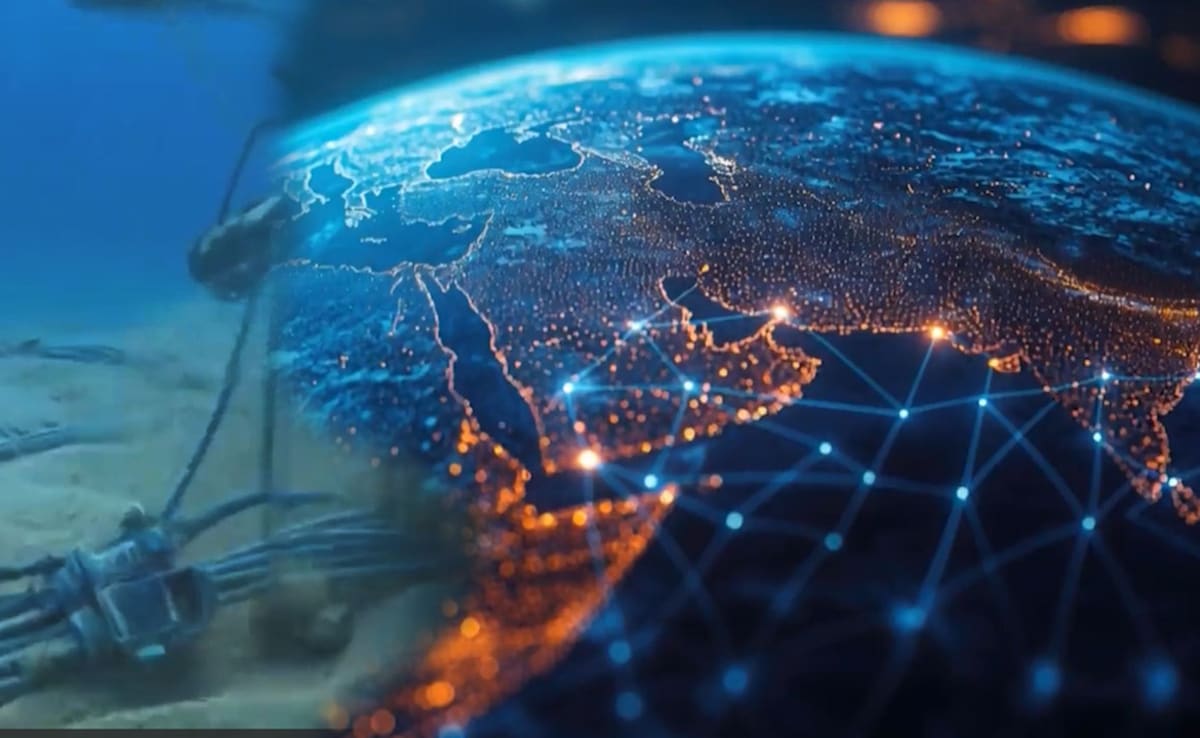
Geopolitics is a magnet for lazy analysis. Every time a Houthi rebel looks at a map or a stray anchor drags across the seabed, the panic industry goes into overdrive. The standard narrative is predictable: India is one cut away from a digital blackout, our $250 billion IT sector is teetering on the edge of a Red Sea abyss, and we are strategically naked.
It is a comforting fantasy for people who love disaster movies. It is also fundamentally wrong.
The panic over the Red Sea cable corridor ignores the basic physics of global networking and the ruthless redundancy built into modern capitalism. We are told the Middle East is the world’s "digital choke point." I’ve spent twenty years watching network architects build around exactly these kinds of "unsolvable" problems. The reality? India’s connectivity has never been more resilient, precisely because the Red Sea is so volatile.
The Myth of the Single Point of Failure
The common argument suggests that because a significant percentage of India-Europe traffic passes through the Bab-el-Mandeb strait, we are vulnerable to a single, catastrophic outage. This assumes that data is like water in a pipe—if you crimp the hose, the garden dies.
Data is not water. It is a swarm of bees. If you block one path, the swarm finds twelve others.
The Red Sea contains roughly 16 to 20 submarine cables, depending on how you count active fiber pairs. Yes, the AAE-1, Seacom, and EIG systems are vital. But the "catastrophe" narrative ignores the massive surge in capacity from the West Africa Cable System (WACS) and the emerging Equiano and 2Africa routes that bypass the Suez entirely by rounding the Cape of Good Hope.
When the Seacom cable went down in previous years, did the Bengaluru tech parks stop humming? No. Latency spiked by 30 milliseconds. That is the blink of an eye. The only people who noticed were high-frequency traders and teenagers playing Twitch shooters. For the rest of the Indian economy, the "crisis" was invisible.
Geography is No Longer Destiny
The "India is at risk" crowd loves to point at the map. They see the narrow gap between Djibouti and Yemen and see a trap. I see a legacy system that is already being disrupted by three distinct forces that the mainstream media refuses to acknowledge.
The Israel-Saudi Land Bridge: While everyone watches the water, the Blue-Raman cable system is quietly changing the game. By running fiber overland through Jordan and Israel, it creates a physical bypass of the Red Sea maritime bottleneck. This isn't just a technical fix; it's a geopolitical shift that renders the Houthi threat irrelevant for any traffic routed through this corridor.
The Rise of "East-to-East" Routing: We are obsessed with the India-Europe link because of a colonial-era mindset that sees London as the center of the web. Look at the data. India’s traffic toward Singapore, Tokyo, and the US West Coast is exploding. We are no longer a terminal at the end of a European line; we are a massive hub connecting the Indo-Pacific. If the Red Sea goes dark, India simply pivots its primary transit east across the Pacific.
Subsea Mesh Networking: Modern SD-WAN (Software-Defined Wide Area Network) technology allows providers to reroute traffic at the packet level in real-time. We are moving away from "static" paths. If a cable snaps near Jeddah, the traffic is redirected via Chennai to Singapore and then across the Pacific to San Jose before the user even finishes loading their LinkedIn feed.
The Anchor Misconception
Let’s address the "sabotage" hysteria. There is a persistent belief that a small group of militants in skiffs can dismantle global civilization with a few grappling hooks.
Submarine cables are not garden hoses. Near the shore, they are armored with layers of galvanized steel wire and buried meters deep in the seabed. In the deep ocean, they are thinner, but they are also miles below the surface. To "accidentally" or even intentionally cut a cable requires specialized equipment or a massive merchant vessel dragging a multi-ton anchor for kilometers.
Most "breaks" in the Red Sea aren't acts of war. They are the result of bad seamanship and shifting tectonic plates. The industry is built for this. We have a global fleet of cable-repair ships that operate like an elite fire department. The idea that a regional conflict will lead to a permanent "darkening" of the Indian internet is a fundamental misunderstanding of how the Submarine Cable Improvement Fund and private consortia operate. They get paid when the data flows. They have every incentive to keep it moving.
The Cost of Paranoia
The real danger to India isn't the Red Sea; it's the reactionary policy that the "risk" narrative generates.
Politicians love a crisis because it justifies "digital sovereignty" projects that are often just sinks for taxpayer money. We are seeing a push for "indigenous" cable landing stations and state-funded maritime patrols. While security is important, the obsession with physical cable protection is a 20th-century solution to a 21st-century problem.
If you want to protect India’s digital future, you don't send a frigate to guard a cable in the Gulf of Aden. You deregulate the landing station licenses in Mumbai and Chennai so that twenty more private cables can land there. You make it so cheap and easy to lay fiber that the redundancy becomes overwhelming.
The goal should be a system so cluttered and complex that cutting ten cables wouldn't even cause a blip on a YouTube stream. We achieve security through abundance, not through fortresses.
The Elephant in the Room: Satellite
Whenever I bring this up to "industry experts," they scoff. "Starlink can't handle the load of a whole country," they say.
They are right, for now. But they are missing the point. Satellite isn't meant to replace the 100 Terabits per second carried by a fiber pair. It is the ultimate insurance policy. As LEO (Low Earth Orbit) constellations like Kuiper and Starlink mature, they provide a "survival layer" of connectivity.
In a total-blackout scenario—the kind the doom-mongers predict—India’s essential services, banking backbones, and military command would shift to space in minutes. The "catastrophe" is downgraded to a "nuisance." The leverage that any regional actor holds over India's digital throat is diminishing every time a SpaceX Falcon 9 launches.
Who Benefits from the Panic?
Follow the money. Who gains when we believe the Red Sea is a deathtrap?
- Insurance Underwriters: They get to spike premiums for every vessel laying or repairing cable in the region.
- Defense Contractors: They get to sell "maritime domain awareness" suites to the Indian Navy.
- Competing Transit Hubs: Countries that want to bypass the Middle East entirely use this fear to pitch their own, more expensive terrestrial routes.
India shouldn't be buying the fear. We are the largest exporter of digital services on the planet. Our leverage over the cable consortia is immense. If a cable operator can't guarantee uptime for Indian traffic, they lose their biggest customer. That market pressure does more to secure the Red Sea than a thousand diplomatic cables or naval patrols.
The Real Vulnerability
If you want to worry about something, don't worry about a Houthi with a hacksaw. Worry about the "Last Mile" inside India.
The vast majority of internet outages in India are caused by a backhoe hitting a fiber line in a suburb of Pune or a local municipal dispute in North Delhi. Our terrestrial infrastructure is far more fragile, less redundant, and more prone to "sabotage" (usually by incompetent construction crews) than anything lying at the bottom of the Red Sea.
We are hyper-focused on the "grand strategy" of undersea cables while our domestic grid is held together with hope and duct tape. It’s classic "big picture" blindness. We fear the shark in the ocean while ignoring the termites eating our house.
The Strategy of Indifference
India’s best move in the Red Sea is a calculated indifference. We should continue to diversify our landing points—moving beyond the Mumbai/Chennai duopoly to Kochi, Vizag, and Tuticorin. We should encourage the "Great Circle" routes that go through Southeast Asia and up to the US.
But we must stop treating the Red Sea as a dagger at our throat. It is a busy, messy, crowded hallway. Sometimes people trip, and sometimes lights flicker. But the hallway isn't going anywhere, and we have already built the exits we need.
The next time you see a headline about "India’s Digital Lifeline at Risk," remember that the people writing it probably don't know the difference between a repeater and a router. They are selling you a story of fragility because stability is boring.
India’s digital economy is a hydra. Cut one head off in the Red Sea, and two more grow in the Atlantic and the Pacific. The "choke point" is a ghost. Stop acting like you're haunted.
Stop looking for a solution to the Red Sea "problem." The problem has already been solved by the sheer, unbridled scale of global data demand. The market fixed it while the geopoliticians were still looking for their maps.
Go back to work. The internet isn't going anywhere.