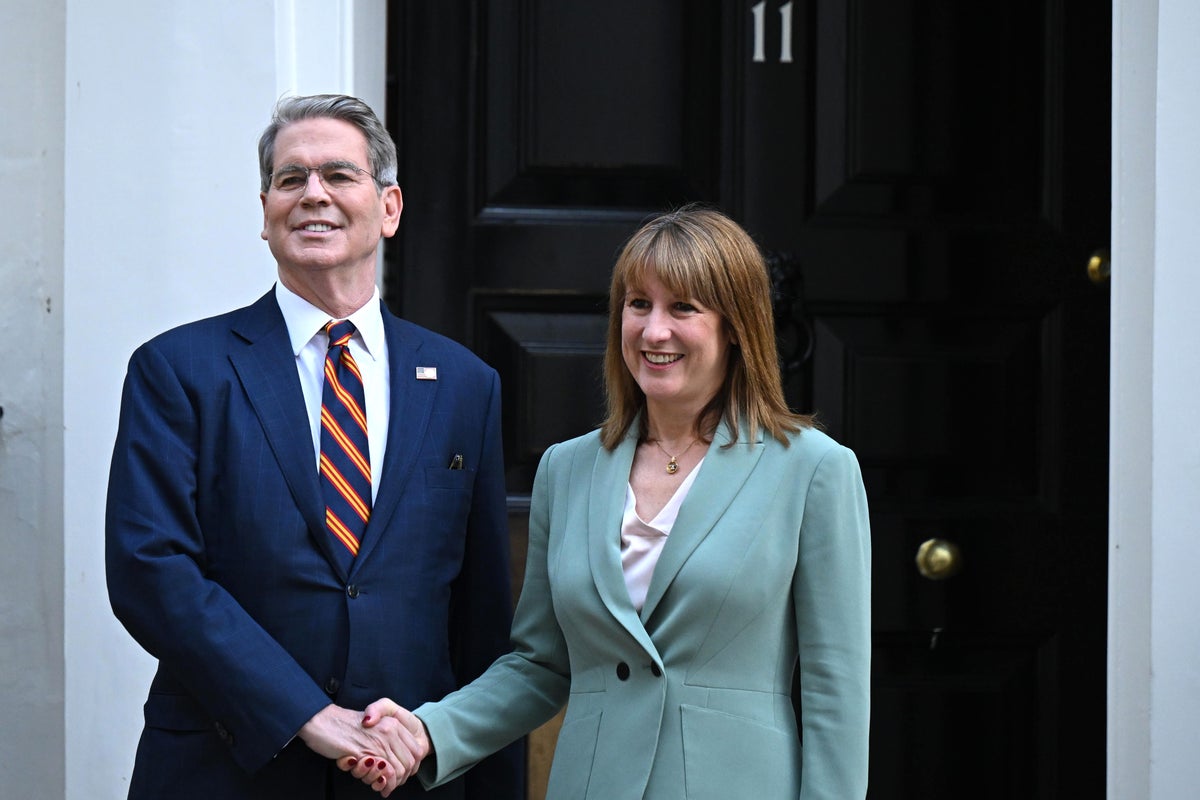
The headlines are fixated on a dinner table scrap.
Rachel Reeves, the UK Chancellor, and Scott Bessent, the incoming US Treasury Secretary, reportedly "argued" in Washington. The catalyst? Reeves had the audacity to suggest that a war with Iran would be a catastrophic mistake for the global economy. The mainstream press is treating this like a high school drama—a "clash of personalities" or a "diplomatic blunder."
They are missing the point.
This wasn't a failure of diplomacy. It was a cold, calculated preview of the new world order. The "argument" wasn't about Iran. It was about the death of the "Special Relationship" as we know it and the birth of a transactional, cold-blooded era of fiscal nationalism.
If you think this is about two politicians not getting along, you are reading the wrong map.
The Myth of the Unified West
For decades, the consensus has been that the UK and US move in lockstep on Middle Eastern policy. We’ve been fed a steady diet of "shared values" and "aligned interests."
It’s a lie.
Reeves isn't arguing from a position of moral superiority or pacifism. She is arguing from a position of fiscal desperation. The UK’s "black hole" in public finances doesn't allow for the luxury of a secondary energy shock. Britain is currently a fragile economy masquerading as a global power. A war in the Middle East doesn't just mean higher petrol prices; it means the total collapse of the Labour party's carefully curated "stability" narrative.
Bessent, meanwhile, represents the "America First" fiscal wing. To him, Reeves’ concerns aren't a strategic warning—they are an annoyance. The US is nearing energy independence in ways the UK can only dream of. When Bessent pushes back, he isn't defending a war cabinet; he is asserting that the US Treasury no longer feels the need to coddle the economic anxieties of a mid-sized European island.
The Iran Distraction
The media is obsessed with the "Iran war" comment because it’s provocative. But Iran is the symptom, not the disease.
The real friction is the divergence of Internal Rates of Return on geopolitical stability.
- The UK Perspective: Reeves knows that any disruption to the Suez Canal or the Strait of Hormuz sends the UK's Consumer Price Index (CPI) into a death spiral. She is terrified of a repeat of the 1970s. For the UK, peace is a fiscal necessity.
- The US Perspective: Under the incoming administration, the US is pivoting toward a "peace through strength" or "calculated chaos" model. If global markets tremble, the Dollar often strengthens as a safe haven. Bessent knows that while a war is expensive, the threat of one is a powerful tool for renegotiating trade deals and forcing allies to pay their way.
When Reeves speaks, she sounds like a bank manager. When Bessent speaks, he sounds like a private equity mogul. They aren't even speaking the same language.
Why Reeves is Right (And Why It Doesn't Matter)
Let’s be brutally honest: Reeves is 100% correct about the economic fallout.
Imagine a scenario where a conflict closes the Strait of Hormuz. We aren't looking at $100 oil; we are looking at $150 or $200. This would trigger a global recession that would make 2008 look like a minor market correction.
The UK’s debt-to-GDP ratio is already hovering around 100%. A spike in borrowing costs, driven by an inflationary shock, would force Reeves to either implement austerity measures that would make George Osborne look like a socialist or watch the Pound Sterling get slaughtered on the FX markets.
But being right doesn't give you leverage.
I’ve seen dozens of junior partners in corporate mergers try to "warn" the majority shareholder about risks. The majority shareholder doesn't care because they have the capital to survive the fire. The junior partner doesn't.
Bessent knows Reeves has no cards. Where is she going to go? To the EU? The UK spent five years burning that bridge. To China? Not with the current security climate. Reeves is screaming into a void because the UK has outsourced its security to a country that is increasingly uninterested in the UK's balance sheet.
The Fallacy of "Diplomatic Friction"
The "People Also Ask" sections of the internet are currently flooded with questions like: Will this hurt UK-US trade relations?
The question itself is flawed. It assumes "relations" are a static thing that can be damaged by a dinner party spat.
In reality, trade relations are now purely algorithmic. Bessent is a man who understands the "carry trade" and "risk premiums." He isn't going to punish the UK because Reeves was annoying at dinner. He is going to squeeze the UK because it is in the US's economic interest to do so.
The spat is a signal to the markets that the US Treasury is no longer acting as a guarantor of global European stability. If you are an investor, you should be looking at the widening spread between US Treasuries and UK Gilts. That gap is the "Reeves-Bessent" tax.
Stop Looking for "Alignment"
The business community needs to wake up. The era of the "unshakeable alliance" is over. We are moving into a period of strategic divergence.
- Currency Volatility: Expect the GBP/USD pair to become more sensitive to geopolitical rhetoric than to actual economic data.
- Energy Hedging: If you are running a business in the UK, your energy strategy cannot rely on "diplomatic solutions." You need to hedge for the worst-case scenario because your government has zero influence over the decision-makers in Washington.
- Defense Spending: Reeves’ criticism of war isn't just about Iran; it’s an admission that the UK cannot afford to participate. This creates a vacuum.
The Professionalism of Conflict
The press calls it an "argument." I call it a price discovery mechanism.
They were testing each other’s limits. Reeves was testing how much the US still cares about the global commons (the answer: not much). Bessent was testing how much pressure the UK can take before it folds on trade concessions (the answer: a lot more).
The "status quo" was a polite fiction where the US pretended to listen and the UK pretended to lead. That fiction is dead.
Reeves' mistake wasn't criticizing a potential war. Her mistake was thinking that the US Treasury still considers "global economic stability" to be its primary mandate. It isn't. The new mandate is American dominance at any cost, including the bankruptcy of its closest allies.
The Hard Truth for the City of London
If you are sitting in a boardroom in London, stop analyzing Reeves’ "tone."
Analyze her impotence.
When the Chancellor of the Exchequer goes to Washington and gets slapped down for stating an obvious economic truth, it tells you everything you need to know about Britain's place in the new hierarchy. The UK is no longer the bridge between Europe and America. It is a lifeboat drifting away from a burning ship, trying to convince the captain of a nearby supertanker to slow down.
The supertanker isn't slowing down.
Bessent’s job is to maximize the US's position. If that means a "hawkish" stance that terrifies the markets, he will take it. If that means letting the UK sweat through an inflationary crisis, he will allow it.
The "argument" in Washington wasn't a glitch in the system. It is the system working exactly as intended.
Get used to the heat. This is just the beginning of the friction.
Stop asking if they will make up. Start asking how your portfolio survives when the two people holding the purse strings of the Atlantic world realize they have nothing in common.
The Special Relationship isn't being tested. It’s being liquidated.