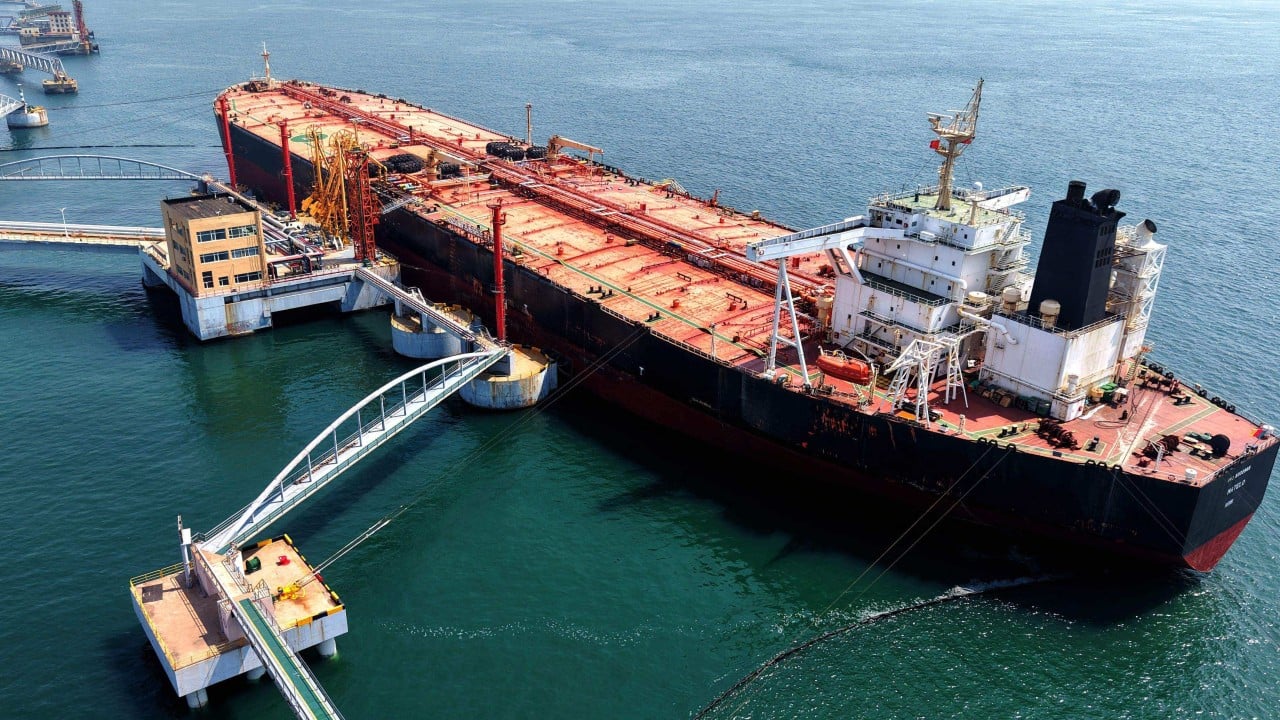
The preliminary maritime accord between Washington and Tehran has triggered a swift 5% liquidation in Brent crude futures, exposing a structural vulnerability for Chinese industrial buyers and independent refiners. For three months, the closure of the Strait of Hormuz forced a systemic re-routing of global energy flows, allowing Chinese market participants to capture significant economic rents through illicit maritime supply chains and discounted "dark transit" barrels. As the geopolitical premium evaporates and the Strait of Hormuz prepares for a phased 60-day reopening, the mechanical basis of this regulatory arbitrage has collapsed.
Understanding the impact on Chinese firms requires moving past vague warnings about market uncertainty and instead analyzing the specific mechanisms of their trade. The disruption is governed by three specific economic forces: the dissolution of the dark-tanker discount structure, the operational friction of high-cost domestic inventory liquidation, and the legal exposures created by evolving sanction architectures.
The Economics of Demolished Arbitrage: The Discount Compression Function
The profitability model of Chinese independent refiners, concentrated heavily in Shandong province, operates as a function of the spread between official benchmarks and heavily discounted sanctioned crude. When the Strait of Hormuz was closed, global spot prices climbed above $100 a barrel, while illicit flows from the Gulf relied on complex transshipment networks that required steep price concessions to offset the risks of maritime transport.
The normalization of the Strait of Hormuz destroys this margin structure through a two-step mechanism:
[Hormuz Reopening]
       │
       ▼
[Global Supply Normalization] ──► [Brent Decelerates toward $80]
       │
       ▼
[Discount Compression] ──► [Spread Between Official & Dark Barrels Shrinks]
       │
       ▼
[Refinery Margin Collapse] ──► [Shandong Teapots Face Net Cash Flow Losses]
The Benchmark Convergence Effect
As global supplies normalize, Brent benchmarks are shifting downward toward $80 a barrel. This drop reduces the absolute discount that sanctioned producers must offer to attract buyers. When official barrels are affordable and legally compliant, the economic incentive to clear illicit cargo disappears.
The Transshipment Cost Sticky Function
While the discount on crude is shrinking, the operational costs of dark-fleet logistics—such as ship-to-ship transfers, multi-flagging, and high-premium alternative maritime insurance—remain fixed. Refiners face a double squeeze: the price advantages of their inputs are vanishing, but the logistical premium required to move those inputs is stuck at peak levels.
This compression alters the cost function of independent refiners. During the blockade, these "teapot" refiners maintained positive cash flows by processing cheap, non-standard feedstocks. With the benchmark dropping to the low $80s, the net margin per barrel processed is falling below breakeven levels, leaving these entities highly exposed to structural oversupply.
The Inventory Devaluation Trap: High-Cost Baselines vs. Spot Market Realities
During the three-month maritime blockade, Chinese state and private actors executed a defensive inventory drawdown, cutting imports by an estimated 4 million barrels per day to insulate the domestic economy from triple-digit oil prices. This strategy successfully protected short-term GDP growth but created a dangerous balance-sheet mismatch.
The current challenge is defined by the financial mechanics of commercial and strategic inventories:
- The Cost Basis Disconnect: Refiners and state trading entities are holding significant volumes of crude acquired when prices were near their peak. The sudden drop in oil prices forces a immediate downward valuation of these physical assets under standard accounting principles.
- The Refining Margin Squeeze: Refiners must now process high-cost inventory while selling the resulting refined products—such as diesel, gasoline, and petrochemical feedstocks—at current, lower spot market prices. This lag ensures compression in refining margins for at least the next two quarters.
- The Capital Deployment Squeeze: Replenishing drawn-down strategic stockpiles at current prices sounds attractive, but doing so ties up valuable corporate cash. Chinese industrial firms face a difficult choice: lock up liquidity to rebuild their physical buffers, or keep cash free at the expense of long-term energy security.
This inventory trap is worsened by declining domestic consumption. Refining margins across Asia were already slowing due to a structural transition toward electric commercial vehicles and a broader economic cooldown. Forcing high-cost inventory through a weak supply chain strips away the remaining profitability of secondary processing facilities.
The Legal Grey Zone: Structural Flaws in the 60-Day Enforcement Window
The text of the preliminary U.S.-Iran memorandum reveals a temporary 60-day window for broader nuclear and economic diplomacy. Rather than delivering immediate clarity, this timeline creates a volatile legal environment for Chinese state-owned enterprises (SOEs) and financial institutions.
       [60-Day Preliminary Accord Window]
                       │
       ┌───────────────┴───────────────┐
       ▼                               ▼
[Snapshot Enforcement Risk]     [The Toll Platform Dilemma]
  - U.S. Office of Foreign        - Iran plans post-60 day
    Assets Control (OFAC)           transit fees on shipping.
  - Retroactive lookbacks.        - Complying with fees violates
  - Exposure of historic          - ongoing western secondary
    dark-fleet transactions.        sanctions framework.
Snapshot Enforcement Risk
The U.S. Office of Foreign Assets Control (OFAC) keeps its primary and secondary sanctions frameworks fully active during these interim negotiations. With the immediate threat of war removed, western regulatory agencies can refocus their attention on enforcing compliance. This shift puts a target on the complex networks of front companies, regional banks, and logistics intermediaries that handled hidden oil shipments over the last quarter. Financial institutions that cleared these transactions now face retroactive penalties during a period of increased scrutiny.
The Toll Platform Dilemma
A major hurdle in the agreement is Iran’s plan to charge transit fees on merchant ships moving through the Strait of Hormuz after the initial 60 days. These fees are intended to cover security and navigation services. However, because these payments go directly to state-linked entities in Tehran, any Chinese firm paying them risks violating Western secondary sanctions. This friction divides the shipping industry into two distinct tiers:
- State-Insulated Maritime Fleets: Operators that carry no Western insurance and have no exposure to the U.S. financial system can pay these fees directly. This allows them to maintain access to the route, though they remain locked out of broader global trade networks.
- Globalized Commercial Fleets: International carriers and major Chinese state lines must avoid these payments entirely to protect their access to Western markets. This restriction forces them to take longer, more expensive routes, wiping out the cost benefits of the reopened strait.
Strategic Playbook for Chinese Energy Procurement
To navigate this transition, Chinese market participants must abandon short-term trading tactics and shift toward structural asset management. This requires adjustments across three specific operational areas:
1. Rebalancing Supply Contracts
Firms must actively reduce their exposure to high-risk spot volumes from the Gulf. They should look to replace these barrels by locking in term contracts with suppliers in the Americas and the UAE, where production capacity is projected to expand through 2027.
2. Upgrading Risk Management for the Dark Fleet
Compliance departments must draw a clear line between legacy transshipment operations and future shipping routes. Any logistics network that relies on unhedged, un-vetted vessels must be unwound before western regulatory agencies step up their enforcement efforts during the 60-day window.
3. Accelerated Downstream Retrofitting
With refining margins squeezed, capital expenditure should be shifted away from primary crude distillation. Instead, investment must target deep-conversion chemical processing assets. Transforming low-margin fuel refining into high-value specialty chemical production is the only viable path to long-term profitability as domestic fuel demand shifts structurally downward.