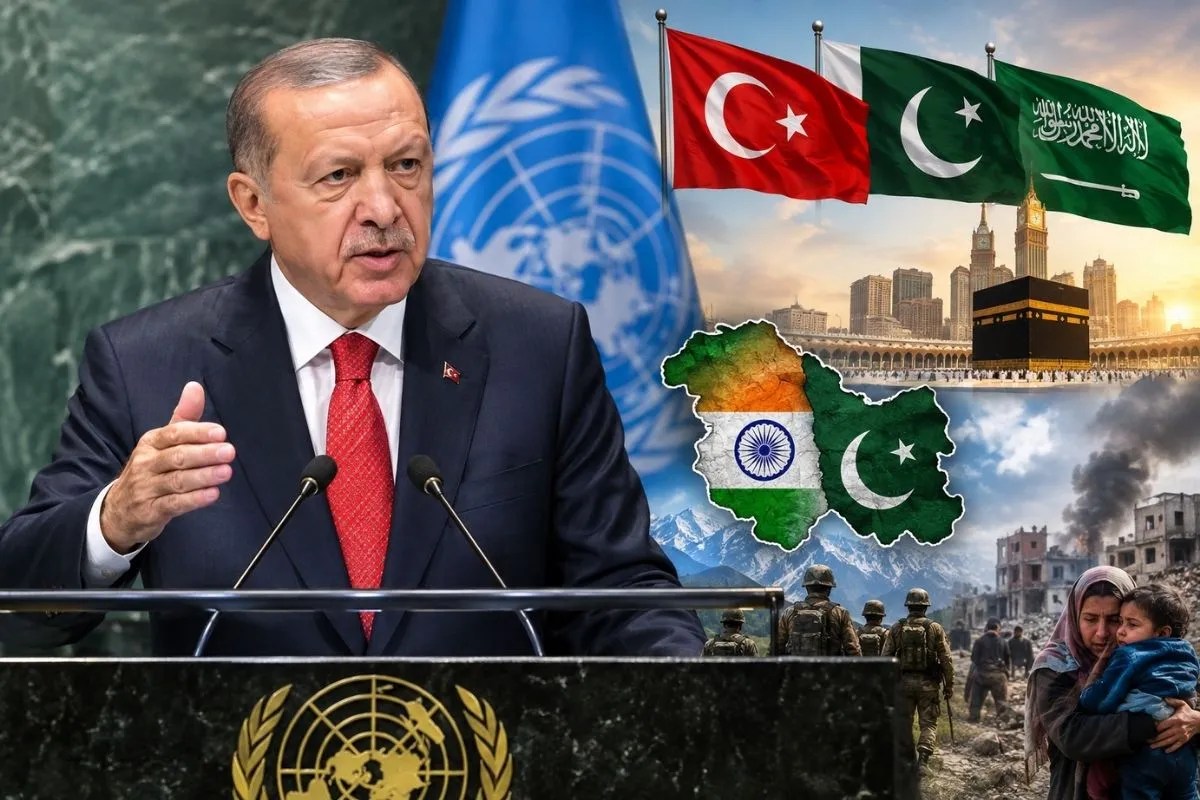
The air inside the great glass chamber of the United Nations General Assembly hall always smells faintly of old paper, polished mahogany, and the quiet, heavy dread of diplomats who know that the words spoken into the microphones can tip nations from peace into ash.
It is a strange place, built on the eastern edge of Manhattan after the second global slaughter to prevent a third. Yet, beneath its soaring ceilings and multi-lingual whispers, leaders still stand at the walnut podium and project the oldest human impulse: the threat of total destruction. When Donald Trump stepped up to that podium during his presidency and warned of the complete annihilation of Iran, the cameras captured the tight mouths of foreign delegates, the frantic scribbling of translators, and the cold geometry of power politics.
We read these headlines over morning coffee or scroll past them on glowing screens while waiting for the subway. We treat them as noise. Just another diplomatic squabble. Another rhetorical salvo in a decades-long cold war fought across the Persian Gulf, through proxy militias, and inside subterranean uranium enrichment facilities.
We forget what annihilation actually means.
To understand the weight of such speeches, you have to look past the teleprompter and the cable news chyrons. You have to step outside the air-conditioned boardrooms of Washington and into the crowded alleys of Tehran, where ordinary families buy bread, worry about the price of medicine, and carry the generational trauma of a revolution, a brutal eight-year war with Iraq, and the crushing gravity of economic sanctions.
Consider a hypothetical textile merchant in the Grand Bazaar of Tehran, a man named Reza. He has never met an American president. He does not vote in U.S. elections, and his English consists of a few polite phrases learned from old Hollywood films. But Reza’s life is entirely dictated by the acoustic resonance of rooms like the UN General Assembly. When a leader halfway across the world speaks of total destruction, Reza does not analyze the syntax for political posturing. He looks at the exchange rate of the Iranian rial against the dollar. He watches the price of cooking oil climb another notch. He wonders, with a quiet, persistent knot in his stomach, whether his sons will be drafted into a war that no one wants yet everyone seems to be sleepwalking toward.
This is the human element that gets lost when statistics and threats are traded like poker chips.
The history of U.S.-Iranian relations is a long, winding tragedy of missed exits and mutual miscalculation. It stretches back to 1953, when American and British intelligence orchestrated a coup that overthrew Iran’s democratically elected Prime Minister, Mohammad Mossadegh, reinstating the authoritarian Shah to secure Western oil interests. That intervention planted the bitter seeds of the 1979 Islamic Revolution—a seismic populist uprising that swept the Shah away and replaced him with a theocracy built on an explicit foundation of anti-American fervor.
For over four decades, this bilateral hostility has hardened into political dogma. On the American side, Iran is viewed through the lens of state-sponsored terrorism, the seizure of the U.S. embassy hostages, proxy attacks across the Middle East, and the relentless pursuit of a nuclear weapon. On the Iranian side, the United States is cast as the Great Satan—an imperialist interloper bent on regime change and the humiliation of an ancient civilization.
When threats of annihilation are hurled across the international stage, they do not convince the regime in Tehran to surrender its ambitions. Instead, they achieve the exact opposite effect. They validate the hardliners. They give the clerics and the Islamic Revolutionary Guard Corps the rhetorical ammunition they need to convince a skeptical populace that external enemies are at the gates, justifying repression at home and defiance abroad.
Diplomacy is not a spectator sport. It is a fragile bridge built out of patience, listening, and the slow, unglamorous work of finding common ground where none appears to exist. When that bridge is shelled with fiery rhetoric, the space for moderation shrinks to the vanishing point.
Think of international relations not as a game of chess played by emotionless grandmasters, but as a crowded room filled with fragile, reactive human beings operating under immense pressure, armed with weapons that can end human civilization in an afternoon. In that room, shouting matches do not project strength. They project a terrifying lack of control.
The words spoken at the United Nations echo long after the delegates pack their briefcases and fly home. They settle into the collective consciousness of millions of people who have no voice in the halls of power. They shape the calculations of generals, the anxieties of parents, and the futures of children who have inherited a world too fragile for the egos of its leaders.
The real danger of such speeches is not just the immediate spike in geopolitical tension. It is the normalization of catastrophe. When the vocabulary of genocide and total annihilation becomes standard political discourse, we inch closer to a reality where the unthinkable becomes inevitable.
We must ask ourselves what kind of world we are building when the ultimate threat of mass violence is packaged as foreign policy. We must demand a return to the grueling, difficult work of dialogue, because the alternative is a silence far more permanent than any speech.
The lights in the General Assembly hall eventually dim. The translators log off. The cleaning crews sweep up the crumpled papers and discarded headphone sets. But out in the world, the human cost remains, waiting to see if cooler heads will prevail before the rhetoric finally catches fire.