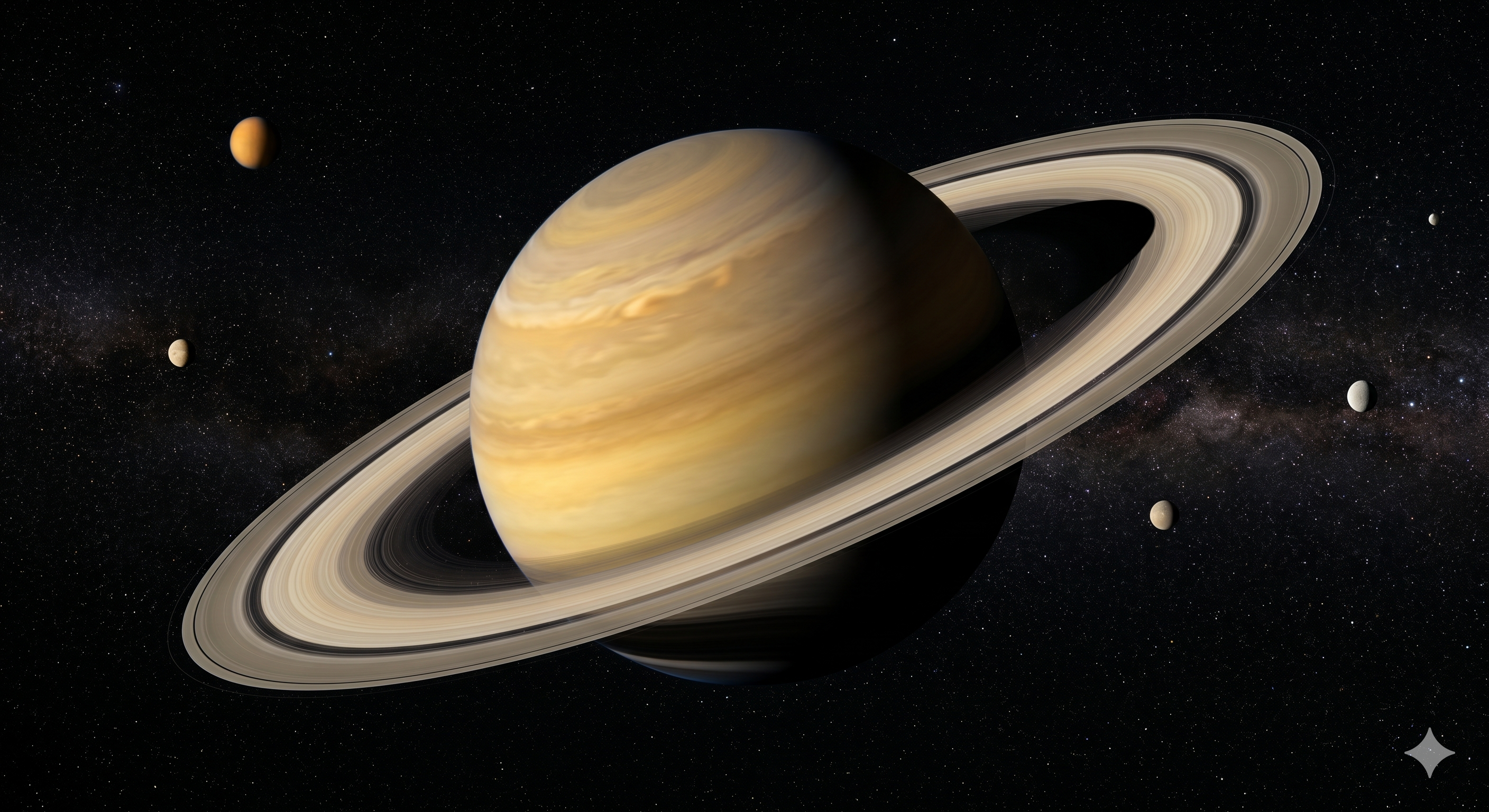
Saturn’s rotation rate is not a fixed constant but a dynamic problem of magnetospheric coupling and internal fluid dynamics. While terrestrial bodies offer a solid crust to serve as a reliable reference frame, gas giants present a "slippery" coordinate system where the visible atmosphere, the magnetic field, and the deep interior rotate at distinct, often decoupled velocities. The historical "mystery" of Saturn’s changing day—a variance of approximately six minutes observed between the Voyager flybys and the Cassini mission—is actually a byproduct of three specific mechanical subsystems: the lack of a surface-anchored magnetic dipole, the influence of the Enceladus plasma torus, and the seasonal variability of ionospheric conductivity.
The Reference Frame Crisis
Measuring the rotation of a gas giant requires a proxy for the deep interior, usually provided by the magnetic field. On Jupiter, the magnetic pole is tilted significantly relative to the rotation axis, creating a "pulsing" radio signal (the System III rotation period) that acts like a planetary lighthouse. Saturn, however, possesses an almost perfectly axisymmetric magnetic field. The alignment of the magnetic and rotational axes is within 0.01 degrees, which effectively hides the rotation of the deep interior from external observers. For another view, read: this related article.
The absence of a tilt forces astronomers to rely on Saturnian Kilometric Radiation (SKR). This radio emission was long assumed to be a direct clock for the planet’s bulk rotation. The data proved this assumption flawed. Between 1981 and 2004, the SKR-derived period shifted from 10 hours, 39 minutes to 10 hours, 45 minutes. A planetary mass does not physically slow down by 1% over two decades without a cataclysmic exchange of angular momentum. Therefore, the "change" is not in the planet’s spin, but in the speed of the clock being used to measure it.
The Plasma Torus Drag Mechanism
The primary driver of the SKR variance is the mass-loading of the magnetosphere by Saturn’s moon, Enceladus. Unlike Jupiter’s volcanic moon Io, which injects heavy sulfur ions, Enceladus ejects water vapor through cryovolcanic plumes. This vapor ionizes into a cold plasma torus surrounding the planet. Related reporting on this matter has been shared by Engadget.
- Mass Loading: As the plasma density increases, it creates an inertial drag on the magnetic field lines.
- Sub-corotational Velocity: The magnetic field lines, which are rooted in the planet’s interior, attempt to drag the plasma torus along at the planetary rotation speed. However, the sheer mass of the plasma causes the field lines to lag.
- Slippage: This lag manifests as a slower rotation of the magnetospheric features, including the SKR radio sources.
The variation in Enceladus’s plume activity directly modulates the density of this torus. When the torus is denser, the drag is higher, and the observed "day" appears longer. This is a classic case of observer bias: the measuring tool (the magnetic field’s radio signature) is being buffered by an external fluid medium, decoupling it from the physical rotation of the core.
Seasonal Ionospheric Conductivity
The second layer of the anomaly is driven by the 26.7-degree tilt of Saturn’s axis, which creates intense seasonal cycles over its 29-year orbit. These seasons change the solar UV flux hitting the northern and southern hemispheres, altering the electron density in the upper atmosphere.
Higher ionospheric conductivity creates a stronger "grip" between the atmosphere and the magnetic field lines. Because the magnetic field lines connect the northern and southern hemispheres, a tug-of-war ensues. During the southern summer, the southern ionosphere exerts a stronger influence on the magnetospheric rotation than the north. This hemispheric asymmetry causes the radio periods in the north and south to diverge. At certain points in Saturn’s orbit, the planet effectively has two different "clocks" running simultaneously, neither of which represents the true rotation of the heavy metal and ice core.
Internal Seismology as a New Metric
To bypass the noise of the magnetosphere, recent analysis has pivoted toward "Kronoseismology"—using Saturn’s rings as a giant seismograph. Gravitational perturbations caused by oscillations within the planet’s interior create spiral density waves in the C-ring.
Unlike radio signals, these gravitational waves are unaffected by plasma drag or seasonal ionospheric shifts. They are direct products of the planet’s internal density distribution and rotation-induced acoustic modes. Analysis of these ring waves suggests a stable interior rotation period of 10 hours, 33 minutes, and 38 seconds. This value is significantly faster than both the Voyager and Cassini radio measurements, indicating that the entire magnetosphere is in a state of permanent lag relative to the deep interior.
Structural Bottlenecks in Data Acquisition
The limitation of our current understanding stems from the "snapshot" nature of orbital missions. Cassini provided a high-resolution view of one seasonal cycle, but it lacked the longitudinal data to map how the plasma drag evolves over centuries. We are currently operating with a limited sample size of two major data points (Voyager and Cassini) separated by a single Saturnian year.
Furthermore, the "Great White Spots"—massive atmospheric storms that occur every 30 years—likely inject massive amounts of energy and material into the upper atmosphere, potentially resetting or disrupting the ionospheric conductivity loops. The causal link between these mega-storms and magnetospheric rotation remains a hypothesis because we lack continuous, multi-decadal monitoring.
Comparative Dynamics: Saturn vs. Jupiter
To quantify the uniqueness of Saturn’s problem, one must look at the magnetic Reynolds number ($R_m$), which defines the ratio of induction to diffusion in a conducting fluid.
$$R_m = \frac{vL}{\eta}$$
In this equation:
- $v$ is the velocity of the fluid flow.
- $L$ is the characteristic length scale.
- $\eta$ is the magnetic diffusivity.
In Jupiter, the high $R_m$ and significant magnetic tilt ensure that the magnetic field is "frozen" into the deep interior, providing a rigid rotation signal. In Saturn, the lower $R_m$ in the outer layers of the metallic hydrogen envelope, combined with the extreme axial symmetry, allows for the "slippage" observed. Saturn’s interior is essentially masked by a layer of differential rotation that Jupiter’s stronger, tilted field manages to penetrate.
Strategic Forecast: The End of the "Mystery"
The resolution of the Saturn spin anomaly shifts the focus from "What is the day length?" to "How does the interior couple with the exterior?" Future mission profiles must abandon SKR as a primary clock and instead prioritize gravity field mapping and ring-seismology instruments.
The definitive rotation period will likely be established not through better radio telescopes, but through the refinement of internal fluid-dynamic models that account for the transition zone between molecular hydrogen and metallic hydrogen. This transition, occurring at pressures exceeding 100 GPa, is where the magnetic field is generated. Until we can map the convection currents at this depth, the "true" day remains a mathematical derivation rather than an observed fact.
Operators and mission planners should treat Saturn’s rotation as a variable system rather than a constant, utilizing a 10-hour, 33-minute baseline for deep-interior modeling while maintaining a secondary, seasonally-adjusted "magnetospheric coordinate system" for orbital navigation and plasma physics.