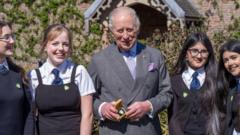
King Charles III has officially received the Blue Peter Green badge, the highest environmental accolade awarded by the long-running BBC children’s program. While the ceremony carries the soft-focus charm of public service broadcasting, it signals a deeper shift in how the British monarchy intends to utilize its soft power. This isn't just about a plastic badge made from recycled yogurt pots. It is a calculated move to bridge the gap between traditional statecraft and the urgent, often radical, environmentalism of the younger generation.
The King earned this recognition for his work launching the Coronation Food Project, a massive logistical undertaking aimed at bridging the gap between food waste and food poverty. In a world where luxury and sustainability often sit at odds, the King is attempting to position the Crown as the ultimate mediator. He isn't just a figurehead anymore; he is trying to be a systems engineer for the planet.
A Legacy Built on Early Warnings
Decades before "sustainability" became a corporate buzzword, the then-Prince of Wales was widely mocked for his views on organic farming and plastic pollution. History has been kind to his predictions, if not his critics. By accepting a badge usually reserved for children who save their local ponds, the King is performing a specific kind of humility. He is acknowledging that the future of the movement belongs to the "Blue Peter" demographic, not the boardroom.
The Green badge itself is a cultural icon in the UK. Since its inception in 1988, it has served as a gateway for youth activism. By joining this club, the King is effectively "degreeding" his status, moving away from the stiff formality of royal decrees and into the grassroots world of community action. It is a brilliant bit of PR, but it also carries the weight of a lifelong obsession with the natural world.
The Mechanics of the Coronation Food Project
The project that secured the badge focuses on two primary failures in the current British infrastructure. First, the staggering amount of perfectly edible food that ends up in landfills. Second, the millions of citizens facing food insecurity. The King’s initiative seeks to build "circulatory hubs"—massive warehouses that can process and redistribute surplus food at a scale previously unseen in the charitable sector.
This isn't a small-scale bake sale. We are talking about thousands of tonnes of produce. By focusing on the supply chain, the King is tackling the environmental crisis at its source: inefficiency. Waste is, after all, the ultimate environmental sin. If you can solve the waste problem, you solve a significant portion of the carbon footprint associated with agriculture and transport.
The Counter Argument to Royal Activism
Critics often point out the inherent contradiction of a monarch—who lives in palaces and travels by private jet—lecturing the public on carbon footprints. It is a valid critique. The carbon cost of maintaining the Royal Estate is significant. However, the King’s strategy appears to be one of "pragmatic influence." He knows he cannot live in a hut, so he uses his platform to move the levers of industry.
The tension here is between individual lifestyle and systemic change. While a child earns a Green badge by recycling at home, the King earns his by convening CEOs of major supermarkets to change their waste policies. Both are necessary, but only one has the potential to move the needle on a national level. The badge acts as a bridge between these two worlds, validating the efforts of the individual while highlighting the power of the institution.
Why the Blue Peter Badge Matters Now
We are seeing a fragmentation of environmental messaging. On one side, you have the doomsday warnings of climate scientists. On the other, the performative activism of social media. Blue Peter represents a third path: practical, optimistic, and community-focused.
For the King, the badge is a tool for intergenerational equity. He is seventy-five years old. The children watching Blue Peter will be the ones living with the consequences of today's policy decisions in the year 2080. By engaging with this specific audience, he is attempting to build a long-term alliance that outlasts his own reign. He is planting trees under whose shade he knows he will never sit.
The Symbolism of Recycled Plastic
The badge is made from waste plastic. This is a deliberate choice by the BBC to showcase the circular economy. In the past, royal honors were made of gold, silver, and silk. Today, the most prestigious honor a King can receive from the public is a piece of molded scrap. This inversion of value says more about our current era than any speech could. We are moving into a period where the ability to "un-waste" something is more valuable than the ability to extract something new from the ground.
Navigating the Political Minefield
Environmentalism in the UK has become increasingly politicized. Policies like the Ultra Low Emission Zone (ULEZ) or shifts in "net zero" targets have created a rift in the electorate. The King, as a constitutional monarch, must remain politically neutral. This makes his environmental work a high-wire act.
He frames his work not as "politics," but as "stewardship." This distinction is vital. Stewardship is a conservative value in the truest sense—the desire to conserve and protect. By grounding his activism in the traditions of the British countryside and the "common sense" of not wasting food, he avoids the trap of being labeled a partisan radical. He is making environmentalism safe for the establishment.
The Ripple Effect on Global Diplomacy
The King’s environmental credentials give him a unique standing on the world stage. When he speaks at COP summits, he does so with the authority of someone who has been in the trenches for fifty years. The Blue Peter badge, while seemingly minor, adds to this "street cred." It shows a willingness to engage with the public on their terms.
Foreign leaders notice this. They see a monarch who is deeply attuned to the concerns of the next generation. This isn't just about the UK; it’s about how the "green brand" of Britain is exported. The badge is a symbol of a nation that, despite its internal struggles, still views environmental protection as a core part of its identity.
The Reality of the Coronation Food Hubs
If we look at the actual data from the first year of the Coronation Food Project, the numbers are promising but highlight the scale of the challenge. The project has already saved millions of meals, yet the "waste gap" remains vast.
- Investment: Millions have been raised through private donations to fund the infrastructure.
- Logistics: Partnerships with groups like FareShare and the Felix Project have been expanded.
- Impact: A measurable reduction in methane emissions from diverted organic waste.
The success of this model depends on consistency. It cannot be a flash-in-the-pan royal project. It requires a permanent shift in how supermarkets and manufacturers view their "seconds" and "near-expiry" stock. The King’s role is to keep the pressure on these corporations, using the prestige of his office—and now his Green badge—as both a carrot and a stick.
A New Era of Royal Recognition
The awarding of this badge marks a departure from the "top-down" nature of royal honors. Usually, the King gives out the medals. In this instance, he is the recipient of an honor bestowed by a cultural institution that represents the voice of the youth. This horizontal shift in power is subtle but significant.
It suggests a monarchy that is aware of its need to be "earned." In the 21st century, the right to lead is increasingly tied to the ability to solve global problems. The King has effectively auditioned for the role of "Environmentalist in Chief" and the Blue Peter audience has given him their seal of approval.
The Weight of the Plastic Badge
There is a certain irony in a man who wears a crown of jewels valuing a plastic badge so highly. But the Green badge is a heavy responsibility. It carries the expectation of a generation that is tired of talk and hungry for results. The King has tied his legacy to the success of these environmental initiatives.
If the Coronation Food Project fails to scale, or if the Royal Estate's own carbon footprint doesn't see a drastic reduction, the badge will become a symbol of hypocrisy. But if he succeeds, he will have redefined the purpose of the British monarchy for a new century. He is betting that the public cares more about a leader who can fix a broken supply chain than one who can simply cut a ribbon.
The badge is currently pinned to a lapel in a palace, but its true value is being tested in the warehouses and community kitchens of the UK. This is the new front line of royal duty. It isn't glamorous. It smells like compost and discarded cabbage. It involves logistics, spreadsheets, and cold storage. But this is exactly where the King needs to be if he wants to remain relevant in a world that is rapidly heating up.
Stop looking at the ceremony and start looking at the tonnage of food being moved through those hubs. That is the only metric that actually matters.