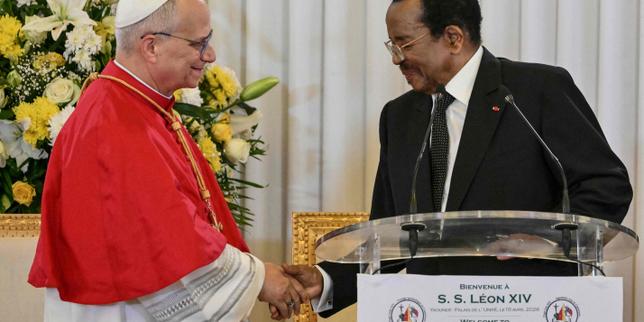
Pope Leo XIV’s recent address in Cameroon painted a romanticized picture of the law as a "sturdy rampart" protecting the weak from the whims of the wealthy. It is a comforting narrative. It is also dangerously wrong. To suggest that the law acts as a neutral shield in developing economies is to ignore the brutal reality of how legal systems actually function under pressure. In the corridors of power from Yaoundé to Zurich, the law isn't a wall; it's a gate. And the wealthy are the ones holding the keys.
The "lazy consensus" pushed by religious and political leaders suggests that if we simply tighten the rules, the playing field levels itself. This ignores the Transactional Nature of Justice. In reality, legal systems in emerging markets often serve as instruments of consolidation for the very people they are meant to restrain.
The Myth of the Neutral Referee
We are told that the law is a static set of rules. It isn't. The law is a living, breathing service industry. Like any service, the quality you receive is directly proportional to the amount of capital you can deploy. When Leo XIV speaks of the law as a "rampart," he fails to mention that building a rampart requires engineers, masons, and constant maintenance. In legal terms, that means top-tier litigators, lobbyists, and the ability to outlast your opponent in a war of attrition.
For a subsistence farmer in the Northwest Region of Cameroon or a small-scale entrepreneur in Douala, a legal dispute isn't a search for justice. It's a death sentence by paperwork. While a billionaire can park a case in the courts for a decade, a small business owner loses their livelihood in three months of "due process." The time-value of money makes the law an inherent weapon for the rich, regardless of what is written in the statutes.
Regulatory Capture is the Feature Not the Bug
The Pope’s discourse assumes that the caprices of the rich are outside the law. They aren't. The truly wealthy don't break the law; they buy the pen that writes it. This is what economists call Regulatory Capture.
I have seen multinational corporations enter African markets and essentially draft the environmental and labor regulations they pretend to follow. By the time the "rampart" is built, it has been designed with specific, high-tech backdoors that only the architect can use.
- Statutory Complexity: The more complex the law, the more it favors the wealthy. Complexity requires interpretation. Interpretation requires expensive experts.
- Arbitration Clauses: The rich have successfully moved the most important legal battles out of public courts and into private, closed-door arbitration.
- The Compliance Moat: Heavy regulation often hurts the poor more than the rich by creating high "barriers to entry" that only the wealthy can afford to navigate.
The Poverty of Institutional Idealism
The central flaw in the Vatican's logic is the belief that institutions precede culture. You cannot drop a "perfect" legal code into a system where the social contract is broken and expect it to function as a shield. In many post-colonial states, the legal framework was never designed to protect the citizen; it was designed to extract resources for the state.
When we tell the marginalized to "trust the law," we are often telling them to trust the very mechanism that dispossessed them. It is a form of gaslighting. Real protection doesn't come from a thick book of statutes; it comes from Economic Agency. A person with a diversified income and mobile assets is far more protected from a "rich man's caprice" than a person with a "strong law" they can't afford to trigger.
The Cost of Entry into "Justice"
Let’s look at the math of a standard commercial dispute. If the cost of legal representation exceeds the value of the claim, the law effectively does not exist for that claimant.
$$V_c - C_l < 0 \implies \text{No Justice}$$
Where $V_c$ is the value of the claim and $C_l$ is the total cost of legal maneuvers. For the global elite, $C_l$ is a rounding error. For the rest of the world, $C_l$ is a mountain. This simple inequality proves that "equality before the law" is a mathematical impossibility in a capitalist framework without radical intervention that the Pope didn't bother to detail.
Stop Praying for Better Laws
The obsession with "strengthening the rule of law" often becomes a distraction from the real work of decentralizing power. If you want to protect the weak from the caprices of the rich, you don't need more judges—who are often selected from the same social circles as the rich. You need to reduce the dependency of the weak on the structures the rich control.
This means:
- Direct Property Rights: Bypassing central bureaucracies to secure land titles via immutable ledgers.
- Radical Transparency: Making every government contract and payment public in real-time, so the "rampart" isn't built in the dark.
- Jurisdictional Competition: Allowing people to opt into different legal frameworks so that no single "rich man" can capture the entire system.
The Moral Hazard of Hope
By framing the law as a "sure rampart," we create a moral hazard. We encourage the vulnerable to put their faith in a system that is rigged against them. It’s like telling a man to hide behind a paper wall during a hurricane. It feels good to say, but it's lethal advice.
The law is a tool, not a temple. Like any tool, it belongs to the person who knows how to swing it. In our current global reality, the rich have been practicing their swing for centuries. They aren't afraid of the law; they are the law's most frequent customers.
If we want to actually disrupt the "caprices of the rich," we have to stop treating the legal system as a sacred protector and start treating it as a flawed, captured market that needs to be broken wide open.
Don't wait for a decree from a palace or a cathedral to save you. Build your own leverage. Secure your own assets. The only rampart that actually holds is the one you own outright.