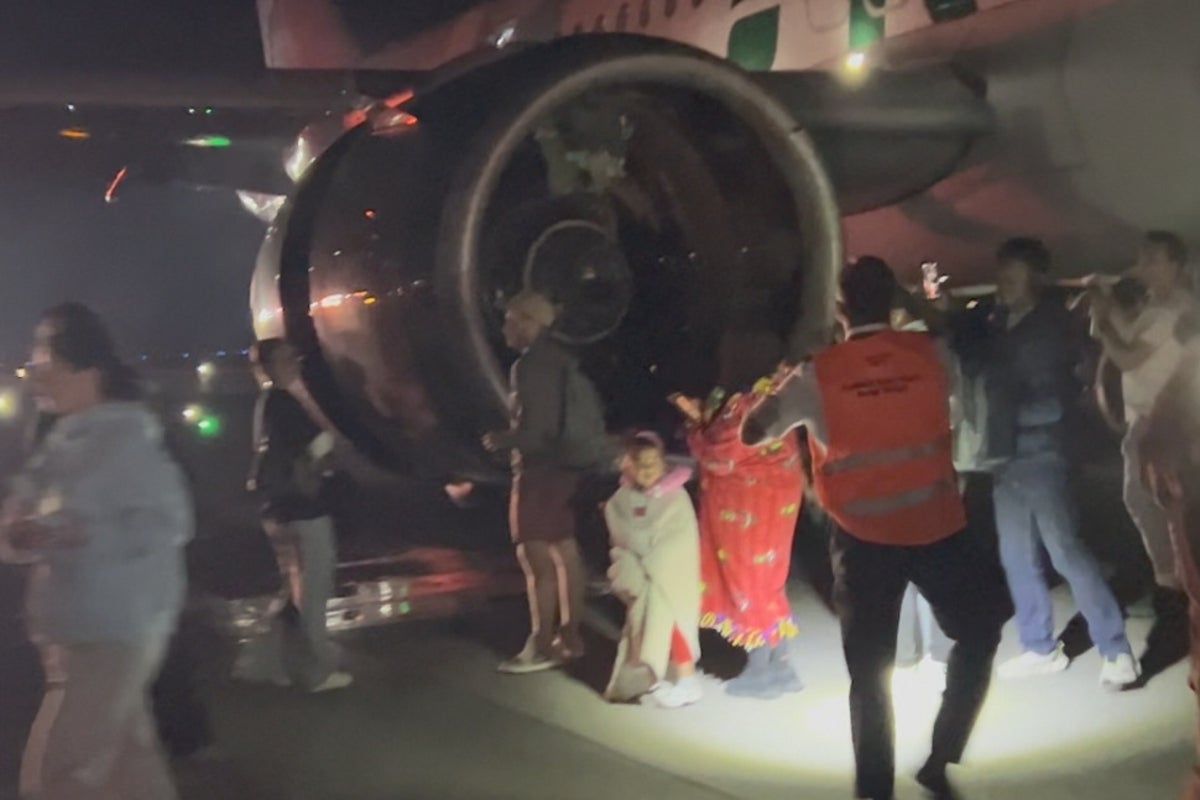
The thermal footage out of Denver International Airport isn't a tragedy of errors. It is a mathematical inevitability that the aviation industry refuses to price into the cost of doing business. While the media salivates over the grainy, glowing heat signatures of a human being being struck by a Boeing 737, they are missing the systemic rot hidden in plain sight. We are obsessed with the "moment of impact" because it’s visceral. We should be obsessed with the infrastructure that allowed a person to walk onto a live runway at one of the busiest hubs in the world.
The standard narrative is lazy. It blames "security lapses" or "human error." This is a comforting lie. It suggests that if we just hire better guards or install more cameras, the problem vanishes. It won't. As long as we prioritize throughput and "invisible" security over physical hardening, people will keep dying on the tarmac.
The Thermal Illusion of Safety
Thermal imaging is the industry’s favorite pacifier. It looks high-tech. It feels proactive. In reality, it is a reactive forensic tool that tells us exactly how someone died after it’s already too late to save them. The Denver footage shows a heat signature moving across the runway. The pilots didn't see it. The towers didn't see it in time.
Why? Because the human eye—and even most current automated logic—is terrible at spotting a 170-pound mammal in a sea of concrete, jet exhaust, and heat soak. A runway is a massive thermal battery. In the summer, the tarmac radiates heat for hours. Trying to spot a person via thermal sensors against that background is like trying to find a specific candle in a forest fire.
I have consulted on perimeter security for Tier-1 logistics hubs. I can tell you exactly why this happens: Ground Radar is a mess. Surface Movement Guidance and Control Systems (SMGCS) are designed to track massive aluminum tubes, not a lone individual. When a person enters the sterile area, they are often filtered out as "noise" by the software to prevent false alarms from birds or debris. We have optimized our safety systems to keep planes from hitting planes. We have entirely ignored the "soft" targets.
The Myth of the Sterile Area
The industry loves the term "sterile area." It implies a vacuum-sealed environment where nothing enters without a badge and a background check. In reality, an airport is a Swiss-cheese sieve of contractors, catering crews, fuelers, and maintenance staff.
- The Labor Gap: We rely on low-wage, high-turnover third-party contractors to manage the most sensitive entry points.
- The Fatigue Factor: Air traffic controllers are overworked, understaffed, and staring at screens that haven't seen a significant UI overhaul in decades.
- The False Sense of Security: Fences are psychological barriers, not physical ones. Anyone with a pair of $15 bolt cutters or enough desperation can breach a perimeter in under 60 seconds.
If you think a fence keeps an airport safe, you’ve never seen a determined intruder. The Denver incident highlights a fundamental flaw in how we perceive airport boundaries. We treat the fence as the finish line. In reality, the fence is just the starting gun for an incursion.
Why Pilot Visibility is a Dead End
The public asks: "Why didn't the pilot just stop?"
This question betrays a fundamental ignorance of physics and cockpit ergonomics. A Boeing 737-800 has a maximum takeoff weight of roughly $79,000$ kg. If that aircraft is in its takeoff roll or even high-speed taxi, the kinetic energy involved is staggering.
The formula for kinetic energy is:
$$E_k = \frac{1}{2}mv^2$$
Even at a "slow" taxi speed of 20 knots (approx. 10.3 m/s), a 70,000 kg aircraft carries over 3.7 million Joules of energy. You aren't "stopping" that because you see a flickering heat signature 100 feet ahead. Furthermore, the nose of a commercial jet creates a massive blind spot. Pilots are trained to look for other aircraft and runway lighting, not a pedestrian who shouldn't exist in their workspace.
Blaming the flight crew is a cheap way to avoid talking about the $500 million upgrades required to actually secure a runway.
Stop Asking How and Start Asking Why
The "People Also Ask" sections of the internet are flooded with questions like: How did they get on the runway?
That is the wrong question. The right question is: Why is it still possible to walk onto a runway in 2026?
We have the technology to prevent this. We choose not to use it because it’s expensive and it slows down the "gear-up, gear-down" cycle of modern aviation.
- AI-Driven LiDAR Fencing: Standard motion sensors are useless. We need LiDAR arrays that create a 360-degree point cloud of the entire airfield, capable of distinguishing a human gait from a wandering coyote.
- Automated Emergency Braking (AEB) for Tarmac Vehicles: We have this in $25,000$ sedans. Why isn't it integrated into ground tugs and, eventually, taxiing logic for aircraft?
- Physical Hardening: Move away from chain-link fences toward anti-climb, crash-rated barriers.
The downside? It costs billions. It adds three minutes to every turnaround. In the airline industry, three minutes is an eternity of lost revenue. So, the industry does a cost-benefit analysis. They decide that the occasional "unauthorized person on the runway" is cheaper than the systemic overhaul required to stop it.
The Brutal Reality of Airport Economics
I’ve sat in the boardrooms where these decisions are made. When you propose a comprehensive, zero-trust perimeter solution, the first question isn't "Will it save lives?" It’s "How does this affect our gate-turnover rate?"
Airports are shopping malls with runways attached. The priority is moving passengers through the terminal and moving planes through the gates. Security is designed to be "just good enough" to satisfy regulatory minimums.
The Denver incident isn't a fluke. It's a data point.
Dismantling the "Lone Actor" Defense
Whenever this happens, the PR machine pivots to the "mental health" or "lone actor" narrative. By painting the intruder as an anomaly, the airport avoids culpability for the systemic failure.
- "They were determined to get in."
- "It was an unpredictable act."
- "No system is 100% foolproof."
These are all variations of the same excuse. If a "determined actor" can reach a live runway, so can a coordinated group with far more malicious intent. This isn't just a safety issue; it's a glaring neon sign pointing to a massive security vacuum.
If you can walk in front of a plane, you can place an object on the runway. You can interfere with navigation arrays. You can compromise the entire hub. The "moment of impact" captured on thermal cameras is the least scary part of this story. The scary part is the five minutes before the impact where the system was blind, deaf, and dumb.
The Actionable Truth
If you’re waiting for the FAA or airport authorities to "fix" this, stop. They won't fix it until the lawsuits exceed the cost of the upgrades.
As a traveler, realize that "airport security" is a performance that ends the moment you leave the gate area. The exterior of the airport is often the most vulnerable part of the entire journey. We spend billions on scanners to find a bottle of water in a carry-on, while the perimeter is guarded by a fence you could jump with a step-stool.
We don't need more footage. We don't need more "moment of impact" replays. We need to stop pretending that our current infrastructure is anything other than a series of lucky breaks.
The thermal footage isn't a tragedy. It’s a receipt. It’s the price we pay for cheap tickets and fast turnarounds.
Stop looking at the glow and start looking at the gaps.