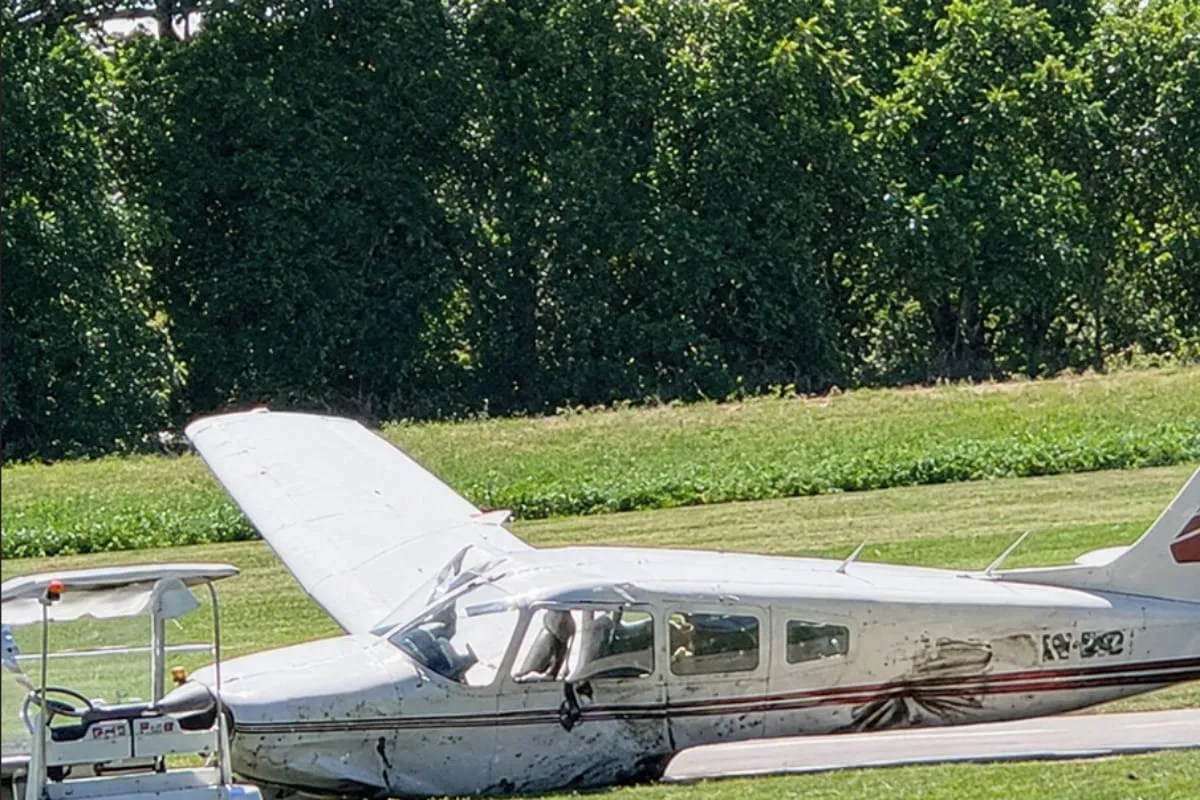
When an aircraft collides with a ground vehicle during landing, the immediate human toll and physical impact dominate headlines, yet the deeper operational failure lies in how two distinct movement systems intersect under high-energy conditions. A report titled "लैंडिंग के दौरान प्लेन की हुई कार से टक्कर, ऑस्ट्रेलिया में दो लोग घायल" (Plane Collides with Car During Landing, Two Injured in Australia) signals an incident where a landing aircraft and a ground vehicle occupied the same physical space at the same time, resulting in physical injury. Because no full incident report, flight data, air traffic control transcripts, or local investigation findings are provided here, any exact figures, locations, aircraft models, or causal determinations beyond the title itself remain unconfirmed. This analysis treats the headline as a structural case study in high-consequence system intersection, mapping how ground-air conflicts occur, why standard separation controls sometimes fail, and how aviation safety systems evaluate risk when exact empirical details are still emerging.
Separating Known Facts From Analytical Hypotheses
A rigorous safety evaluation begins by drawing a hard boundary between verified facts and analytical hypotheses. In this scenario, the only confirmed facts given in the reference are that a collision occurred between a plane and a car during landing, that the event took place in Australia, and that two people were injured. Everything beyond those four elements—such as whether the vehicle was an airport service truck, a maintenance utility vehicle, or an unauthorized car near or on a runway or landing strip; whether the aircraft was a commercial airliner, a charter plane, or a general aviation craft; and what weather, lighting, or communication conditions prevailed—is unverified.
Treating hypotheses as settled facts distorts risk analysis. If a reader assumes a commercial jet struck an airside operations vehicle at a major international hub, they will apply air traffic control and apron management models suited to high-density commercial terminals. If instead a light aircraft touched down on a regional airstrip or rural strip and struck a ground vehicle, the governing dynamics shift toward visual acquisition, perimeter access control, and unmonitored or lightly controlled airspace procedures. A disciplined analyst states what is known, flags what is missing, and builds models around mechanisms rather than invented details.
The operational logic of a landing collision can be understood through three structural dimensions:
- Spatial-Temporal Convergence: Two mobile objects—one moving primarily along a high-speed glide and rollout path, the other moving on a surface network—enter the same volume of space at the same moment.
- Control Regime Asymmetry: Pilots operate under aerodynamic momentum, runway alignment constraints, and cockpit workload demands, while ground drivers operate under surface visibility, road/track rules, and local clearance protocols that may or may not be linked directly to tower frequencies.
- Energy-to-Margin Ratio: Landing aircraft carry substantial kinetic energy and have limited lateral maneuverability once committed to touchdown and rollout, leaving narrow recovery margins when an unexpected obstacle appears.
The Architecture of Ground and Landing Conflicts
Landing is one of the highest-workload phases of flight. The crew manages descent profile, airspeed, configuration changes, runway alignment, touchdown point, braking action, and directional control within a compressed time window. Unlike level cruise, where minor deviations can be corrected over minutes, late-stage approach and landing leave seconds for perception, decision, and physical response.
Ground vehicles around aerodromes and landing areas operate in a parallel environment with different physical constraints. Vehicles move slower than landing aircraft, yet they can enter hazardous zones through several pathways:
- Direct Movement Area Intrusion: A vehicle enters an active runway or designated landing strip without proper clearance or awareness of an approaching aircraft.
- Perimeter or Access Boundary Breach: A vehicle enters a landing area from an adjacent road, track, or unmonitored access point, creating a surprise hazard that neither air traffic control nor flight crews anticipated.
- Visual and Situational Blind Spots: Low sun glare, rain, fog, terrain undulations, hangars, vegetation, or vehicle positioning obscure sightlines between the cockpit and the surface.
- Communication and Coordination Gaps: Ground personnel lack direct radio contact with the aircraft or controlling facility, or rely on outdated position assumptions when schedules or runway assignments shift.
Consider two contrasting operational settings to see how these mechanisms play out. At a controlled airport with towered operations, surface movement radar, lighting controls, and formal vehicle permitting, layers of procedural and technical defense exist to keep vehicles clear of active runways. Even there, human factors—such as habit capture, readback/hearback errors, or task saturation—can allow a vehicle to cross a threshold at the wrong time. At a smaller regional strip or non-towered landing area, technical surveillance may be minimal or absent, placing heavier reliance on visual scan, local procedures, and physical barriers. In both cases, a collision happens when multiple preventive barriers fail or are bypassed simultaneously.
Why Conventional Safety Buffers Break Down
Aviation safety relies heavily on defense in depth—overlapping barriers designed so that one mistake does not produce an accident. When a landing collision occurs, it exposes how conventional buffers can degrade under real-world friction.
One major vulnerability is asymmetric perception. A pilot descending toward a runway is focused on aim point, glide path, airspeed, and centerline alignment. A small vehicle, or a vehicle angled away from the viewer, or a car operating outside typical airside markings can blend into background clutter. Conversely, a driver inside a vehicle may hear engine noise or see an aircraft only when it is already low and fast, misjudging closing speed because human depth perception struggles with rapidly growing silhouettes at a distance.
A second vulnerability is coupling and latency. Safety systems often assume tight coupling between information and action: a controller sees a conflict, issues an instruction, the pilot or driver hears it, understands it, and executes a change. In practice, each link introduces latency. Radio frequencies can be congested, drivers may not monitor aviation frequencies, call signs or positions can be misheard, and mechanical deceleration takes distance regardless of how quickly a brake is applied.
A safety buffer only protects the system if the time required to detect, decide, and act is shorter than the time remaining before impact. Once closing time drops below human and mechanical reaction thresholds, procedure alone cannot prevent contact.
High-reliability organization theory helps explain why organizations sometimes overestimate their defenses after long stretches of incident-free operation. Prolonged periods without a collision can create normalization of deviance—shortcuts in perimeter checks, informal vehicle routes, or complacency around routine movements start to feel normal because nothing bad happened yesterday. Yet rare, high-consequence events often sit at the intersection of routine shortcuts and an unusual external condition, such as poor visibility, a schedule change, or a distracted operator.
Cause-and-Effect Chains Often Missed in Surface Coverage
Standard news summaries tend to treat a plane-and-car collision as a simple sequence: a plane was landing, a car was in the way, they collided, and people were injured. That linear framing misses critical feedback loops and second-order effects that shape both the severity of the event and the recovery afterward.
First, kinetic transfer and structural mismatch govern injury mechanics. Aircraft fuselages, wings, and landing gear are engineered to balance strength with strict weight limits, whereas passenger and utility vehicles are built for road crash standards rather than aircraft strike geometry. A strike to a wing, propeller, engine cowling, or fuselage skin can deflect the aircraft, collapse gear, or spark fuel and electrical hazards, turning a low-speed ground encounter into a severe structural or fire event. Even when injuries are limited to two people, the physical dynamics depend heavily on relative speed, point of impact, and whether occupants were belted or near high-energy components.
Second, operational ripple effects extend far beyond the immediate site. Even a minor collision on or near a landing surface typically triggers an emergency response, scene preservation, and a formal safety investigation. That freezes the affected runway or strip, delays inbound and outbound flights, forces diversions or cancellations, and ties up emergency and operational staff. The direct injury count captures human harm, while the operational freeze captures system disruption.
Third, investigative lag creates an information vacuum. Immediately after an incident in Australia or any other jurisdiction, authorities must secure the scene, interview witnesses, examine physical wreckage and records, and verify timelines before releasing verified conclusions. Early reports inevitably lack root-cause certainty. Analysts who rush to assign blame before official findings emerge risk reinforcing myths rather than fixing system weaknesses.
Evaluating Risk Without Guessing Missing Data
When exact facts are unavailable, structured risk analysis offers a practical way to assess what matters most without fabricating details. Safety practitioners often evaluate hazards by looking at likelihood, severity, and controllability, paired with clear indicators of where defenses are strongest or weakest.
Here is how an analyst can structure an evaluation when only high-level facts exist:
- Establish Baseline Facts: Record only verified elements—in this case, a landing collision involving a plane and a car in Australia with two injuries—and timestamp when those facts were reported.
- Map Plausible Operating Contexts: Identify the distinct environments where a plane and car could meet during landing (controlled aerodrome airside, regional/non-towered strip, or adjacent perimeter/access interface) without assuming one is proven.
- Audit Barrier Categories: Examine physical barriers (fencing, gates, markings, lighting), procedural barriers (clearances, briefings, right-of-way rules), and technical barriers (surveillance, alerting, communications).
- Track Leading vs. Lagging Indicators: Treat the collision and two injuries as a lagging outcome, and look for leading indicators in real investigations—such as prior runway or strip incursions, perimeter gate faults, visibility conditions, or training gaps.
A key limitation of this analytical framework is that conceptual models cannot substitute for physical evidence. Knowing that visibility, communication, or perimeter control can fail does not prove which one failed in a specific case. Over-interpreting an early headline can lead organizations to over-index on the wrong fix—such as tightening a rule that was already followed while ignoring a physical barrier that was broken. Good strategy respects uncertainty until evidence narrows the field.
Strategic Play for Operators and Safety Teams
For airport operators, aerodrome managers, flight operations teams, and safety analysts confronting an incident report like this one, the immediate strategic move is to run a structured 72-hour barrier audit across every point where ground vehicles and landing paths can converge, anchored strictly to verified facts until official investigation findings are published. Rather than reacting to rumors or making sweeping policy changes based on incomplete details, teams should inspect physical access points, verify communication and visual sightlines along landing corridors, review recent near-miss logs for similar spatial conflicts, and brief crews on situational awareness during approach, touchdown, and rollout. Disciplined verification paired with targeted barrier checks turns an incomplete headline into a concrete test of real-world system resilience.