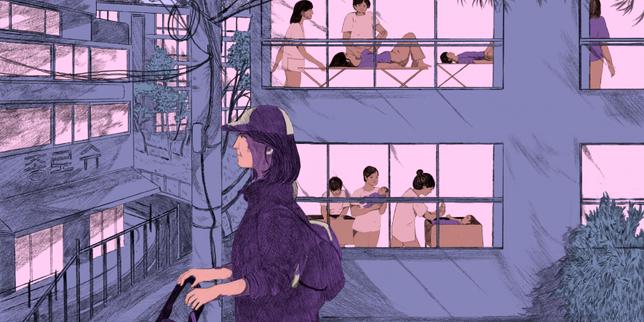
The door closes. The sound of the street outside—the frantic hum of traffic, the sharp clatter of delivery scooters, the relentless ticking of a city that never stops running—vanishes.
Silence. Or at least, a heavy, padded quiet.
Min-jee stands in the center of the room. She is holding a newborn who weighs less than a bag of flour, yet feels as heavy as an anchor pulling her down into an abyss of exhaustion. She has not slept a stretch longer than forty-five minutes in three days. Her stitches throb. Her bones feel as though they have been unbolted and reassembled by an amateur. She looks down at the bassinet, then at the hospital discharge papers, and a cold wave of terror washes over her. How am I supposed to keep this fragile thing alive when I can barely keep myself upright?
Then, a soft knock breaks the spell.
A woman in a crisp uniform enters, smiling with the practiced gentleness of a monk. She does not offer platitudes about how fast they grow. She does not tell Min-jee to cherish every moment. Instead, she reaches out, takes the baby with practiced ease, and says something that sounds almost illegal in its generosity: "Go sleep. Everything else is taken care of."
This is not a fairy tale. This is a postpartum care center in Seoul.
To understand what happens inside these buildings—locally known as sanhujoriwon—you have to first understand the modern architecture of exhaustion that awaits new parents across the globe. In most Western societies, the arrival of a child is treated as an individual endurance test. You give birth, you stumble home after forty-eight hours, and you are expected to figure out lactation, sleep deprivation, and healing while managing laundry, grocery shopping, and unsolicited advice from relatives. The message is clear: suffering is the price of admission to parenthood.
South Korea looked at that model and decided it was broken.
The origin of this system lies in an ancient tradition called *sanhuk, a period of intentional postpartum confinement designed to protect a mother's vulnerable body. For centuries, grandmothers brewed herbal broths and managed the household so the new mother could rest. But as Korea modernized, families atomized. High-rise apartments replaced multigenerational homes. Young couples moved to Seoul for work, far from their ancestral villages.
Nature abhorred a vacuum. The market stepped in, transforming an ancient cultural practice into a multi-million-dollar industry of institutionalized grace.
Today, nearly eighty percent of South Korean women check into a sanhujoriwon after leaving the hospital. These facilities range from clean, mid-tier spaces to ultra-luxurious hotels where elite chefs prepare bone broths infused with red ginseng, and where nurseries are equipped with air purification systems that rival semiconductor cleanrooms.
Let us be entirely honest about the economics of this. These centers are expensive. The top-tier facilities in wealthy districts like Gangnam cost thousands of dollars a week—sums that spark fierce debates about inequality and the soaring costs of child-rearing in a country already grappling with the world’s lowest birth rate. Critics rightly point out that a luxury cocoon cannot solve the systemic structural pressures pushing young Koreans away from starting families.
Yet, to dismiss the sanhujoriwon as merely a playground for the wealthy is to miss the deeper psychological truth of why they exist. They exist because the postpartum body is a disaster zone, and our modern societies pretend it is a construction site.
Imagine running a marathon while recovering from major abdominal surgery, then being handed a demanding, round-the-clock management job with zero training. That is the reality of the first two weeks postpartum.
Inside the center, the rules of normal life are suspended.
Min-jee’s room features a bed that adjusts with the touch of a button, a high-end breast pump waiting on the counter, and a window overlooking the gray, neon-lit sprawl of Seoul. But outside that window, the city doesn't matter. Inside, time is measured only in feeding intervals and massage appointments.
Every morning begins with a knock on the door. A specialist arrives to check the surgical incision, tracking the slow, agonizing contraction of the uterus back to its proper size. Down the hall, physical therapists work on pelvic floors that have borne the weight of an expanding universe. Traditional herbal medicines arrive steaming in ceramic bowls.
And then, there is the baby care.
In a traditional home setting, the infant is a relentless alarm clock. In the center, the nursery features rows of transparent cribs monitored by pediatric nurses. Closed-circuit cameras beam a live feed of the baby directly to an app on the mother's phone. When Min-jee needs to sleep, she turns off the app, draws the blackout curtains, and surrenders to the deep, heavy sleep of the profoundly exhausted. When she wants her baby, she buzzes the nursery.
The greatest gift these centers offer is not the Michelin-star-adjacent soup or the postpartum yoga classes. It is the dismantling of isolation.
In the common areas, women who arrived as strangers sit side by side in oversized pajamas, nursing their infants and whispering about the strange, terrifying geometry of motherhood. They compare notes on engorgement, share tips on latching techniques, and confess their secret fears of inadequacy. There is no judgment here. No one tells them to bounce back. The culture of the center assumes that the mother is the patient who needs healing just as much as the child needs feeding.
This communal validation is a powerful antidote to postpartum depression, a condition that thrives in the dark, silent hours of a solitary 3 a.m. feeding. When you see five other women pacing the dimly lit corridors in identical slippers, clutching ice packs and staring blankly into space, you realize a vital truth: you are not failing. You are simply human.
Fathers are welcome, though their presence is often strictly regulated to maintain the sanctuary's tranquility. Many centers ban male visitors entirely or restrict them to specific evening hours to ensure the environment remains a place of absolute recovery. Some fathers complain about the rules, but most quickly realize the wisdom in them. The center is a theater of recovery, not a family hotel.
When the two weeks—or sometimes four weeks—come to an end, the dread returns.
The checkout day is notoriously emotional. Mothers pack their bags, staring at the front door that opens back out into the chaotic, unyielding reality of the real world. They have learned how to bathe a slippery newborn under the watchful eye of a veteran nurse. They have attended lectures on infant CPR and developmental milestones. They leave armed with charts tracking every ounce of milk and every wet diaper.
Yet, the true transformation is internal.
Min-jee steps back out onto the Seoul pavement. The air is cold against her face. The traffic noise rushes back in. But her shoulders are no longer pinned to her ears. Her core feels knit together, if only slightly. Her mind, once frayed by panic, has caught up with the reality of her new identity.
She looks down at her child, sleeping peacefully in the stroller. She adjusts the blanket, takes a deep, steady breath of the city air, and walks forward.