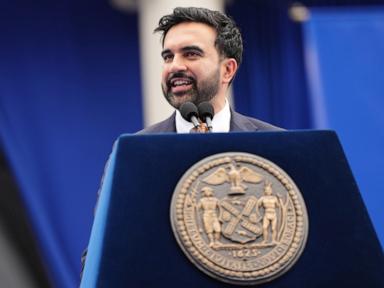
The victory of democratic socialist Zohran Mamdani in the New York City mayoral race and the subsequent primary triumph of Janeese Lewis George in Washington, D.C. are not isolated regional anomalies. Instead, these outcomes represent a repeatable infrastructure model designed to scale progressive political factions from local municipalities into national federal arenas. The transition of this electoral apparatus from dense urban centers to Washington reveals a structural strategy that treats municipal offices as low-cost incubation labs for scalable federal political networks.
The Municipal Incubator Framework
The expansion of democratic socialist influence operates via a clear cost-efficiency function. Municipal and state assembly races require low capital expenditure relative to federal campaigns. This low barrier to entry allows insurgent factions to field candidates, establish grassroots operational structures, and validate specific economic messaging with minimal initial investment. Also making news recently: The Razor Edge of a Broken Promise.
Once an executive office like the New York City mayoralty is secured, the financial and structural calculation shifts. The office provides a high-yield institutional platform that serves three distinct operational functions:
- Resource Consolidation: Incumbents utilize their visibility to accumulate nationwide donor databases, transforming a local victory into a decentralized funding apparatus for external races.
- The Policy Sandbox: High-visibility municipal initiatives, such as New York's $500 million pied-à-terre wealth tax or proposals for fare-free public transit, function as empirical test cases. These initiatives serve as policy proof-of-concept indicators that can be exported to other jurisdictions with comparable demographic profiles.
- The Brand Franchise: Progressive factions standardize their operational playbooks. The deployment of identical media production teams, messaging structures, and door-to-door canvassing metrics across both New York City and Washington, D.C. demonstrates a franchise model where candidates are integrated into a uniform ideological brand.
The Mechanics of Jurisdictional Replication
The alignment between New York’s executive shifts and Washington’s mayoral primary reveals the core mechanism of the progressive franchise model. Factions minimize operational friction by selecting target jurisdictions that feature specific structural and demographic variables. More details on this are explored by NBC News.
[Dense Urban Base with Rent/Cost Pressures] + [Closed Primary Systems] ---> [Low-Turnout Electoral Leverage]
The primary variable driving this replication is the exploitation of closed, low-turnout primary systems in heavily Democratic urban areas. In these environments, mobilizing a highly disciplined, ideologically cohesive core of voters yields disproportionate leverage. For instance, the Washington D.C. chapter of the Democratic Socialists of America mobilized over 300 disciplined canvassers to secure the primary victory for Janeese Lewis George. In a low-turnout municipal primary, this concentrated human capital bypasses the need for the massive television advertising expenditures typically deployed by establishment candidates.
A secondary variable is the structural exploitation of urban affordability crises. Both Mamdani and Lewis George anchored their campaigns on tangible economic pain points: housing costs, childcare deficits, and utility rate hikes. By framing structural inflation as a consequence of policy design rather than macroeconomic trends, these campaigns construct an direct causal narrative that resonates with working-class and tenant voting blocs.
Structural Bottlenecks to National Expansion
While the municipal franchise model scales efficiently between highly concentrated urban centers, it encounters immediate structural bottlenecks when attempting to expand into the federal legislative arena.
The Capital Expenditure Chasm
Federal congressional campaigns demand a radically different cost structure. While a state assembly or city council race can be swung via localized door-knocking networks, federal Senate or house campaigns covering expansive geographic regions require capital-intensive media buys. The localized human capital that provides high leverage in a dense city ward fails to scale efficiently when distributed across an entire congressional district or state.
The Heterogeneous Voter Problem
Urban progressive platforms rely on a demographic mix of high-education progressives and low-income tenant populations. This coalition relies on specific structural conditions—such as high rent burdens and heavy reliance on public infrastructure—that are absent in suburban and rural districts. When progressive factions attempt to back candidates in suburban or swing districts, the economic messaging regarding wealth taxes and universal state programs frequently triggers opposition from asset-owning, middle-income demographics.
Institutional Resistance from Party Gatekeepers
The expansion of the Mamdani-aligned slate in New York's primary elections—including challenges against established figures such as Representative Adriano Espaillat and the backing of Brad Lander against Representative Dan Goldman—has forced a counter-mobilization from the institutional Democratic establishment. Party leadership possesses deep capital reserves, control over endorsement apparatuses, and entrenched relationships with reliable, high-turnout older demographics. This establishment counter-mobilization raises the marginal cost of every subsequent progressive electoral victory.
The Inter-State Revenue Playbook
To overcome these structural bottlenecks, the expanding faction relies on aggressive tax policy frameworks designed to generate immediate revenue while consolidating its working-class base. The primary mechanism deployed is the targeted wealth tax, implemented through distinct local levers.
The New York model established a pied-à-terre tax on second homes valued over $1 million, generating a projected $500 million in state revenue, alongside proposals for a two-percentage-point increase on city income taxes for top earners. In Washington, the parallel strategy focuses on a Business Activity Tax to close loopholes that allow commuters from Maryland and Virginia to shield their professional partnerships from local taxation, targeting an estimated $500 million annually.
These synchronized policy maneuvers demonstrate that the franchise does not merely export rhetoric; it exports specific legislative architecture designed to fund universal public services—such as childcare systems and transit subsidies—thereby locking in voter loyalty through direct material benefits.
Strategic Forecast
The trajectory of this political franchise suggests a bifurcated outcome over the next electoral cycle. In dense, deep-blue urban centers, the progressive franchise will continue to displace moderate, business-friendly Democratic incumbents. The structural realities of urban housing markets and childcare costs ensure a steady demand for aggressive affordability platforms.
However, the assumption that urban executive dominance will translate into immediate federal legislative power in Washington is fundamentally flawed. The franchise will hit a hard ceiling in the federal arena unless it decouples its economic messaging from polarizing cultural narratives and alters its platform to address the asset-preservation priorities of suburban voters. The immediate play for this movement is not an outright national takeover, but rather the creation of an urban executive bloc capable of acting as an institutional veto power over the national Democratic Party's legislative agenda.