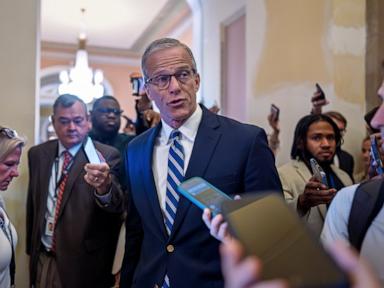
You don't usually see United States senators pulling all-night sessions unless something is fundamentally broken. Early Friday morning, the Senate finally wrapped up a brutal, marathon voting session just before 5 a.m., passing a $70 billion immigration enforcement bill by a razor-thin 52-47 margin. But the real story isn't the immigration funding. It's the absolute chaos that happened behind closed doors, exposing a massive, bitter divide within the Republican party over Donald Trump's controversial $1.8 billion settlement fund.
People looking at this mess are asking a simple question: why did Republicans spend almost a full day haggling among themselves over a fund that the Justice Department already claimed was dead?
The short answer is trust. Or rather, a complete lack of it.
Even though acting Attorney General Todd Blanche explicitly stated earlier in the week that the administration was dropping the $1.776 billion "anti-weaponization" fund, rank-and-file GOP senators weren't buying it. They spent the night fighting off amendments from both Democrats and their own colleagues, revealing deep anxiety about how Trump uses taxpayer money to reward his inner circle.
The 1.8 Billion Dollar Problem
Let’s look at what this fund actually is. The money stemmed from a surprise Justice Department settlement resolving Trump’s personal lawsuit against the IRS over the leak of his tax returns. Instead of a standard resolution, the administration structured a massive pool of cash meant to compensate Trump allies who claim they've been politically prosecuted.
To say this blindsided Capitol Hill is an understatement. Senate Majority Leader John Thune and other leaders got zero heads-up. The backlash was instant. Former GOP leader Mitch McConnell openly called the settlement "utterly stupid, morally wrong."
The core issue that kept senators awake all night was the terrifyingly vague criteria for who gets paid. Because the Justice Department refused to explicitly rule out January 6 defendants, lawmakers faced the political nightmare of taxpayer dollars going to people who attacked the Capitol and injured law enforcement.
A Bitter Family Fight
The overnight session wasn't just a partisan standoff; it was a civil war. Republicans used complex procedural maneuvers to bypass a Democratic filibuster, but their biggest hurdle was dealing with their own members.
Consider what happened with Louisiana Senator Bill Cassidy. He offered a pointed amendment to redirect the settlement cash directly to the law enforcement officers injured during the January 6 Capitol riots. Cassidy, who recently lost his primary after Trump backed an opponent, flatly rejected the White House's assurances that the fund was dead. He noted that the settlement remains active in the courts and "absolutely can be used."
GOP leadership narrowly killed Cassidy's amendment overnight. Why? Because passing it would have altered the broader immigration spending package and sent the party into a total tailspin right before an election year.
Other Republicans tried different tactics. North Carolina Senator Thom Tillis pushed an amendment to permanently ban the settlement fund and shift the $1.8 billion into a Department of Justice anti-fraud account. More than 10 Republicans voted for it, breaking ranks to show their disgust with the White House's financial maneuvering.
Red Lines on Government Spending
What we saw this week wasn't an isolated incident. It’s part of a growing trend of Senate Republicans quietly drawing a line in the sand against executive overreach.
Before this settlement fight even started, Republicans forced the White House to strip out $1 billion in security upgrades that included funding for Trump’s personal ballroom project. Lawmakers are getting tired of defense bills and immigration packages being treated as blank checks for pet projects.
If you are tracking how Washington actually works, here is what needs to happen next. First, keep your eyes on the House of Representatives next week. They have to take up this $70 billion immigration bill, and the fight over these settlement restrictions will start all over again. Second, watch the federal courts. A U.S. District Judge has already temporarily paused the fund, and a critical hearing is set for June 12. That legal ruling will dictate whether the administration can sneak this fund back to life, regardless of what Todd Blanche promised Congress.
The Senate got its immigration bill through, but the price was a bruised, exhausted party that looks more divided than ever.
Senate Republicans Clash With Trump Over $1.8 Billion DOJ Compensation Fund This video offers crucial context on the direct friction between Senate Republicans and the White House regarding the compensation fund's rules and January 6 defendants.



:max_bytes(150000):strip_icc()/how-many-types-of-dwarfism-are-there-2860725-v1-8dae2c531b4b47d9ae36ae404d3308a0.png)