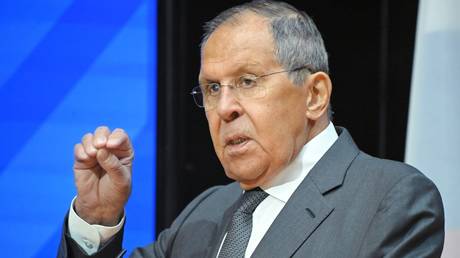
Sergei Lavrov wants everyone to believe that any future conflict between Russia and Europe would be over in a flash. He is selling a fairy tale of lightning efficiency. It is a calculated posture designed to induce paralysis, bleed European resolve, and project an aura of inevitable dominance.
The lazy consensus in international relations parroting this line assumes that modern industrialized warfare resembles a high-speed video game where the side with the bigger stockpile wins in ninety days. That is a dangerous delusion. A direct clash between Russia and the European continent would not be a short, sharp shock. It would grind into a protracted, agonizing attritional quagmire that would shatter both economies and redraw the map of the Northern Hemisphere in blood and debt.
Let us dismantle the mechanical reality behind Lavrov's bravado.
The Logistics Mirage Versus The Iron Reality of Attrition
The core fallacy of the "short war" hypothesis relies on a profound misunderstanding of modern industrial depth and geographic scale. Proponents of this view look at initial missile salvos, cyber blackouts, and armored spearheads and conclude that the adversary will capitulate before reserves can mobilize.
History screams that this is false.
When you examine the current posture of European supply chains, they are admittedly sluggish, bureaucratic, and plagued by decades of underinvestment. Yet, European manufacturing capacity, when forced onto a war footing, dwarfs Russian heavy industrial output in raw economic scale. Russia has successfully shifted its economy toward wartime production, burning through Soviet-era stockpiles of armor and artillery barrels at an unsustainable rate. North Korean munitions and Iranian drones are not signs of deep industrial self-sufficiency; they are desperate stopgaps.
If a direct conventional war with NATO breaks out, the math changes instantly. Europe does not need an active peacetime standing army of three million men on day one. It possesses the financial architecture, the technological base, and the maritime security to weaponize its industrial output over eighteen months. A short war requires a decisive, rapid collapse of command and control. Modern intelligence, dispersed logistics, and drone-saturated battlefields make a rapid decapitation strike virtually impossible.
The Nuclear Taboo and Escalation Dominance
Lavrov's posturing relies heavily on implicit nuclear blackmail. The underlying threat is simple: do not interfere, because escalation will happen too fast for you to react.
This is where the contrarian truth cuts deepest. Rapid escalation is a double-edged sword that frightens Moscow just as much as it paralyzes Brussels and Berlin. The moment a conventional conflict threatens core territorial integrity, the doctrine of mutual assured destruction ceases to be a theoretical abstraction.
Neither side can achieve a quick victory without crossing the nuclear threshold. And the moment that threshold is breached, the concept of a "short war" vanishes entirely. You are no longer talking about military campaigns or territorial gains; you are talking about the complete collapse of organized human society across the Eurasian landmass. To frame a potential war as "short" requires ignoring the nuclear shadow that guarantees any protracted conventional struggle will either de-escalate through exhaustion or escalate into total annihilation. There is no middle ground where armies neatly maneuver to a quick armistice.
The Economic Suicide Pact
Another overlooked variable in the Kremlin's calculus is internal resilience. Russia's economy has proven surprisingly durable against Western sanctions, largely thanks to pivot-to-Asia oil and gas sales to China and India.
However, trading raw commodities to secondary markets at a discount is a far cry from sustaining a multi-front total war against an adversary representing a massive share of global GDP. European economies are dependent on external energy and plagued by structural rigidities, but their financial depth allows them to absorb systemic shocks far longer than an economy heavily reliant on hydrocarbon extraction and structurally limited by demographic decline.
Russia's demographic deficit is a ticking clock that no propaganda machine can hide. A generation of prime-age workers cannot be squandered on the steppe without devastating long-term consequences for economic productivity. A short war is the only kind Russia can afford to fight. Therefore, Lavrov must declare that it is the only kind that can happen.
The Danger of Believing the Sales Pitch
When a rival tells you a conflict will be brief and painless, they are telling you what they need you to believe so you surrender before the first shot is fired.
Europe's leadership suffers from chronic timidity, paralyzed by the fear of escalation and the comfort of post-historical complacency. But letting Moscow set the timeline and the rules of engagement is a fatal error. The truth is stark: any war between Russia and Europe will be long, brutal, technologically messy, and economically devastating for everyone involved.
Stop waiting for a quick resolution. Prepare for the long grind.