The air in the Gulf does not smell like oil or ozone. It smells like old heat and dry dust that coats the back of your throat, a stillness that feels less like peace and more like a held breath.
Imagine standing on a dock in Dubai or Doha at dusk, watching the massive cargo tankers slice through water the color of molten tin. To the casual eye, the commerce is eternal, the skyline a glittering testament to human ambition built on sand. But beneath the hum of air conditioners and the clink of glasses in high-rise lounges, a low-frequency anxiety vibrates. It is the anxiety of geography. You cannot pack up a skyscraper and move it when the diplomatic weather turns.
Far to the north, behind layers of mountains and decades of institutional hardening, centrifuges spin in cold silence.
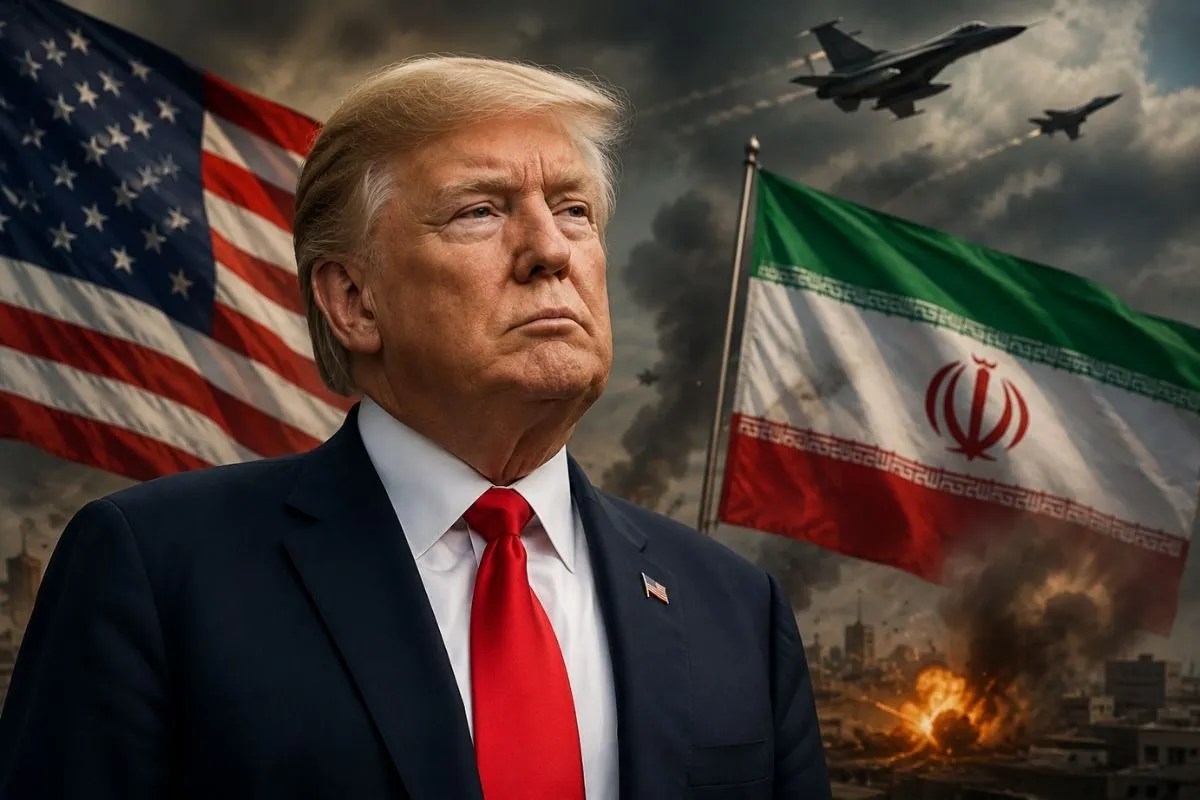
Donald Trump’s return to the center stage of American politics has not merely altered the weather of international relations; it has brought a category five storm right back to the shores of West Asia. The recent signaling from Washington and the halls of the United Nations is unmistakable: the nuclear question, long buried under layers of fatigue and regional proxy conflicts, is roaring back to life. And in the Gulf capitals, the phone lines are burning.
The Arithmetic of Fear
To understand why a diplomatic shift in Washington or a resolution at the UN matters to a merchant in Manama or a diplomat in Riyadh, you have to strip away the abstractions of geopolitics and look at the math of proximity.
Tehran is roughly nine hundred miles from the gleaming towers of the United Arab Emirates. In missile time, that distance is measured in minutes, not hours.
For years, the official narrative in Western policy circles treated Iran’s nuclear ambitions as a distant chess match—a matter of inspectors, enrichment percentages, and sanctions waivers. But ask anyone who lives within sight of the Strait of Hormuz, through which a massive share of the world's liquefied natural gas and petroleum passes daily, and they will tell you a very different story. They do not talk about enriched uranium as a chemical abstraction. They talk about it as a fuse.
When Washington signals a renewed maximum pressure campaign, or when whispers grow louder about dragging the Iranian nuclear issue back to the UN Security Council with the full weight of renewed American backing, the reaction in regional capitals is not a cheer for toughness. It is a cold knot in the stomach.
Because escalation has a gravity of its own.
Consider what happens when economic strangulation meets ideological survival. A government backed into a corner does not quietly fade away; it lashes out at the margins. For decades, the theater of conflict has been outsourced to proxy groups in Yemen, Lebanon, and Iraq. Yet the underlying engine of that entire network is the state’s nuclear deterrence calculus. If Tehran believes its ultimate survival depends on crossing the threshold—or getting close enough to touch it—the calculus of every neighbor shifts overnight.
Why the UN Battleground Changes Everything
The United Nations is rarely a place where wars are stopped; it is where wars are narrated before they are fought.
When diplomats speak of taking the Iran nuclear issue back to the UN, they are talking about activating the "snapback" mechanisms or pushing new resolutions that could legally isolate Iran’s remaining economic lifelines. On paper, it sounds orderly. It sounds like law and order on an international scale.
On the ground, it is an accelerant.
During my time talking with regional analysts who track the pulse of the foreign ministries in the Gulf, a common refrain emerges: the West treats containment like a switch you can flip on and off depending on who sits in the Oval Office. But the region lives with the consequences long after the news cycle moves on.
If the UN becomes the arena for a renewed diplomatic collision between Washington and Tehran, the diplomatic middle ground evaporates. Oman and Qatar, who have traditionally played the role of the quiet translators in the dark room, find their channels narrowing. When superpowers demand absolute alignment, neutrality becomes a luxury few small states can afford.
And then there is the elephant in the room that no one likes to invite to high-level summits: the domestic pressure inside Iran.
The Inside View of a Cornered State
It is easy to view a nation of eighty-eight million people through the lens of its regime's rhetoric. We see the Friday prayers, the chants, the military parades showing off ballistic missiles draped in banners.
But talk to young urbanites in Tehran via encrypted apps—those who risk their freedom to share a sarcastic meme or stream music banned by the morality police—and you hear a different kind of desperation. They are exhausted. Inflation has eaten their savings; water scarcity is turning fertile provinces into dust bowls; corruption has hollowed out the promise of the revolution.
Yet, paradoxically, external pressure often achieves what internal propaganda cannot: it unifies a fractured populace against a common external enemy.
When a foreign power threatens economic annihilation or rattles the sabre at the UN, the average citizen—even one who detests the clerical establishment—feels the primal instinct of national self-preservation kick in. They look at Iraq. They look at Libya. They see what happens to nations that dismantle their security apparatus under foreign pressure.
This is the tragic paradox of the current moment. The harder Washington squeezes to choke off the nuclear program, the more the regime can successfully argue to its own people that the program is the only thing standing between them and foreign subjugation.
The Stakes for the Global Economy
Step back from the politics for a moment and look at your own utility bill, your grocery receipt, your morning commute.
The Strait of Hormuz is the jugular vein of global energy. If a confrontation over Iran’s nuclear file triggers a kinetic response—be it mined shipping lanes, drone strikes on processing facilities, or a blockade—the shockwaves will not stay contained within the Persian Gulf.
Markets do not wait for bombs to drop; they price in fear the moment a headline flashes across a terminal. A spike in crude oil prices acts as a regressive tax on every working family from Mumbai to Madrid. It stalls post-pandemic recoveries, feeds inflation, and forces central banks into corners they cannot easily escape.
This is why the current diplomatic chess game in New York and Washington is not just a Middle Eastern story. It is a global story told in oil barrels and shipping insurance rates.
The Unresolved Horizon
We are standing at a familiar precipice, yet the footing is much worse than it was a decade ago. The diplomatic architecture of the old nuclear deal—flawed as it was—has rotted away. Trust is not just depleted; it is non-existent.
In Washington, the political appetite for protracted nation-building is dead, replaced by a preference for blunt economic instruments and distant deterrence. In Tehran, the hardliners are firmly entrenched, believing that endurance is their ultimate weapon. And in the Gulf, leaders are quietly diversifying their partnerships, hedging their bets between a mercurial America, an ascendant China, and a dangerous neighborhood.
The sun sets over the Gulf, turning the water the color of bruised copper. The tankers keep moving, guided by satellite navigation and quiet prayers from captains who know that a single miscalculated word at the United Nations could turn this maritime highway into a zone of exclusion.
The question is not whether the nuclear issue will explode into the headlines tomorrow or next week. The question is whether anyone remembers how to put out a fire once the match has already been struck.



