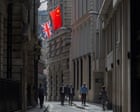
The radiator in Room 404 of the administrative annex has clanked a warning rhythm since October. Professor Arthur Sterling, a man whose skin has taken on the color of parchment after thirty years of grading essays under fluorescent tubes, does not look up when it knocks. He is staring at a spreadsheet that glows with the merciless intensity of an operating room lamp.
The numbers are straightforward. They are also terminal.
For the past decade, British higher education has operated on a quiet, desperate fiction. Campuses across the United Kingdom—once celebrated as bastions of uncompromised inquiry, stone-carved tradition, and intellectual independence—have transformed into corporate enterprises scrambling to meet payroll. Domestic tuition fees were capped by statute, frozen in place while inflation chewed through utility bills, pension obligations, and library budgets. To stay afloat, universities had to find oxygen somewhere else.
They found it across an ocean.
Thousands of miles away, rising middle classes in Beijing, Shanghai, and Shenzhen looked to British degrees as golden tickets. They sent their children, and with them, they sent rivers of tuition fees charged at international rates—often three or four times higher than what domestic students paid. At many Russell Group institutions, these foreign fees stopped being a supplementary revenue stream. They became the oxygen mask. Without them, departments closed. Without them, laboratories went dark. Without them, the ancient towers would have simply folded inward.
And then came the knock on the door from Thames House.
When the head of MI5 issues a public warning regarding foreign interference, national security correspondents write their analyses, politicians furrow their brows on morning television, and the news cycle spins on to the next crisis. But the shockwave hits differently in places like Room 404. It lands not as a political talking point, but as an existential tremor. Because the very financial survival that rescued British universities from bankruptcy has tied their fortunes to a superpower whose geopolitical interests are increasingly diverging from, and colliding with, those of the West.
Consider a hypothetical administrator named Dr. Elena Vance, director of advanced materials research at a mid-tier northern university. Elena is neither a spy nor a politician. She is a metallurgist who spends her days trying to secure grants for titanium alloy testing. Three years ago, her department faced a deficit so severe that the vice-chancellor threatened to shutter the entire physical sciences faculty. Then, a consortium of international postgraduate candidates arrived, bringing with them millions of pounds in fee revenue. Along with them came joint research agreements, funded partnerships, and specialized equipment donations from overseas entities.
The deficit vanished. The lights stayed on. The graduate students published brilliant papers on aerospace stress tolerances.
Now, read the latest security bulletin. It warns that state-backed actors from authoritarian regimes are systematically exploiting academic partnerships to harvest dual-use technology—innovations that start as civilian aerospace research and end up inside hypersonic guidance systems. It speaks of quiet data transfers, visiting scholars who report back to foreign ministries, and intellectual property slipping out of university servers before patent lawyers even know a breakthrough has occurred.
Elena sits at her desk, holding the security briefing in one hand and her department's monthly ledger in the other.
She knows the math. If she cuts ties with foreign partners, complies with strict new security vetting, and turns away high-fee international applicants to satisfy counter-intelligence guidelines, her faculty goes broke within twelve months. If she looks the other way, protects her budget, and maintains the status quo, she keeps her labs open while potentially funneling cutting-edge engineering data straight into the hands of a strategic rival.
This is the trap.
For years, British universities believed they could separate commerce from security. They treated education as a pure export commodity, akin to selling Scotch whisky or luxury cars. Money is money, the logic went. A pound note carries no passport, bears no ideological allegiance, and asks no questions.
That logic is dead.
The security services know it. Government ministers know it. Yet, the systemic addiction remains unaddressed. Whitehall expects universities to act as vigilant fortresses against foreign espionage while simultaneously starving them of public funding. It is the equivalent of defunding a city’s fire department while demanding that firefighters personally pay for their own hoses, then expressing shock when they accept donations from local arsonists.
The mechanics of this infiltration are rarely cinematic. There are no trench coats, no midnight microfilm handoffs behind brutalist library stacks. The reality is far more mundane, and infinitely more difficult to police. It looks like a doctoral candidate whose stipend is routed through a shell company linked to a foreign defense contractor. It looks like a visiting professor who requests unrestricted access to quantum computing clusters for academic purposes, only for the resulting algorithms to be quietly repurposed for military encryption cracking. It looks like a cash-strapped university department eagerly signing a nondisclosure agreement on a joint venture because the alternative is redundancy notices for half the faculty.
Academic freedom has always relied on institutional autonomy. When an institution depends on a foreign state—or entities tightly bound to that state—for its financial heartbeat, autonomy becomes an illusion.
Critics whisper about xenophobia. They ask whether heightened security screening will deter brilliant international minds from bringing their talents to British shores. This fear is not baseless. International students are not foot soldiers for foreign intelligence services; the vast majority are young people seeking an education, free expression, and a better future. To paint every tuition-paying student from East Asia with the brush of suspicion is intellectually lazy and morally corrosive.
Yet, acknowledging that reality does not mean blinding oneself to institutional vulnerability. Intelligence agencies do not care about the ethnicity of a student body; they care about the structural mechanisms of state-directed technology transfer. They care when research funded by British taxpayers—or conducted in British labs—is systematically siphoned off to modernize the military apparatus of a potential adversary.
The silence in the faculty lounge is heavy.
Professors who spent decades championing globalized academic exchange now find themselves caught in an ideological crossfire they never signed up for. To speak out against foreign influence risks professional excommunication, accusations of racism, or the termination of lucrative international partnerships. To remain silent risks complicity in economic and technological self-harm.
So they grade papers. They balance budgets that do not balance. They pretend that the wire transfers appearing in the university's central accounts come with no strings attached, even as the strings wrap tighter around their collective throat.
The chill from MI5's warning is not passing. It is settling into the masonry.
At dusk, the lights in the campus quad flicker against the damp English mist. Inside the laboratories, automated centrifuges spin in empty rooms, recording data that will be beamed across continents within milliseconds. The bills are paid for another month. The deficit is held at bay by a thread. And somewhere in the dark, the ledger keeps running.