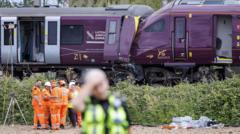
The mid-afternoon sun over Bedfordshire was warm, casting long, peaceful shadows across the fields near the Elstow interchange. It was just after five on a Friday evening, that specific, golden window of the week when thousands of minds simultaneously drift away from computer screens and assembly lines toward the quiet promise of the weekend.
Inside the 15:50 East Midlands Railway service out of Nottingham, the rhythm was entirely familiar. Laptops were being folded into bags. A child was quieted by a parent offering a snack. Commuters leaned their foreheads against the glass, watching the green hedges of the English countryside blur past as the sleek Aurora train sped toward London St Pancras. Then, a shuddering halt. A technical fault, simple and mechanical, brought the great machine to a stop on the line. Passengers sighed, checked their watches, and texted loved ones about a minor delay.
Behind them, on the exact same stretch of steel ribbon, traveled the 16:40 service from Corby.
What followed was a sudden, violent rewriting of a decades-long narrative of safety. Without a screech of brakes, without a siren, and without a single moment of warning, the two trains collided. It was a rear-end impact of devastating force. The metal frame of the stationary carriage buckled, twisting upward as seats snapped backward into the passengers behind them. People were flung forward like loose cargo.
In an instant, the peaceful, sunlit train compartments became a chaotic world of smoke, bloodied faces, and the terrifying, sharp sound of shattering glass.
The Cost of the Closed Line
We tend to look at infrastructure through numbers. When a disaster like this occurs, the initial dispatches focus entirely on the immediate, shocking physics of the event. We read of the tragic loss of the Corby train driver, a dedicated railway colleague pronounced dead at the scene among the buckled steel. We count the injuries: eleven people clinging to life in critical condition, dozens more seriously hurt, and a total of nearly ninety human beings whose Friday evening ended not in the warmth of St Pancras station, but on the cold, grass embankments of a remote field, waiting for the rotors of six air ambulances to cut through the twilight.
But a tragedy of this scale possesses a secondary, invisible physics. It creates a shockwave that radiates outward from the impact site, paralyzing the veins of a nation's transit system.
By Saturday morning, the red emergency lights had given way to the cold reality of forensic tape. Rail Accident Investigation Branch inspectors began the meticulous process of combing through the wreckage, seeking to understand how the highly sophisticated signalling systems designed to prevent exactly this kind of collision could have failed. The line between Luton and Bedford is a vital artery, a corridor that moves hundreds of thousands of lives every single week. Now, it is completely dark.
Network Rail and train operators have issued a stark warning that will redefine the week for a vast swath of the population: the total closure and severe disruption of the Midland Main Line will drag on until the end of the upcoming week.
To the casual observer, a notice reading "essential travel only until Thursday" is merely an inconvenience, a headline to be scrolled past. But consider the reality for those who depend on these tracks. Infrastructure is not just steel and concrete; it is the invisible scaffolding of our daily lives. When it breaks, the human cost ripples into places a spreadsheet can never capture.
Consider a hypothetical commuter named Sarah. She lives in Bedford but works a crucial shift at a London hospital. The train is her only link, a reliable forty-minute capsule that allows her to manage her career while keeping her family rooted in a quieter town. Suddenly, that forty-minute journey dissolves into a frantic, multi-stage odyssey. She must now navigate a world of reduced timetables, long queues for a limited fleet of rail replacement buses to Hitchin, and secondary connections on completely different rail networks. A normal working day transforms into a exhausting twelve-hour test of endurance.
Then there are the economic ripples. Small businesses operating inside the major terminuses, the independent coffee shops that rely on the rhythmic surge of the morning rush hour, suddenly see their foot traffic vanish. The thousands of tons of freight that quietly move along these corridors every night must be diverted, slowed down, or halted entirely, adding friction to supply chains that are already stretched tight.
A Century of Heavy Iron
To understand why the Bedford collision has sent such a profound shudder through the entire rail industry, one must understand the history of British rail safety. For over two decades, the United Kingdom has maintained one of the safest rail networks in the entire world. The catastrophic accidents of the late 1990s and early 2000s—names like Ladbroke Grove and Southall that still evoke a grim memory among older railway workers—led to a massive, systemic overhaul of how trains are signaled and controlled.
Millions were poured into automated safety systems designed to act as a fail-safe when human error or mechanical failure occurs. Trains became smart. They communicate with the track, automatically applying brakes if a red signal is passed or if a train enters a section of track that is already occupied. Rail travel became so remarkably safe that fatal collisions between two passenger trains on a British mainline effectively vanished from modern memory.
The events at Elstow have shattered that hard-won certainty. It is the first fatal collision of its kind on a British mainline this century.
The investigation will take months. Experts will look at the train’s internal data recorders, the black boxes that log every input, every kilometer per hour, and every mechanical message in the seconds leading up to the impact. They will test the signalling relays, look for software glitches, and examine whether the track itself played a role. But while the technicians look at the wires, the public is left to grapple with a fragile truth: even our most sophisticated shields against catastrophe are vulnerable.
The true weight of this disruption is not found in the delayed timetables or the financial losses of the operators. It is found in the quiet tension that will linger in the minds of passengers when the lines finally reopen on Thursday.
When the first morning service pulls out of Bedford station later this week, passengers will sit in those same seats. They will fold open their laptops. They will look out at the same sunlit fields of Elstow. But they will do so with a newfound awareness of the heavy iron beneath them, and the fragile, invisible thread of trust that keeps us all moving forward.