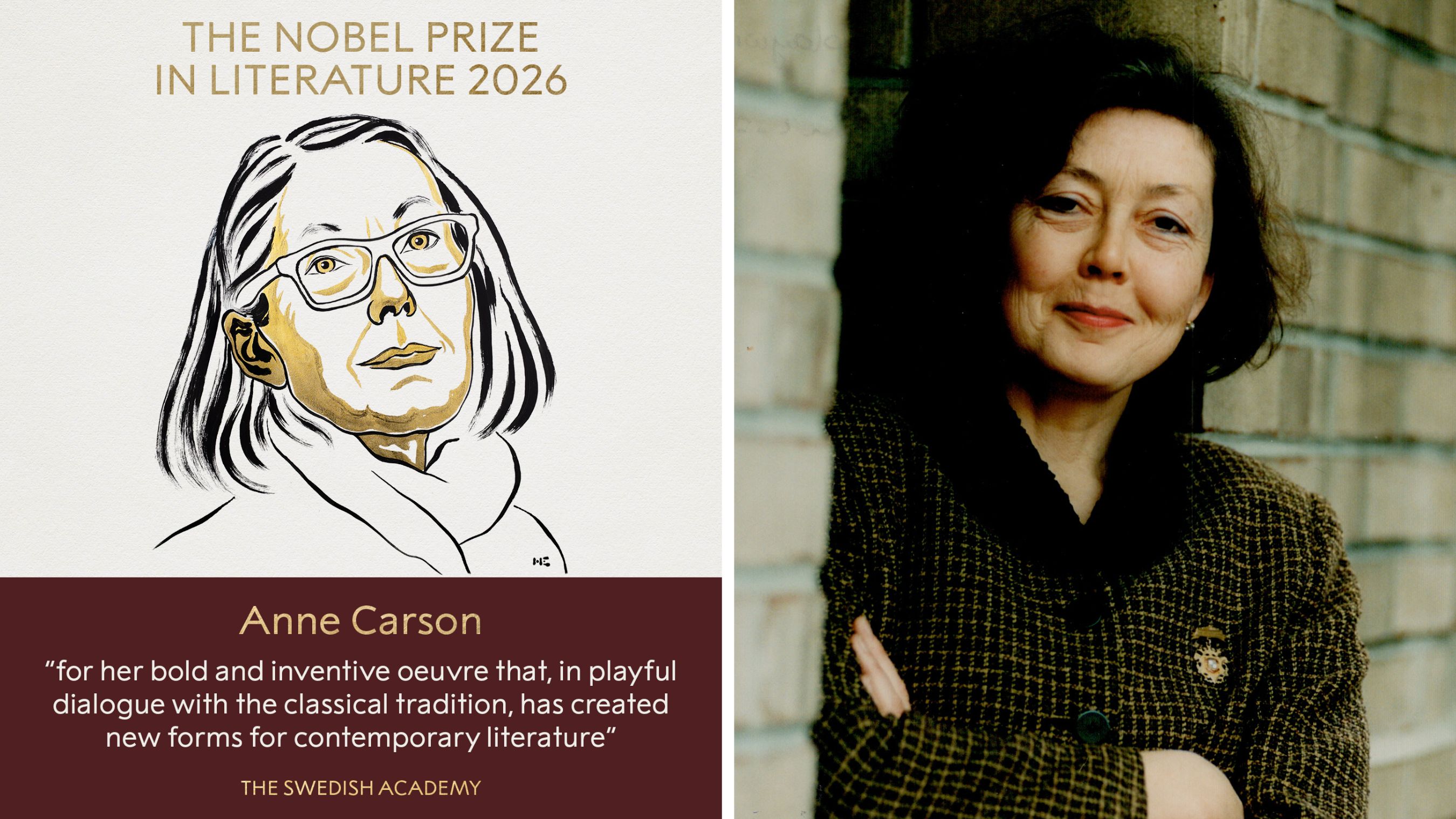
There is a specific kind of quiet that fills a room when someone reads Anne Carson aloud. It is not the polite hush of a library or the reverent stillness of a church. It is the breath-holding quiet of a car teetering on the edge of a gravel driveway, tires whispering against loose stone, waiting to see which way gravity pulls.
For decades, the literary establishment has tried to categorize her, and for decades, she has slipped through their tidy architectural drafts like smoke through a screen door. Is she a classicist? A translator who breathes modern pulse into ancient Greek bones? A poet who breaks narrative into jagged, brilliant shards?
She is all of these things, and she is none of them.
And now, the Swedish Academy has done something extraordinary. They have looked past the churning machinery of mass market publishing, past the predictable bios of career novelists, and handed the 2026 Nobel Prize in Literature to a woman who writes about ancient adultery, modern grief, and the geometry of heartbreak with equal, devastating precision.
Consider what happens next. Across the globe, readers who have never opened a book of verse will pull her name from their screens, searching for the key to an iconoclast. They will find a writer who treats the page not as a canvas for decoration, but as a site of archaeological excavation.
To understand why this matters, you have to go back to the classrooms of Toronto and Montreal, where a young scholar sat hunched over crumbling manuscripts, refusing to treat dead languages as museum artifacts. To Carson, Sappho was not a historical footnote. Sappho was a living, breathing woman whose jealousy and longing echoed across two and a half millennia with the clarity of a telephone wire hum.
Most people think of poetry as a gentle thing. A soft cushion for tired thoughts. A rhyming lullaby designed to soothe the edges of a hard day. Carson looked at that definition and burned it to the ground.
Her breakthrough work, Autobiography of Red, reframed an ancient myth about a monster named Geryon and a hero named Herakles into a blistering, aching contemporary narrative about love, art, and the vulnerability of being alive. It was written in verse, but it read like a psychological thriller crossed with a road trip movie. It proved that form is not a cage. Form is an instrument. If you play it right, it bleeds.
We live in an era obsessed with speed. We consume our stories in bite-sized fragments, scrolling through digital noise until our attention spans fray into lint. Every headline competes for the same shallow gasp of outrage or delight.
Carson demands the exact opposite.
She demands your stillness. She structures her books with blank spaces that feel heavy, pregnant with unsaid things. She juxtaposes high classical philosophy with low-down modern absurdity—a Greek chorus discussing domestic despair while eating breakfast cereal. It is jarring. It is brilliant. It makes you feel acutely, painfully human.
When the news of the 2026 Nobel broke, the literary world did not erupt in polite applause. It shuddered. Writers texted one another screenshots of the announcement in disbelief, not because Carson was unworthy—everyone who knew her work knew this recognition was long overdue—but because the Nobel committee actually chose a writer who refuses to pander. They rewarded difficulty. They rewarded integrity. They rewarded the strange, solitary path of an intellect that charts its own coordinates.
Think about the sheer audacity of her career. She translated Euripides and Sophocles not as a duty to academia, but as an act of intimate trespassing. She crawled inside the minds of ancient Greeks and dragged them kicking and screaming into the harsh fluorescent light of the twenty-first century. When she writes about grief, she does not offer cheap comforts or neat resolutions. She maps the topography of loss with cold, unsparing accuracy.
Pain does not wrap up neatly in three acts. Carson knows this. Her lines break mid-thought, mirroring the way our own minds fracture under pressure.
There is an old myth about translation: that something essential is always lost in the transfer from one tongue to another. Carson turned that premise on its head. She proved that translation is not a loss, but a transformation. It is the act of taking an ancient ghost, dressing it in modern denim, and walking it down a city street until it catches the reflection of a storefront window and realizes it is home.
This prize is a vindication for every writer who has ever stared at a blank page and worried that their voice was too strange, too hybrid, too unwilling to fit inside the designated boxes of commerce and genre.
For the reader, this moment is an invitation.
Do not approach her work looking for easy answers. Approach it the way you would approach a dark staircase in an unfamiliar house. Reach out your hand. Feel the wall. Let your eyes adjust to the absence of light until the shapes begin to emerge from the shadows.
Because when you finally encounter a mind like Anne Carson’s, you realize that the gaps between the words—the empty spaces she leaves for you to fill—are where the real story has been happening all along.
The prize money will clear. The press conferences will fade. The academic journals will publish their solemn, analytical essays dissecting her syntax and her classical lineage.
Yet somewhere in a quiet room, a reader will open Nox, her heartbreaking accordion-fold book eulogizing her estranged brother, and unfold its pages across a table like a map of an undiscovered country. They will trace the photographs, the dictionary definitions, the fragments of memory and translation. They will feel the terrible, beautiful weight of a life examined without illusion.
And for a few seconds, the noise of the modern world will stop entirely.
Just an open book. Just a breath drawn in the dark.
And the quiet.