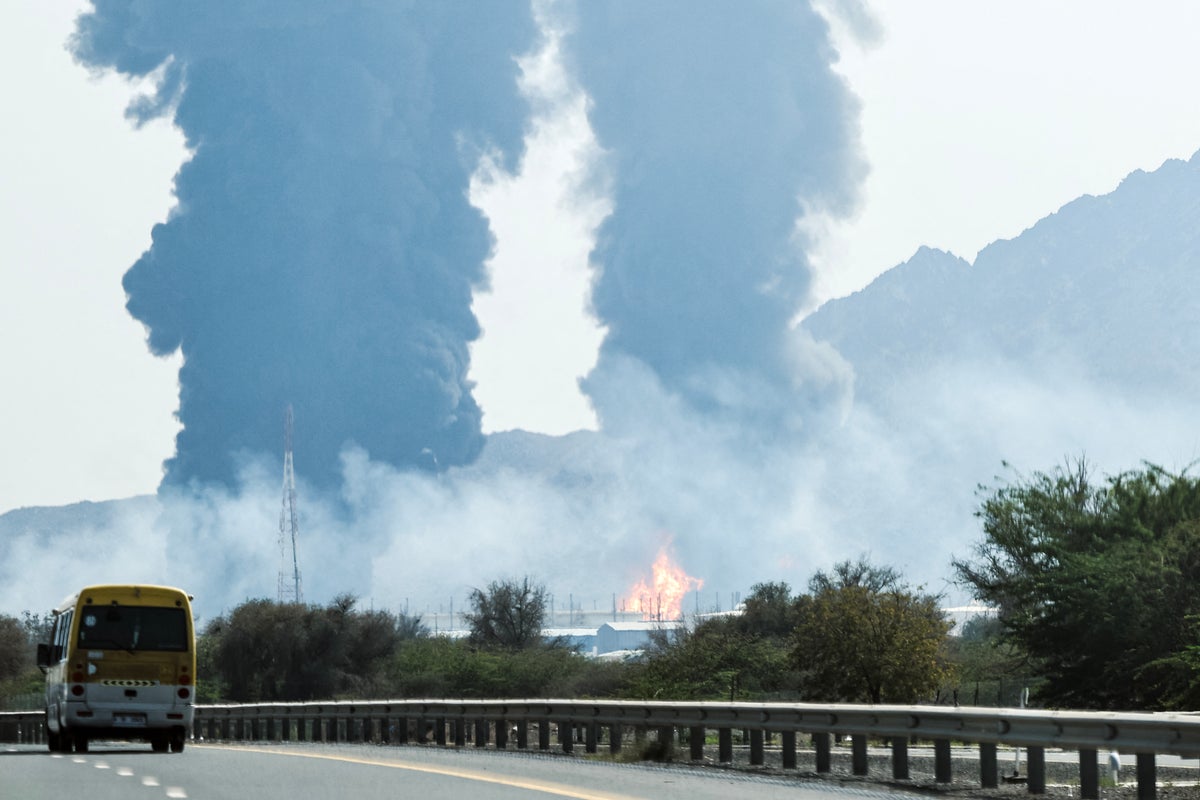
The night air in the Persian Gulf doesn't just sit; it clings. It carries the scent of salt, heavy humidity, and the faint, metallic tang of industrial ambition. For decades, the water between the Arabian Peninsula and the Iranian coast has been a theater of high-stakes posturing, a stretch of blue where the world’s energy pulse beats loudest. But lately, the rhythm has changed. The sound of diplomacy has been replaced by a silence so profound it feels deliberate.
Behind that silence lies a transformation of regional power that few saw coming. Reports have begun to surface, whispered in intelligence circles and documented in hushed corridors, suggesting that the United Arab Emirates has moved beyond the role of a traditional mediator. The claim is startling: a series of clandestine military strikes directed at Iranian targets, executed with a surgical precision that leaves no fingerprints. This isn't just about geopolitics. It is about the terrifyingly thin line between a fragile peace and a localized apocalypse.
The Ghost in the Machine
To understand how a nation known for its shimmering skylines and global logistics hubs becomes a covert kinetic actor, you have to look at the tools of the trade. Modern warfare has shed its heavy armor. It no longer requires the thundering boots of an invading army or the visible streaks of a massive bombing raid. Instead, it lives in the invisible. It lives in the data streams of a drone flying so high it is indistinguishable from a star.
Consider a hypothetical operator in a nondescript room in Abu Dhabi. There is no sand in his boots. There is no sweat on his brow. He watches a thermal feed of a facility across the water—perhaps a drone manufacturing plant or a transshipment point for regional proxies. With a single movement of a finger, a pressurized piece of hardware is released. Minutes later, a fire breaks out in a remote Iranian province. The Iranian state media calls it an industrial accident. The UAE says nothing. The world moves on.
This is the new face of escalation. It is deniable. It is quiet. And because it is quiet, it is incredibly dangerous.
The Weight of the Mirror
For years, the regional dynamic was predictable. Iran projected power through a network of proxies, using asymmetrical tactics to keep its neighbors off balance. The Gulf states, in turn, relied on the massive, visible shield of Western protection. But the shield has started to feel heavy, and more importantly, it has started to feel unreliable.
The UAE’s shift toward independent, covert action reflects a gritty realization: in a multipolar world, you cannot outsource your survival. If these reports are accurate, the Emirates are mirroring the very tactics once used against them. They are speaking a language of shadows that Tehran understands perfectly.
But what does this mean for the person living in Dubai, or the fisherman in Bandar Abbas? It means the sky is no longer just the sky. It is a potential vector. Every unexplained explosion, every "technical failure" at a sensitive site, adds a brick to a wall of paranoia. When nations stop talking and start striking in secret, they lose the ability to signal their intentions. In the world of high-stakes intelligence, a misunderstanding is often more lethal than a planned attack.
The Geometry of the Strike
The technical sophistication required to pull off these operations is staggering. We are talking about electronic warfare suites that can blind local radar, or autonomous systems that navigate via terrain contour mapping to avoid detection. These are not the crude tools of twenty years ago. They are the result of a massive, decade-long investment in domestic defense technology.
The UAE has spent years building an ecosystem that produces its own munitions and its own sophisticated unmanned aerial vehicles. They aren't just buying security anymore; they are engineering it. This shift in the balance of power changes the math for every player in the region. If a small, wealthy nation can project power across a sea without a single soldier crossing a border, the old maps of influence are effectively useless.
The reality of these strikes, if true, suggests a level of confidence—or perhaps a level of desperation—that should give every global leader pause. It suggests that the UAE believes the risk of being caught is lower than the risk of remaining passive.
The Human Cost of High-Tech Shadows
We often talk about these events in terms of "assets" and "strategic objectives," but those words are hollow. They hide the heartbeat of the situation.
Imagine a family in a coastal Iranian town. They are far from the political centers of Tehran, trying to navigate an economy strangled by sanctions. One night, a blast echoes from a nearby hillslope where a "research facility" is tucked away. There is no warning. There is no declaration of war. There is only the sudden, violent intrusion of a conflict they cannot see and cannot influence.
Across the water, the citizens of the UAE live in one of the safest, most prosperous societies on earth. They go to brunch, they build tech startups, they plan for a post-oil future. But that prosperity is built on a foundation of absolute stability. The moment the "secret war" becomes a public one, the cranes stop moving. The tourists stop coming. The glass towers that define the skyline become fragile liabilities.
The stakes are not just about who controls a shipping lane. They are about the preservation of a way of life that depends entirely on the perception of peace. By engaging in covert strikes, the UAE is gambling with that perception. They are betting that they can weaken their adversary enough to prevent a larger war, without accidentally triggering the very conflagration they fear.
The Paradox of Precision
There is a seductive quality to precision warfare. It promises the ability to remove a threat without the mess of a total conflict. It feels clean. It feels controlled. But history is a graveyard of "clean" military operations that spiraled into chaos.
When you strike in secret, you deny the enemy a face to negotiate with. You leave them with two choices: admit their defenses were breached and look weak to their own people, or retaliate in kind, equally in the shadows. This creates a feedback loop of escalating hits that never make the front page but steadily erode the possibility of a diplomatic breakthrough.
The UAE’s reported actions represent a pivot from a defensive crouch to a proactive, aggressive stance. It is a bold move, born of a region that feels abandoned by its traditional allies and surrounded by a persistent, ideological foe. But the problem with the shadows is that eventually, the sun comes up.
A single mistake—a drone that crashes in a populated area, a misinterpreted signal, a strike that hits the wrong target—could shatter the illusion of deniability. In that moment, the secret war becomes a very loud, very bloody reality.
The Blue Between
As the sun sets over the Gulf, the water turns a deep, bruised purple. Tankers move sluggishly through the Strait of Hormuz, carrying the lifeblood of the global economy. From the shore, everything looks serene. It looks like progress. It looks like peace.
But somewhere out there, beneath the radar and above the clouds, the silent machines are moving. They are the physical manifestation of a new age of anxiety, where the most powerful weapons are the ones you never see, used by the people you least expect. The UAE has decided that the only way to stay safe is to become the ghost in the neighbor’s house.
The world is watching the skyline, but the real story is happening in the dark. It is a story of a small nation that decided it would no longer wait for the storm to arrive, choosing instead to become the wind. Whether that wind clears the air or fans the flames of a regional wildfire is a question that will be answered not in a press release, but in the echoes of the next "accident" on the Iranian coast.
The silence is getting louder.


