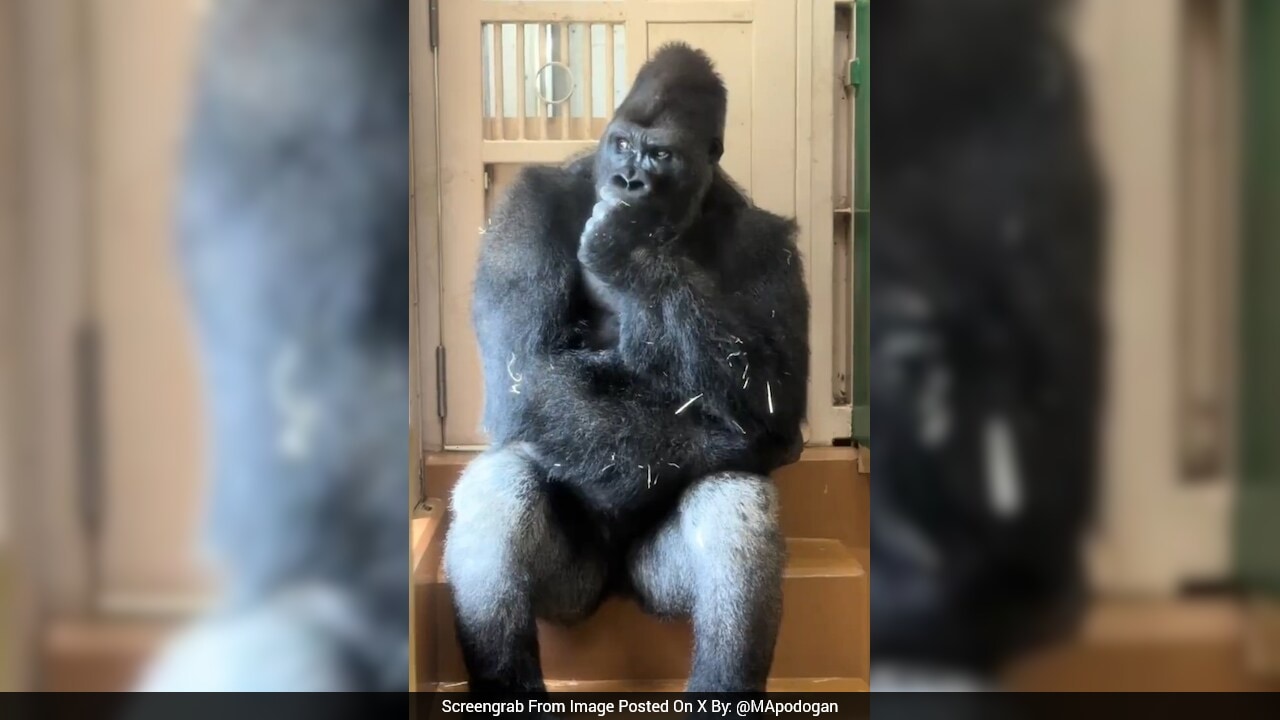
The humidity inside the rainforest exhibit always hits you first. It smells of damp earth, bruised fruit, and the unmistakable, heavy scent of large animals. On any given Tuesday, a crowd gathers five-deep against the reinforced glass, holding up smartphones like digital mirrors. They are waiting for a moment of connection with a creature that shares 98% of our DNA. Mostly, they get stillness. A silverback gorilla sits with his back to the world, a mountain of muscle and dark fur, seemingly indifferent to the flashing screens.
Then, the domestic dispute begins. You might also find this connected coverage interesting: The Drawer Where Good Intentions Go To Die.
It starts with a sharp bark and a sudden, violent rustle of vegetation. Shamu, a dominant male gorilla, shifts his weight. His mate, Uzuri, has crossed an invisible boundary in their enclosure. What follows is not a cinematic battle, but a brief, intense flash of primate politics—a sudden lunge, a sweeping gesture of dominance, and a hasty retreat. The crowd gasps. Phones tilt.
But the real story does not happen during the fight. It happens in the heavy silence right after. As discussed in recent reports by ELLE, the effects are notable.
The Anatomy of a Cold Shoulder
Watch the viral video capturing this exact moment, and you will see something deeply unsettling. After the scuffle, Shamu does not roar. He does not beat his chest. Instead, he walks over to a artificial rock structure, sits down heavily, and folds his arms tightly across his chest.
He glares into the middle distance. He refuses to look at Uzuri.
When she attempts to move back into his field of vision, Shamu deliberately pivots his entire upper body away. It is a textbook display of the cold shoulder. The crowd watching the footage online erupted in recognition. "That is exactly what my husband does when I tell him he bought the wrong milk," one comment read. Another noted, "I’ve seen that exact look on my boyfriend’s face after an argument in the car."
We laugh because the reflection is mirror-sharp. But beneath the internet commentary lies a deeper, more profound truth about how we communicate emotion. We tend to view human body language as a highly sophisticated, culturally learned art form. We think our sighs, our crossed arms, and our dramatic pouts are products of modern psychology, shaped by reality television and centuries of social conditioning.
They are not. They are ancient.
Consider the physical mechanics of the sulk. When Shamu crosses his massive arms, he is doing something evolutionary biologists call a "protective posture." Even a 400-pound silverback feels vulnerable after social friction. By folding his arms, he shields his vital organs. By turning his head, he signals a temporary cessation of hostility—he is removing the threat of eye contact, which in primate societies serves as a direct challenge.
It is a sophisticated psychological negotiation, happening in a zoo enclosure, caught on a high-definition smartphone camera.
The Illusion of the Human Divide
For decades, behavioral scientists warned against the danger of anthropomorphism. If you saw a dog "smile," you were told it was just panting. If you saw a cat "grieve," you were corrected; it was merely experiencing a disruption in its routine. We built a firewall between human emotion and animal behavior to protect our status at the top of the evolutionary ladder.
But anyone who has spent an afternoon watching a family of gorillas knows that firewall is made of paper.
The viral reaction to Shamu’s domestic drama highlights a massive shift in how we understand our place in the natural world. We are not looking at a wild beast acting like a human. We are looking at the foundational blueprint of human behavior itself.
Think about the last time you had a disagreement with someone you love. The argument itself is rarely the part that exhausts us. The exhaustion comes from the aftermath—the heavy, suffocating silence in the kitchen, the deliberate avoidance of eye contact, the loud slamming of a cabinet door that translates to I am still angry, and I want you to know it.
We call this emotional maturity, or perhaps passive aggression. Shamu calls it Tuesday.
The stakes in that zoo enclosure are remarkably high, even if they look like comedy to the people holding the smartphones. In a gorilla troop, social harmony is a matter of survival. A silverback cannot afford to alienate his mates permanently; a fractured troop is vulnerable to rivals and internal chaos. The "sulk" is actually a peace-keeping mechanism. It is a non-violent way to express anger, establish a boundary, and allow the adrenaline to drain from the room before total reconciliation can occur.
What the Glass Reveals
Step back from the glass for a moment and look at the people watching the gorillas.
There is an old man leaning on a cane, smiling softly. There is a young couple, hands intertwined, whispering to each other. There is a child with his nose pressed so hard against the viewing window that his breath fogs the surface.
Why does this specific footage resonate across the globe, racking up millions of views in a matter of hours? Because in an increasingly digital world, we are starved for genuine, unfiltered connection. We spend our days communicating through text messages, emojis, and curated social media profiles. We have sanitized our interactions, hiding our raw emotions behind screens and polite email sign-offs.
Then we see a gorilla throw a temper tantrum, fold his arms, and pout like a toddler.
It reminds us that beneath our clothes, our jobs, our mortgages, and our technology, we are beautifully, undeniably primal. Our emotions are not liabilities to be engineered away by productivity apps or self-help books. They are ancient tools designed to keep us connected to our tribe.
The next time you find yourself crossing your arms after an argument, sitting on the edge of the couch and staring resolutely at the wall, do not judge yourself too harshly. You are not being childish. You are simply speaking a language that predates human civilization by millions of years.
The afternoon sun begins to dip below the tree line of the zoo enclosure. Shamu finally drops his arms. He takes a deep breath, his massive chest rising and falling, and reaches out a leathery hand to pluck a piece of lettuce from the ground near Uzuri. The tension in the exhibit dissolves as quickly as it arrived. The crowd shifts, moving toward the exit, their phones tucked away in their pockets, carrying with them the quiet comfort of a shared secret.