The coffee in the ready room at Ämari Air Base is universally acknowledged to be terrible. It is thick, bitter, and tastes faintly of the industrial detergent used to scrub the stainless-steel counters. But at 3:00 AM on a freezing Baltic morning, nobody complains. You drink it because it is hot, and because holding the ceramic mug is the only way to keep your fingers from stiffening up before you pull on your flight gloves.
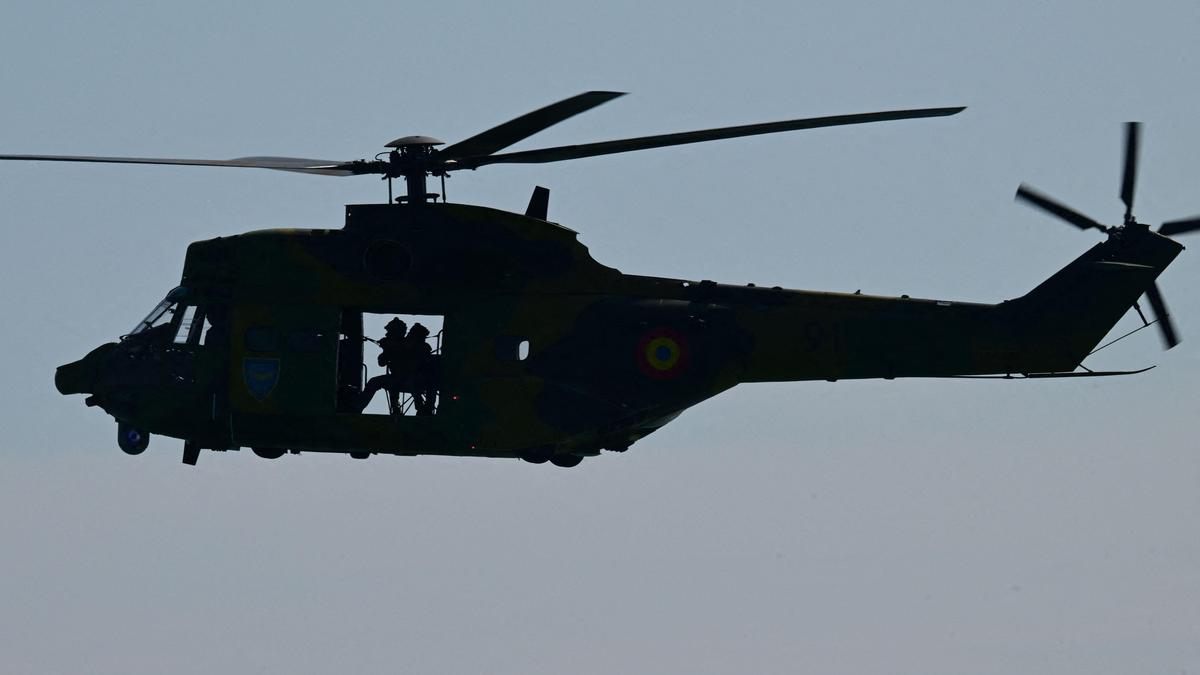
For the pilots of the Romanian Air Force detachment currently deployed to Estonia, this base is a temporary home, a concrete island surrounded by dark pine forests and an even darker sea. They are here on a mission known in military bureaucracy as NATO Air Policing. It sounds routine. It sounds like a traffic cop directing cars at a quiet intersection.
It is not.
When the alarm sounds, the transition from boredom to adrenaline is instantaneous. A klaxon rips through the quiet of the hangar. It is a harsh, electronic wail that vibrates in your chest. Mugs are abandoned. Zippers are yanked up. Harnesses are snapped into place. Within minutes, two F-16 Fighting Falcons are screaming down the runway, their afterburners cutting twin orange gashes into the Estonian night.
Up there, above the cloud layer, the world is a monochrome void of black and grey. You are suspended in a cockpit, strapped to a jet engine, staring at a green radar screen.
Then, a blip appears.
The Cold Geometry of Interception
To understand what happened in the airspace over Estonia, you have to look past the sensational headlines. A standard news report tells you that a Romanian jet destroyed a suspected Ukrainian drone. It gives you the date, the location, the official military statements. It treats the event like a mathematical equation.
But equations do not capture the sheer, heart-stopping tension of a night intercept.
Imagine flying at 400 knots through total darkness. Your eyes track the instruments, but your mind is projecting outward, trying to visualize the shape in the dark ahead of you. The radar lock tells you the target is small. It has a radar cross-section completely different from a commercial airliner or a standard military fighter. It is moving too slowly to be a jet, yet it is flying at an altitude that rules out civilian hobby craft.
This is the reality of modern electronic warfare. It is a game of whispers.
The target in question was an unmanned aerial vehicle, a drone. Initial tracking suggested its trajectory originated from the south-east, a path consistent with the chaotic, long-range drone strikes that have come to define the conflict further south in Ukraine. In the confusion of a continental war, machines sometimes lose their way. Guidance systems fail. GPS signals are jammed, spoofed, or warped by electronic countermeasures until a flying robot becomes a blind wanderer, thousands of miles from its intended target.
As the F-16 closed the distance, the pilot had to make a visual identification. This is the moment where technology meets human judgment. You pull up alongside an unknown aircraft in the dark, using night-vision goggles that turn the world into a grainy, lime-green ghost story. You are looking for wings, for tail fins, for markings.
Is it a reconnaissance platform? A loitering munition packed with high explosives? Or a harmless piece of stray research equipment?
In the airspace above a NATO member state, the margin for error is exactly zero. A rogue drone entering civilian flight paths is a flying kinetic hazard. If it loses power over a city like Tallinn, it becomes a falling anvil. If it carries a payload, it is a potential act of war. The decision to fire is never made lightly. It requires a chain of command stretching from the cockpit to the regional command center in Germany, flashing through fiber-optic cables and satellite links in milliseconds.
The authorization came through. A single command.
The pilot flipped the safety cover on the stick. A short-range, infrared-guided missile ignited with a blinding flash, illuminating the cockpit for a fraction of a second before streaking into the dark. A moment later, a distant spark bloomed against the stars, followed by a shower of falling debris.
Target destroyed. The sky was empty again.
The Invisible Stakes of a Stray Machine
The morning after an intercept, the world feels strange. You walk out of the hangar, and the sun is coming up over the Estonian countryside. Farmers are waking up. People are driving to work in Tallinn, checking their phones, drinking their own, presumably better, coffee. They have no idea that a piece of high-tech military hardware was obliterated just a few dozen miles away while they slept.
This event highlights a profound shift in how we live today. We have entered an era where war is no longer contained by borders, not because armies are marching, but because the technology of conflict is inherently leaky.
Consider the mechanics of a modern long-range drone. These are not the quadcopters you buy at an electronics store. These are essentially small, autonomous airplanes. They are built cheap, manufactured by the thousands, and launched into contested skies where the electromagnetic spectrum is a raging storm of interference.
When a drone encounters heavy jamming, it can lose its connection to Russia's GLONASS or the American GPS network. When that happens, the machine relies on inertial navigation—calculating its position based on its last known speed and direction. But small errors compound over hundreds of miles. A drift of a few degrees at the launch point becomes a deviation of hundreds of miles by the end of the flight.
That is how a machine meant for a frontline bunker ends up drifting silently over the Baltic states.
The danger here is not just the physical impact of the drone. The real threat is the fragile architecture of international diplomacy. Every time an incident like this occurs, the risk of miscalculation skyrockets. What if the drone had been misidentified? What if its debris had damaged civilian infrastructure? What if the intercepting jet had crossed into restricted airspace while maneuvering for the shot?
The public often views air defense as a shield—a hard, impenetrable ceiling that keeps the bad things out. But the people who fly these missions know the truth. Air defense is a tightrope walk. It is an exercise in restraint just as much as it is an exercise in force. You have to be aggressive enough to deter an intrusion, but precise enough to prevent a localized mistake from escalating into something catastrophic.
The Human Factor in an Automated War
There is a growing temptation to believe that modern security is a problem solved by algorithms. We talk about automated radar arrays, satellite tracking, and autonomous intercept systems. We comfort ourselves with the idea that the machines are watching over us.
But the incident over Estonia proves that the human element remains irreplaceable. A machine can detect a radar return. A machine can calculate an interception vector. But a machine cannot understand the context of a delicate geopolitical situation. It cannot feel the weight of pulling a trigger when the consequences could ripple across an entire continent.
The Romanian pilots deployed to the Baltic are a long way from home. They speak a different language, they eat different food, and they operate in a climate that is radically harsher than the shores of the Black Sea. Yet, they are the ones sitting in the cockpits, making split-second decisions that protect people who will never know their names.
It is a strange, lonely kind of service. You spend weeks waiting for an alarm. Most of the time, it is a false positive—a weather balloon, a civilian pilot who forgot to turn on their transponder, or a scheduled transport flight that drifted slightly off course. You intercept them, you wave from the cockpit, you guide them back to where they belong.
But then comes the night when the target doesn't wave back. The night when the target has no cockpit, no pilot, and no intention of turning around.
When the Romanian F-16s taxied back to their shelters at Ämari after the shootdown, the ground crews were already moving. The jets were inspected, rearmed, and refueled. The pilots walked back to the ready room, the adrenaline slowly leaving their systems, leaving behind a profound, bone-deep exhaustion.
They sat down. Someone poured another cup of that terrible, bitter coffee. Outside, the Estonian sky was turning a pale, watery blue as the sun finally rose, revealing nothing but an empty expanse of air, quiet and still, hiding the ghosts of the night before.