The delivery truck smells like stale coffee and ozone. If you sit in the driver's seat of a modern electric vehicle long enough, you start to notice the hum. It isn't an engine. It is the sound of thousands of tiny lithium-ion cells waking up, whispering to each other through copper veins, calculating precisely how much energy to throw into the asphalt.
For three years, I managed a fleet of these machines for a mid-sized logistics firm. I know the exact weight of a battery pack. I know how they behave when the January frost hits the concrete. When you look at an electric car, you see a sleek commuter machine, a quiet revolution on wheels, or maybe just a way to skip the gas pump.
The Pentagon sees a map.
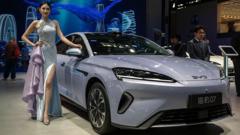
A few days ago, Washington quietly dropped a massive boulder into the quiet pond of global logistics. The Department of Defense added BYD—the Chinese automotive juggernaut that recently dethroned Tesla as the world’s top electric vehicle seller—to its official list of companies allegedly controlled by or tied to the Chinese military.
It sounds like a bureaucratic footnote. A line item on a spreadsheet typed up in a windowless room in Virginia. But on the ground, where the rubber meets the road, it feels like the opening salvo of a completely different kind of war. One where the weapons aren't missiles, but microchips and supply lines.
The Ghost in the Machine
To understand why a sedan parked in a suburban driveway could freak out a four-star general, you have to stop thinking of cars as transportation.
Modern electric vehicles are rolling data centers. They are packed with cameras that map street corners, radar systems that calculate distances, and software that pings location data back to central servers every second. They know where you work. They know how fast you take the turn on Elm Street. They know the exact topography of the naval base you drive past on your morning commute.
Imagine a hypothetical delivery driver named Marcus.
Marcus doesn't care about geopolitics. He cares about his lower back pain and finishing his route by five. Every morning, he hops into a cutting-edge electric van, syncs his phone, and lets the onboard navigation guide him through the secure gates of a commercial shipping port. The van’s sensors are constantly scanning, optimizing, and learning. The vehicle functions beautifully.
But who owns the eyes of that van?
That is the question haunting Washington. The Pentagon's list—technically known as the Section 1260H roster—is designed to highlight foreign entities that the US government believes are secretly pulling double duty. On paper, these companies make commercial goods for global consumers. Under the hood, the government argues, they are legally obligated to share their data, technology, and research with Beijing’s military apparatus under China’s national security laws.
BYD has repeatedly and fiercely denied these allegations. They maintain they are an independent, publicly traded entity focused strictly on green transit. They aren't building tanks. They are building hatchbacks.
Yet, the line between civilian tech and military power has completely evaporated.
The Great Decoupling
We used to believe that global trade would save us from conflict. The theory was simple: if our economies are stitched together like a patchwork quilt, nobody will want to tear the fabric. We bought their batteries; they bought our agricultural goods. Everyone won.
Then the world shifted.
Managing a fleet taught me that dependency is a fragile thing. When a single chip shortage hit a few years back, our entire operation ground to a halt. We had vehicles sitting idle for months, waiting for a piece of silicon smaller than a fingernail. Now, scale that vulnerability up to a national level.
China controls roughly 70 percent of the world’s lithium-ion battery production capacity. They didn't stumble into this position; they spent two decades building the mines, refining the chemicals, and subsidizing the factories while Western automakers were still trying to figure out if consumers actually wanted hybrids.
BYD sits at the absolute apex of that empire. They don't just assemble cars. They build the batteries that power them from the raw minerals up.
By blacklisting the company, the US government isn't just targeting a brand. It is trying to build a firewall around the American grid. The immediate consequence of being placed on the 1260H list isn't an outright ban on consumer sales—you can still technically buy the vehicles where available—but it acts as a massive scarlet letter. It warns American defense contractors, federal agencies, and municipal governments to keep their distance. No federal dollars. No official contracts.
Consider what happens next.
If you are a major shipping firm or a city transit authority looking to electrify your bus fleet, a Pentagon black flag is a radioactive sign. You cannot risk investing millions into an infrastructure that Congress might completely outlaw next year. The market cools instantly. The invisible wall goes up.
The Concrete Dilemma
This is where the grand strategy hits the harsh reality of climate goals.
We are constantly told that the transition to green energy is an existential race against the clock. The planet is warming. The emissions need to drop. To do that, we need cheap, reliable, mass-produced electric vehicles right now.
And nobody makes them cheaper or faster than BYD.
During my time running logistics, we looked at the balance sheets constantly. The American and European electric options were beautiful, but they were staggeringly expensive. Their supply chains were tangled, fractured, and slow. On the other side of the Pacific, the Chinese alternatives offered incredible range at a fraction of the cost.
So, we are trapped in a profound paradox.
If we prioritize national security, we lock out the very technology that could accelerate the transition away from fossil fuels. If we prioritize the environment, we potentially allow an economic rival to wire up our infrastructure with sensors that report back to a foreign capital.
It is a choice between two different types of vulnerability. Fear of the climate, or fear of the state.
I remember watching a mechanic work on one of our high-capacity battery units. He had the casing off, exposing the cooling lines and the dense rows of cells. It looked less like a car part and more like a heart lung machine—vital, complex, and terrifyingly delicate. He looked up at me, wiping grease from his forehead, and said something that stuck with me ever since.
"If this thing stops talking to the motherboard, the whole truck is just an expensive paperweight."
The New Cold Horizon
The boardroom battle over BYD isn't an isolated incident. It is a symptom of a world that is rapidly fracturing into tech-blocs. The era of the borderless internet and the frictionless global market is dying in real-time.
We are entering a period where every piece of technology must declare its citizenship. Your phone, your solar panels, your automated tractor, and your family car are no longer just tools. They are territory.
Washington's latest move ensures that the highways of the future will not be a shared space. The supply chains are being ripped apart, severed by a sharp knife of political necessity. Western automakers are rushing to build domestic battery plants, scrambling for minerals in Canada and Australia, trying to recreate in years what took China decades to perfect.
It is an incredibly expensive game of catch-up. The cost of that scramble won't be paid by the politicians or the CEOs. It will be paid at the dealership by everyday consumers. It will be paid by small business owners watching their overhead climb.
Late last night, I drove past a local distribution center. Through the chain-link fence, I could see rows of electric delivery vehicles plugged into their charging stubs, their small green status lights blinking uniformly in the dark. They looked peaceful. They looked like progress.
But if you look closely enough at those blinking lights, you can see the reflection of a quiet, massive conflict. The hum inside the dashboard isn't just electricity anymore. It is the sound of a closing door.